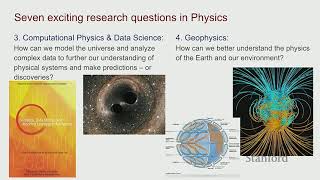
Physics and Engineering I - Stanford ENGR1
Explore physics and engineering with Stanford's Prof. Burchat, gaining insights to guide your academic path and discover potential career directions in these fields.

Nuclear Fusion Lecture
Explore nuclear fusion's potential, recent breakthroughs, and future prospects in energy production with insights from a leading expert in the field.

Ocean Energy: Potential, Types, and Future Prospects - Lecture
Explore ocean energy's potential, history, and types including kinetic, thermal, and chemical, with insights on environmental impacts and future prospects.
Nuclear Fission - Principles, Applications, and Environmental Impact
Comprehensive lecture on nuclear fission covering its significance, history, commercial applications, and environmental impact. Explores key aspects of nuclear energy for informed decision-making.

General Relativity Lecture Collection
Explore Einstein's theory of gravity, curved space-time, black holes, and Big Bang cosmology in this comprehensive lecture series on General Relativity by Stanford University.
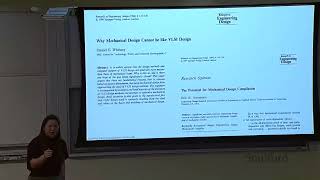
When Design Equals Planning - Computational Approaches to Robot Design
Exploring the intersection of robot design and planning, this seminar discusses computational approaches to simplify design processes and make formal statements about design feasibility across various robotic systems.
Data Compression I - Lecture 5: Asymptotic Equipartition Property
Explore the Asymptotic Equipartition Property in data compression, a fundamental concept for understanding information theory and efficient coding techniques.

Fundamentals of Photovoltaics, Fall 2011
Comprehensive exploration of photovoltaic fundamentals, covering solar resources, cell design, materials, manufacturing, efficiency, economics, and advanced concepts in renewable energy technology.

Introduction to Instruments and Musical Genres - Lecture 2
Explore classical music terminology, instruments, and acoustics. Learn about motives, themes, and genres while experiencing live demonstrations of French horn, bassoon, and viola.
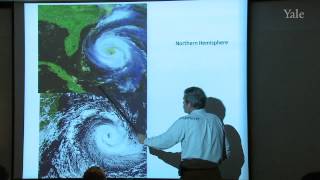
Coriolis Force and Storms - Atmospheric Dynamics and Weather Patterns
Explore atmospheric dynamics, pressure systems, and storm formation. Learn about geostrophic balance, Coriolis effects on hurricanes, and various types of storms including convective and severe thunderstorms.

Water in the Atmosphere - Lapse Rates and Atmospheric Stability - Lecture 9
Explore atmospheric stability, lapse rates, inversions, and moisture. Learn how these factors influence weather patterns, pollution trapping, and air saturation processes.
The Atmosphere, the Ocean and Environmental Change - Review and Overview
Comprehensive review of atmospheric and oceanic processes, covering properties, balances, equilibrium states, transport mechanisms, and hemispheric differences in Earth's environmental systems.

Introduction to Freshman Organic Chemistry - How Do You Know?
Explore the foundations of scientific inquiry through experimentation and logic, using historical examples to illustrate key principles in organic chemistry and scientific thinking.
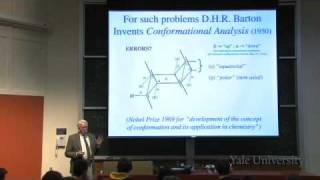
Conformational Energy and Molecular Mechanics - Lecture 33
Explore conformational energy and molecular mechanics in organic chemistry, focusing on cyclohexane structures, conformational relationships, and energy estimation techniques.

Maxwell's Equations and Electromagnetic Waves - Lecture 15
Explore electromagnetic waves, their energy, and connection to relativity. Understand Maxwell's equations' consistency with special relativity and how magnetism can be deduced from relativistic principles.

Quantum Mechanics - Key Experiments and Wave-Particle Duality
Explore quantum mechanics fundamentals: double-slit experiment, wave-particle duality, photoelectric effect, and uncertainty principle. Gain insights into the revolutionary concepts that reshaped our understanding of physics.

Introduction to Electrostatics and Coulomb's Law - Lecture 1
Explore fundamental concepts of electrostatics, including charge, Coulomb's Law, and the principle of superposition. Learn how to calculate electrostatic forces and understand charge distributions.

Past and Future of Nuclear Power - Lecture 22
Explores nuclear energy's global impact, risks, and challenges, including waste storage, proliferation, and disasters like Chernobyl, while comparing it to coal-fired plants' risks.

Rotations and the Parallel Axis Theorem - Lecture 10
Explore advanced rotational physics concepts, including the Parallel Axis Theorem, moment of inertia, and angular momentum, with practical examples and real-world applications.
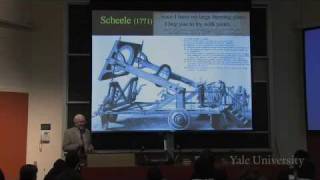
Oxygen and the Chemical Revolution - From Alchemy to Lavoisier (1789)
Explore the origins of modern chemistry, from alchemy to Lavoisier's revolutionary ideas on oxidation, elements, and scientific language in this historical journey through early chemical discoveries.
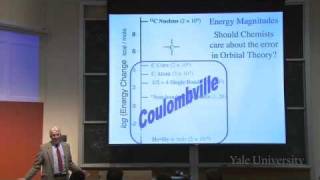
Orbital Correction and Plum-Pudding Molecules in Organic Chemistry - Lecture 11
Explore advanced orbital theory, electron repulsion corrections, and molecular structure using the Plum-Pudding model. Gain insights into atomic orbitals and their relation to molecules like methane and ammonia.