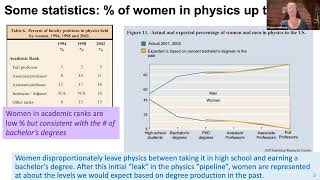
A Brief History of Women in the American Physical Society
Explore the historical gender dynamics in physics through an examination of APS's role in addressing demographic challenges and the persistent gender gap among physicists.
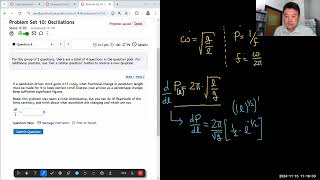
Physics Problem Solving: Calculus-Based University Physics - Chapter 15, Problem 63
Master calculus-based problem-solving techniques for university-level physics through a detailed walkthrough of OpenStax Physics Chapter 15's Problem 63.

Graph Structure of the Nodal Set on Riemannian Manifolds
Explore the geometric analysis of eigenfunction zero sets on Riemannian manifolds, examining connections between graph theory, nodal sets, and critical point estimation in spectral geometry.
Marked Length Spectral Invariants of Birkhoff Billiard Tables and Compactness of Isospectral Sets
Delve into advanced spectral geometry concepts, exploring marked length spectra of planar billiard tables, Mather's beta function, and isospectral compactness in dynamic systems.

Spectral Invariants of Integrable Polygons
Delve into advanced mathematical concepts exploring integrable polygons, their spectral invariants, and connections to plane tessellation and crystallographic Coxeter groups in higher dimensions.
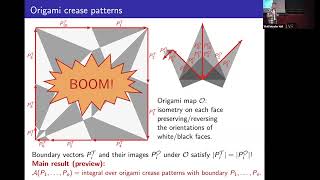
Amplituhedra and Origami
Dive into the fascinating intersection of physics and mathematics, exploring amplituhedra concepts and their connection to origami principles through advanced combinatorial approaches.
Probing Moduli Space Cohomology Using Quantum Field Theory
Delve into advanced quantum field theory applications for analyzing moduli space cohomology, exploring mathematical connections between combinatorics and fundamental physics principles.
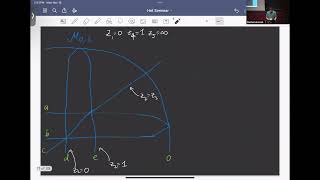
Matroids and Amplitudes: From Linear Independence to Scattering Theory
Delve into the mathematical theory of matroids, exploring their relationship with scattering amplitudes, intersection theory, and positive geometry through advanced theoretical physics concepts.
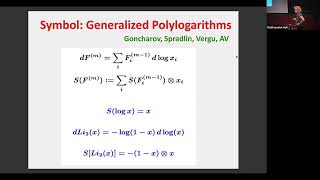
Combinatorics of Symbol Alphabets in N=4 Super Yang-Mills Theory
Delve into advanced combinatorial analysis of symbol alphabets in N=4 Yang-Mills theory, exploring fundamental physics concepts and their mathematical representations in quantum field theory.
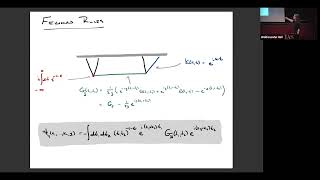
Kinematic Flow and Differential Equations for Cosmological Correlators
Explore advanced mathematical concepts in cosmological correlators, focusing on kinematic flow and differential equations through fundamental physics principles and theoretical frameworks.
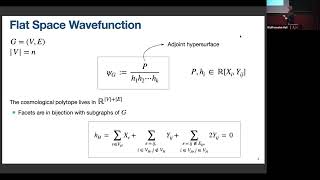
Euler Discriminant of Complements of Hyperplanes
Delve into advanced mathematical concepts exploring the Euler discriminant in hyperplane complements, focusing on combinatorial applications in fundamental physics.
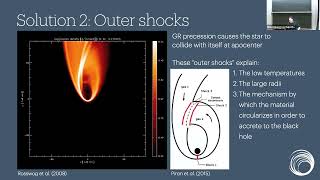
Stars Disrupted, Destroyed and Coalesed: Investigating Supernovae and Stellar Events
Explore groundbreaking research on stellar phenomena including supernovae, tidal disruption events, and neutron star mergers, examining their impact on understanding cosmic evolution and fundamental physics.
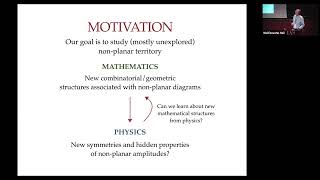
Non-Planar On-Shell Diagrams
Delve into advanced physics concepts exploring non-planar on-shell diagrams and their applications in fundamental physics, presented by UC Davis expert Jaroslav Trnka.
Sharp Strichartz Estimates via Hermite Polynomials and Hypercontractivity
Delve into advanced mathematical concepts exploring Schrödinger propagator inequalities through pseudo-conformal transformation and hypercontractivity in Gauss space, featuring Hermite polynomials applications.
A Reverse Minkowski Theorem in Lattice Theory and Geometry
Explore the groundbreaking reverse Minkowski theorem and its applications in complexity theory, cryptography, and algorithms, building on fundamental concepts in geometry of numbers.
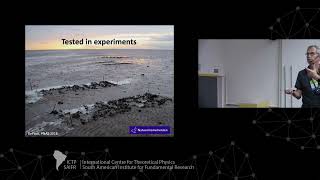
The Physics of Spatial Ecology - Class 4
Explore the fundamental principles of spatial ecology through physics-based approaches, examining pattern formation and biological systems across different scales in natural environments.
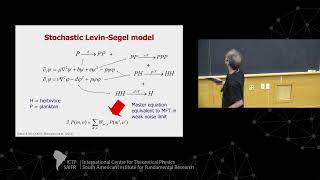
Stochastic Pattern Formation in Space and Time: From the Brain to the Biosphere - Class 5
Explore stochastic pattern formation principles across biological systems, from neural networks to ecosystem dynamics, with insights into spatial-temporal mathematical modeling.
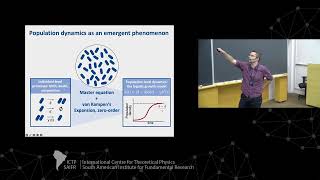
Integrating Different Levels of Pattern Formation: From Sub-cellular to Multi-cellular Structures - Class 1
Explore pattern formation across biological scales, from subcellular structures to multicellular systems, examining fundamental principles and mechanisms of biological organization.
Theory of Nuclear Matrix Elements - Lecture 2
Delve into advanced nuclear physics concepts and matrix element calculations, exploring theoretical frameworks and computational methods for understanding nuclear structure and interactions.

A New Approach to Optimizing Completion and Stimulation Fluids in Oil Production
Discover how completion fluid components impact oil production, from frac fluid essentials to holistic performance evaluation and testing methodologies for optimal stimulation results.
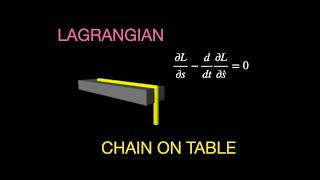
Lagrangian Mechanics - Chain Sliding Off a Table
Explore the dynamics of a chain sliding off a frictionless table through Lagrangian mechanics, including derivation of equations and Python implementation.