Data Shift and Model Adaptation in Machine Learning
Explore data shift principles, detection strategies, and adaptation techniques in machine learning for dynamic environments. Practice hands-on with advanced topics to enhance model performance.
Orchestrating Quasi-Real Time Data Processing in the Computing Farm of the ATLAS Experiment at CERN
Discover how CERN's ATLAS experiment leverages Kubernetes to orchestrate massive data processing, managing 25,000 pods across 2,500 nodes for real-time physics event filtering at 5 TB/s.
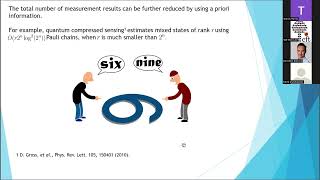
Quantum State Tomography Beyond Ten Qubits
Explore advanced quantum state tomography techniques for systems beyond 10 qubits, focusing on efficient reconstruction methods using minimal quantum circuits and Pauli gates.
Equilibrium is Inference - Lessons from Liquid-Liquid Phase Separation Models
Delve into the relationship between equilibrium systems and information processing, exploring neural computation models and their applications in molecular systems and phase separation dynamics.
Latest Developments in the Wolfram Quantum Framework - Quantum Computing and Simulation Tools
Explore the cutting-edge Wolfram Quantum Framework's capabilities, from symbolic quantum representations to simulation tools, enhancing your understanding of quantum computation and research applications.
An Approach Towards the Aaronson-Ambainis Conjecture via Fourier Completely Bounded Polynomials - Part 1
Delve into quantum computing theory through an analysis of the Aaronson-Ambainis conjecture, exploring its relationship with Fourier completely bounded polynomials and implications for quantum algorithm simulation.
Testing and Learning Phase States and Their Variants - Part 2
Delve into quantum computing concepts focusing on tolerant testing, learning stabilizer states, and understanding degree-based phase states in quantum mechanics.
Testing and Learning Phase States and Their Variants - Part 1
Explore advanced concepts in quantum computing, focusing on tolerant testing methods for stabilizer states and the intricacies of phase state analysis and testing.
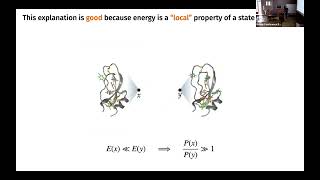
A Markov Chain Theory of Self-Organization in Nonequilibrium Systems
Explore the groundbreaking theory of 'rattling' in nonequilibrium systems and its role in predicting ordered states across scientific domains, from living systems to statistical mechanics.
HoloChemie - Sustainable Fabrication of Soft Biochemical Holographic Devices for Ubiquitous Sensing
Discover innovative approaches to fabricating sustainable biochemical holographic sensors through soft materials and cutting-edge sensing technologies for widespread environmental applications.
Absolute Continuity of the Robin Harmonic Measure on Rough Domains
Delve into advanced mathematical analysis exploring Robin harmonic measure's absolute continuity on rough domains, connecting to lung modeling and boundary value problems in physics.
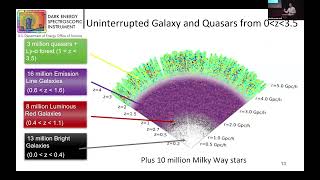
Cosmology from the First Year DESI BAO Measurements
Explore groundbreaking findings from DESI's first-year measurements of baryon acoustic oscillations, examining implications for dark energy, neutrino mass, and the Hubble Constant tension.
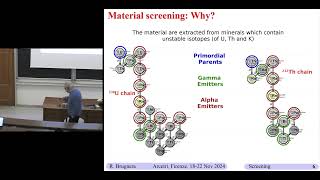
Methods to Measure Radioactivity - Lecture
Discover essential techniques and methodologies for measuring radioactivity, from fundamental principles to practical applications in scientific research and radiation detection.
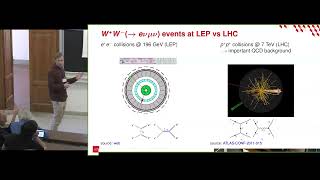
Heavy Neutrino Searches and Lepton Flavor Violation Searches at Colliders - Lecture 1
Explore advanced concepts in heavy neutrino detection and lepton flavor violation searches at particle colliders, focusing on experimental methods and theoretical frameworks.
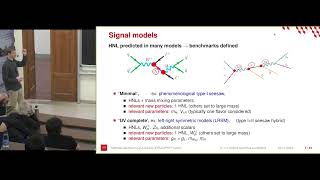
Heavy Neutrino Searches and Lepton Flavor Violation Searches at Colliders - Lecture 2
Delve into advanced concepts of heavy neutrino detection and lepton flavor violation searches at particle colliders, exploring experimental methods and latest research findings.
Topology of Electronic Materials and Their Linear and Nonlinear Responses - Lecture 1
Delve into quantum physics concepts like Berry curvature and electron wavefunction geometry, exploring topological states and their applications in electronic materials through advanced theoretical frameworks and experimental observations.
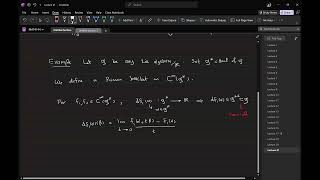
Lie Groups and Quantization - Lecture 21
Delve into advanced mathematical concepts exploring Lie groups and their applications in quantization theory through rigorous theoretical frameworks and practical examples.
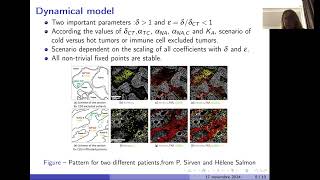
How Cancer-Associated Fibroblasts Promote T-Cell Exclusion in Human Lung Tumors: A Physical Perspective
Explore the physical mechanisms behind cancer-associated fibroblasts and their role in T-cell exclusion within lung tumors through mathematical and biological perspectives.
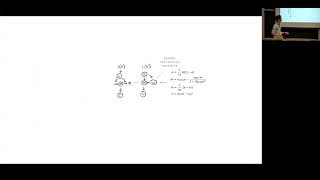
Balancing Interpretability and Predictive Accuracy in Mathematical Models of T Cell Activation
Explore mathematical modeling approaches for T cell activation, examining the trade-offs between model interpretability and accuracy in immunological systems.
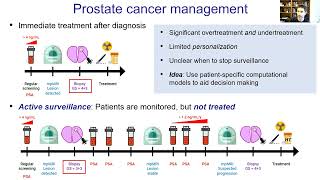
Prostate: Small Organ, Big Problems - Informing Clinical Decisions with Computational Models
Explore how computational models enhance clinical decision-making for prostate-related conditions through advanced mathematical and biological approaches.
Envisioning the Future of Atoms and Light
Explore groundbreaking theoretical physics concepts in atom-light interactions through an advanced discussion of future developments and emerging research directions in quantum optics.