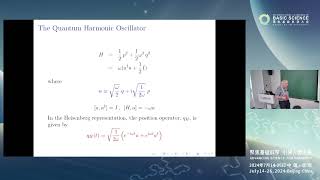
Quantum Field Theory in Curved Spacetime - Introduction and Mathematical Issues
Explore quantum field theory in curved spacetime, examining its principles, applications, and mathematical challenges in the context of general relativity and black hole phenomena.
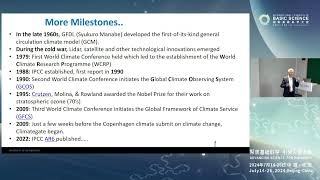
The Important Roles of Modeling in the Development of Climate Science
Explore the evolution of climate science through modeling, from simple energy balance models to sophisticated Earth System Models, and their role in understanding and predicting climate change.
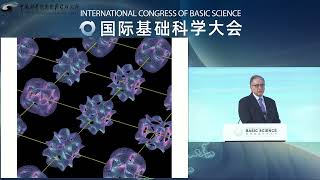
Quantum Gravity and Predictions for Our Universe
Explore quantum gravity's impact on our universe, including predictions about dark energy and testable hypotheses derived from string theory.
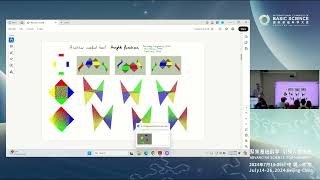
Geometry of Dimer Models - ICBS 2024
Explore asymptotic phenomena in random dimer coverings, focusing on Aztec diamonds and their connection to Riemann surface geometry.
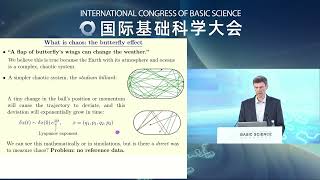
Chaos and Black Holes: From Butterfly Effect to Event Horizons - ICBS 2024
Explore chaos theory, quantum systems, and black holes, examining their interconnections and the fascinating implications for understanding event horizons.

Lensless Imaging: Overview, Opportunities, and Challenges
Explore lensless imaging advancements, principles, and applications in 3D reconstruction, discussing challenges and future opportunities in camera design and computational algorithms.
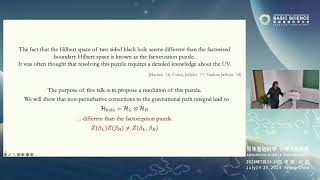
How the Hilbert Space of Two-Sided Black Holes Factorizes - ICBS 2024
Explore the factorisation puzzle in AdS/CFT, examining how spacetime wormholes contribute to Hilbert space factorisation in two-sided black holes and its implications for holography.
Top Down Approach to Generalized Symmetries in Quantum Field Theory and Quantum Gravity
Explore generalized symmetries in quantum field theory and quantum gravity using string theory's extra dimensions, uncovering new physical objects and tracking symmetry fates.
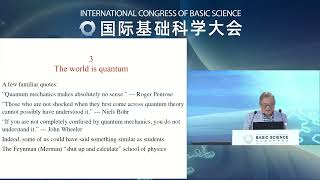
Ten Foundational Ideas of Theoretical Physics
Explore ten foundational ideas of theoretical physics in a sweeping overview, providing insights for those interested but unfamiliar with the subject.
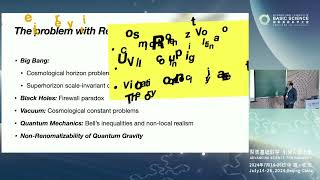
Quantum Spacetime in the Sky: From Horizon to Horizon
Explore quantum spacetime fluctuations in gravitational wave observatories, including Hawking emission, detector noise, and cosmic glitches near cosmological horizons.
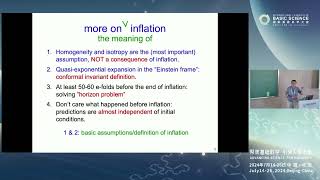
Inflation as a Tool to Explore the Physics of the Early Universe
Explore inflation's role in understanding the early Universe, including primordial black hole formation and its implications for cosmology.
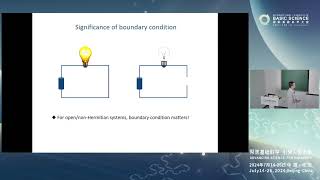
Non-Bloch Band Theory and Amoeba
Explore non-Bloch band theory and amoeba concepts in condensed matter physics with expert Zhong Wang. Gain insights into cutting-edge research in this specialized field.
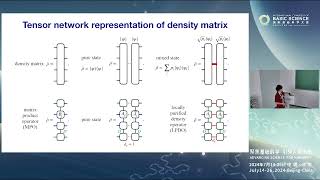
Locally Purified Density Operators for Noisy Quantum Circuits
Explore efficient representation of mixed states in noisy quantum circuits using locally purified density operators, addressing challenges and insights in open quantum systems simulation.
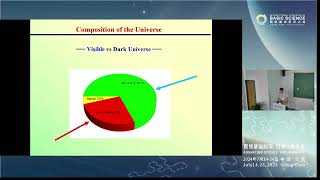
Massive Gauge/Gravity Scattering Amplitudes, Geometric and Topological Mass Generations and Double Copy
Explore massive gauge/gravity scattering amplitudes, geometric and topological mass generations, and double copy constructions in Kaluza-Klein and Chern-Simons theories.
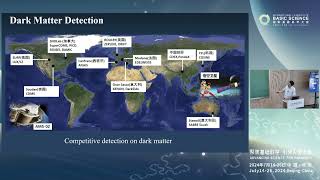
Comparative Lattice Analysis of SU(2) Dark Glueball
Explore SU(2) glueballs as dark matter using lattice simulations. Compare traditional and machine learning methods for mass calculation and scattering cross-section analysis.
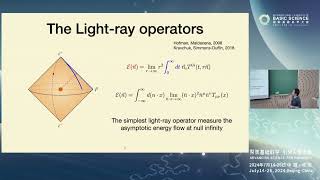
Energy Operator in Particle Physics and Quantum Field Theory
Explore recent advancements in energy operator theory and its applications in particle physics, quantum field theory, and collider experiments, emphasizing the resurgence of energy-energy correlator measurements.
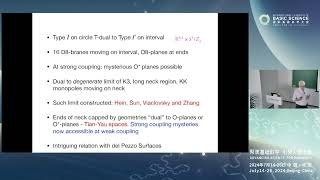
Degeneration, Geometry and Duality in String Theory
Explore generalised T-dualities in string theory, focusing on type I' and IIA duality, SYZ interpretation of mirror symmetry, and geometric duals of strong-coupling phenomena.
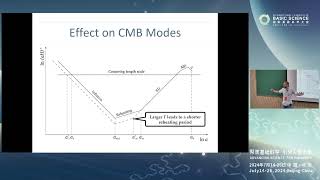
The Early Universe as a Probe of Fundamental Physics
Explore nonequilibrium quantum processes in the early universe and their implications for particle physics and cosmology, bridging fundamental physics with cosmic observations.
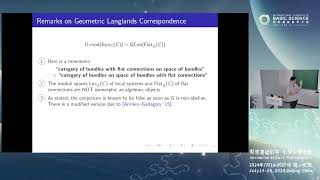
String Theory and Geometric Representation Theory
Explore connections between string theory and geometric representation theory, uncovering surprising relationships and new developments in supersymmetric gauge theory.

Computational Quantum Mechanics in Phase Space - An Attempt to Break the Curse of Dimensionality
Explore computational quantum mechanics in phase space, focusing on breaking the curse of dimensionality through grid-based and particle-based methods for high-dimensional Wigner quantum dynamics simulations.
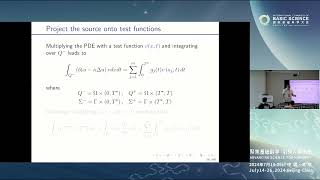
Multipollutant Traceability via Dynamic CGO Solutions
Explore a novel inversion framework using dynamic CGO solutions for precise identification of multiple pollution sources in environmental systems, addressing complex pollutant interactions.