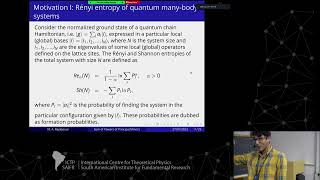
Minors: How I Learned to Stop Worrying and Love the Exponential
Explore exponential complexity in quantum systems through minors, gaining insights into non-equilibrium phenomena and many-body physics.
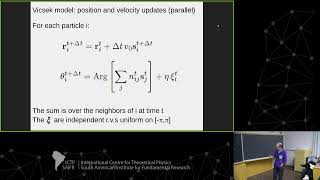
Phase Transitions in Active Matter
Explore phase transitions in active matter systems, examining their unique behaviors and emergent properties in non-equilibrium conditions.
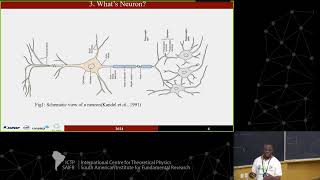
Collective Behaviors in Neuronal Networks Under the Actions of Electric and Magnetic Fields
Explore collective behaviors in neuronal networks influenced by electric and magnetic fields, examining dynamics and implications for complex network processes.
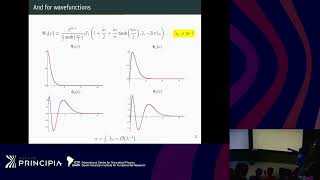
Exploring 2D QCD with Integrability
Explore 2D QCD through integrability techniques, uncovering insights into gauge theory dynamics and string theory connections in this advanced physics lecture.
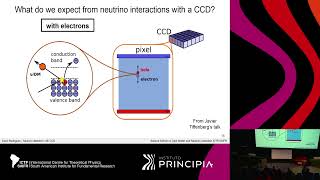
Neutrino Detection with CCDs
Explore neutrino detection techniques using CCDs, focusing on cutting-edge methods and applications in dark matter research.
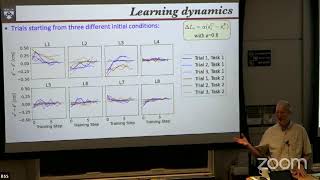
Autonomous Learning Metamaterials III - July 26, 2024
Explore advanced concepts in autonomous learning metamaterials, focusing on cutting-edge developments and future applications in materials science.
Exploring Noisy Quantum Computers: Current Capabilities and Discoveries
Explore the potential of current noisy quantum computers in addressing complex physics problems, focusing on condensed matter and many-body physics challenges unsolvable by classical computers.
Machine Learning for Quantum Applications - Part 1
Explore machine learning applications in quantum physics, focusing on cutting-edge techniques and their impact on quantum systems research.
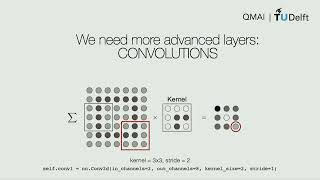
Machine Learning for Quantum Applications - Lecture 2
Explore advanced machine learning techniques for quantum systems, focusing on applications in condensed matter and statistical physics.
Simplifying the Simulation of Local Hamiltonian Dynamics
Explore advanced techniques for simplifying simulations of local Hamiltonian dynamics in quantum systems, enhancing understanding of complex quantum behaviors.
Amorphous Quantum Magnets in a Two-Dimensional Rydberg Atom Array
Explore amorphous quantum magnets using 2D Rydberg atom arrays, delving into cutting-edge research in condensed matter and statistical physics.
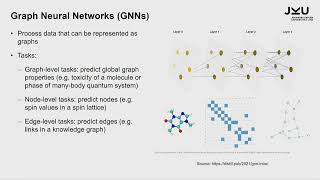
Deep Learning for Quantum Physics and Astronomy
Explore deep learning applications in quantum physics and astronomy, uncovering innovative techniques for data analysis and scientific discovery.
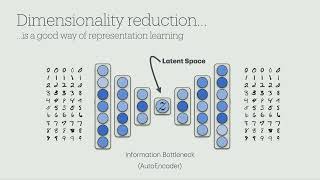
Representation Learning for Quantum Systems
Explore advanced techniques for representation learning in quantum systems, focusing on cutting-edge approaches and their applications in condensed matter physics.

Classical Machine Learning for Quantum Simulations: Detection of Phases, Order Parameters, and Hamiltonians
Explore classical machine learning techniques for quantum simulations, focusing on phase detection, order parameters, and Hamiltonian analysis.

Optimal Control and Implementation of Quantum Algorithms
Explore optimal control techniques for implementing quantum algorithms, enhancing efficiency and performance in quantum computing systems.
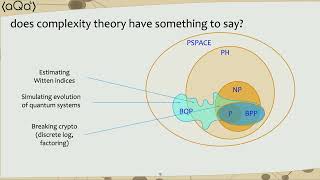
Provable Quantum Learning Advantages for Physics Data
Explore quantum learning advantages for physics data, uncovering provable benefits and applications in scientific research and analysis.
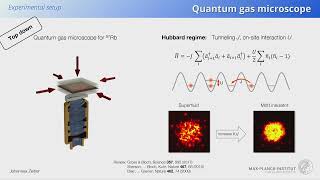
Quantum Gas Microscopy of Hubbard Systems Out of Equilibrium
Explore quantum gas microscopy techniques for studying Hubbard systems in non-equilibrium states, focusing on cutting-edge research in condensed matter physics.
Tensor Networks for Classical and Quantum Machine Learning Tasks
Explore tensor networks for machine learning in quantum systems. Learn to implement sequence prediction using matrix product operators for classical and quantum problems.
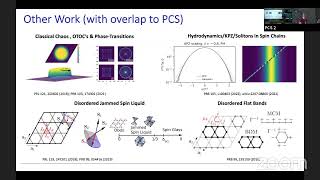
Exploring Long Range Dipolar Interactions: From Collective Dipolar Spin Dynamics to Light-Mediated Interactions
Explore long-range dipolar interactions in quantum systems for sensing, simulation, and discovery. Examine collective spin dynamics, layer exchange, light-mediated interactions, and Pauli-blocking.
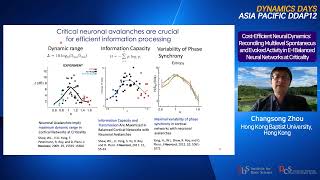
Cost-Efficient Neural Dynamics: Reconciling Multilevel Spontaneous and Evoked Activity in E-I Balanced Neural Networks at Criticality
Explore cost-efficient neural dynamics in E-I balanced networks, examining irregular spiking, oscillations, and critical avalanches. Uncover how these properties achieve minimal energy cost and maximal information capacity.
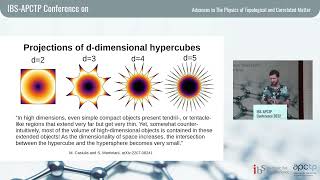
Persistent Homology Analysis of Phase Transitions in Quantum Systems
Explore persistent homology for analyzing phase transitions in complex physical systems. Learn how this topological machine learning method extracts meaningful information from sparse data in condensed matter physics.