Encoding Shape, Structure, Mechanics, and Dynamics of a Soft Network with an Active Fluid
Explore the emergence of complex structures in non-equilibrium systems through microtubule-based active fluids and passive actin filaments, revealing self-organizing processes across multiple scales.
Non-structural Aging in Adhesive Colloidal Suspensions
Explore non-structural aging in adhesive colloidal suspensions, focusing on time-dependent rheological properties and the role of adhesive forces in macroscopic aging processes.
Dynamics of Active Particles at High Densities
Explore the dynamics of active particles at high densities in this advanced physics lecture by Thomas Voigtmann from the ESI's thematic programme.
From Thermal to Athermal Systems: Self-Assembly and Absorbing Phase Transitions
Explore self-assembly and absorbing phase transitions in thermal and athermal systems, bridging physics and biology in non-equilibrium processes.
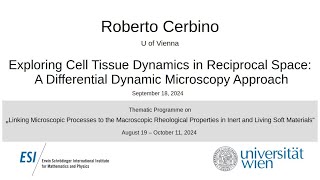
Exploring Cell Tissue Dynamics in Reciprocal Space: A Differential Dynamic Microscopy Approach
Explore cell tissue dynamics using differential dynamic microscopy in reciprocal space, uncovering non-equilibrium processes in physics and biology.
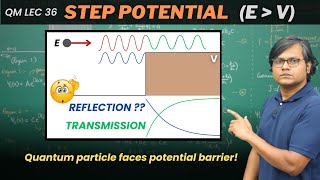
Step Potential: Reflection and Transmission Probability Derivation - Part I (E > V)
Explore quantum particle behavior at potential steps, deriving reflection and transmission probabilities. Gain insights into wave-like properties and partial reflection phenomena.
How Squishy is the Middle Crust? - Exploring Crustal Rheology
Explore the deformation of Earth's middle crust and its implications for geological processes with Dr. Steven Kidder's insightful analysis.
Stellar Magnetic Activity with Kepler and TESS
Explore stellar magnetic activity through Kepler and TESS data, uncovering insights into stellar behavior and its impact on exoplanet detection and characterization.
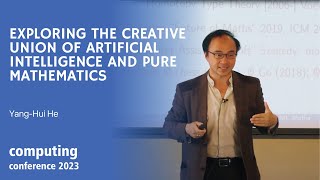
Exploring the Creative Union of Artificial Intelligence and Pure Mathematics
Explore the fusion of AI and pure mathematics, uncovering how machine learning can predict complex mathematical structures and potentially revolutionize theorem proving and scientific discovery.
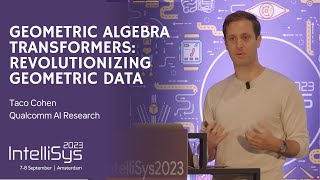
Geometric Algebra Transformers: Revolutionizing Geometric Data
Explore GATr's revolutionary approach to geometric data processing, enhancing computer vision, robotics, chemistry, and physics with efficient 16-dimensional vector space representations and E(3) equivariance.
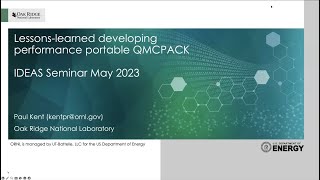
Lessons Learned Developing Performance-Portable QMCPACK
Explore strategies for developing performance-portable scientific applications, focusing on QMCPACK's redesign for GPU and CPU compatibility in materials property prediction.
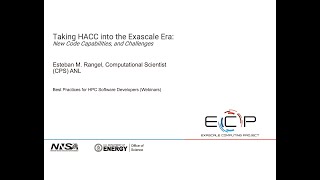
Taking HACC into the Exascale Era - New Code Capabilities and Challenges
Explore HACC's evolution for exascale systems, new capabilities, and performance optimization in cosmology simulations.
Quantum Computing: Developments and Opportunities
Explore quantum computing's current capabilities, applications, and future potential, including hardware advancements and software tools for quantum programmers.
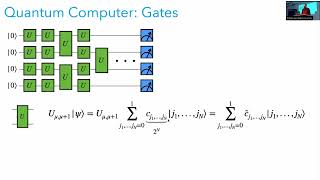
Quantum Computing Today and Tomorrow - Current State and Future Applications
Explore quantum computing's current state, potential applications, and future developments with insights from Prof. Dr. Michael Hartmann's seminar on recent advancements and upcoming challenges.
Bridging Domain Science and HPC with Julia
Explore Julia's potential in HPC, combining scientific ecosystem with high performance. Gain insights on its strengths, limitations, and notable international projects from an experienced user.
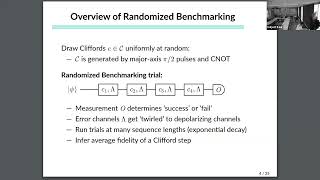
Optimized Experiment Design and Analysis for Fully Randomized Benchmarking
Explore optimized fully randomized benchmarking for quantum gates, offering improved error estimation, flexible analysis, and enhanced experimental protocols in quantum computing.
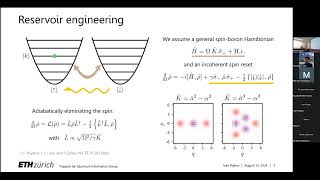
Stabilization of Cat-State Manifolds Using Nonlinear Reservoir Engineering
Explore novel reservoir engineering for stabilizing multi-component Schrödinger's cat states, examining interference, symmetry, and robustness in bosonic codes with trapped ion and superconducting circuit implementations.
What's Going On at the OsloMet Quantum Hub - Quantum Awareness and Research Overview
Explore quantum technology research and its real-world impact, focusing on quantum computing and machine learning advancements at OsloMet Quantum Hub.
Machine Learning Calabi-Yau Metrics - Landscapia
Explore machine learning techniques for Calabi-Yau metrics in string theory, focusing on applications in the Landscapia project and their implications for theoretical physics.
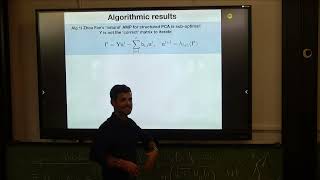
Bayesian Limits in Structured PCA and How to Reach Them - Workshop on Spin Glasses
Explore Bayesian limits in structured PCA and techniques to achieve them, presented by J. Barbier from ICTP Trieste.
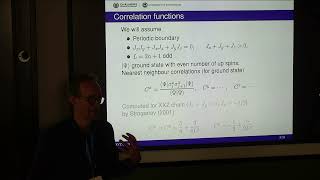
Supersymmetric XYZ Correlations and Painlevé VI
Explore supersymmetric XYZ correlations and their connection to Painlevé VI equations in condensed matter physics and quantum field theory.