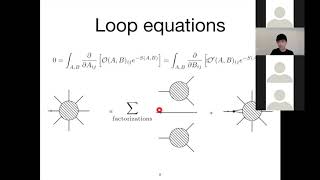
Solving Random Matrix Models with Positivity - Henry Lin
Explore advanced matrix models, focusing on positivity constraints and loop equations. Learn techniques for solving complex mathematical problems in high-energy physics.
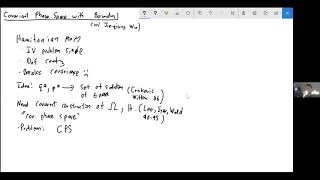
Covariant Phase Space with Boundaries - Daniel Harlow
Explore covariant phase space with boundaries in field theory, covering key concepts like configuration space, prephase space, and Hamiltonian construction.
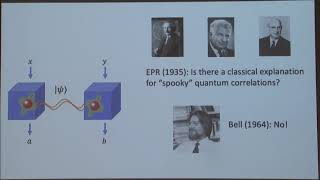
MIP* = RE - Henry Yuen
Explore quantum correlations, nonlocal games, and entanglement models in this seminar on MIP* = RE, delving into complexity theory and efficient tests for quantum phenomena.
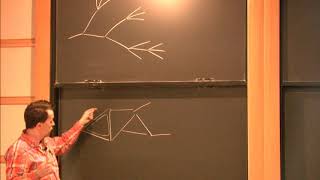
Inverse Problems for Quantum Graphs - Pavel Kurasov
Explore inverse problems for quantum graphs, covering Ambartsumian-type results, trace formulas, and implications for various graph structures. Gain insights into local inverse problems and explicit formulas.
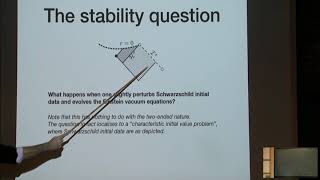
The Nonlinear Stability of the Schwarzschild Metric Without Symmetry - Mihalis Dafermos
Explore the nonlinear stability of the Schwarzschild metric in general relativity, covering key concepts, theorems, and challenges in mathematical physics and black hole dynamics.
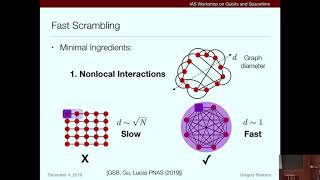
Treelike Geometries and Fast Scrambling from Nonlocal Spin Models - Gregory Bentsen
Explore treelike geometries and fast scrambling in nonlocal spin models, delving into quantum spacetime, artificial spacetime, and optical cavities with numerical simulations and experimental insights.
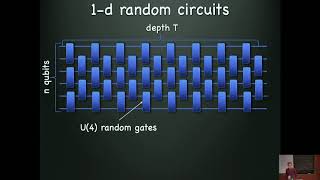
Random Quantum Circuits, Phase Transitions and Complexity - Aram Harrow
Explore quantum complexity, random circuits, and phase transitions in higher dimensions, with applications to tensor networks and simulation algorithms.
Spacetime, Quantum Entanglement and Black Holes
Explore quantum entanglement's role in resolving spacetime puzzles, focusing on black holes and their connections to various physics fields. Four researchers present fascinating insights.
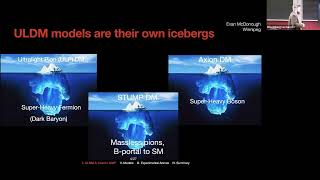
Ultralight Dark Matter and Cosmological Condensed Matter Physics - Evan McDonough
Explore ultralight dark matter theories, their exotic phenomena, and experimental tests across cosmic scales. Delve into composite models and their observables, connecting to early dark energy and the Hubble tension.
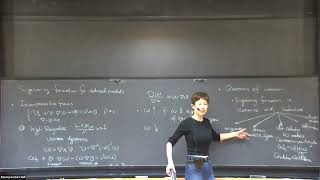
Singularity Formation for Reduced Models of Fluid Equations - Mimi Dai
Explore singularity formation in reduced fluid equation models, focusing on electron magnetohydrodynamics and its connection to Euler equations. Gain insights into nonlinear dynamics and finite-time singularities.
Some Progress on Categorical Local Langlands - Linus Hamann
Exploration of categorical local Langlands correspondence, discussing recent progress, proofs, and implications for number theory and algebraic geometry.
Random Matrix Models, 2D Quantum Gravity, and Holography - Part 1 - Clifford Johnson
Explore random matrix models, focusing on the Gaussian Unitary Ensemble and its applications to gravity, holography, and quantum physics. Discover new insights into discrete spectra and non-perturbative information.
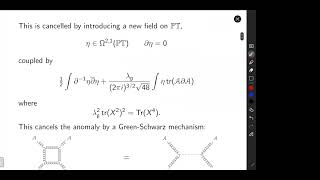
Scattering Amplitudes in Gauge Theory as Chiral Algebra Correlators - Kevin Costello
Explore gauge theory scattering amplitudes as chiral algebra correlators, connecting to celestial holography and deriving expressions for form factors using innovative mathematical approaches.
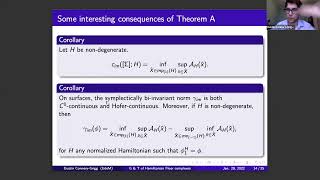
Geometry and Topology of Hamiltonian Floer Complexes in Low-Dimension - Dustin Connery-Grigg
Explore Hamiltonian Floer complexes on surfaces, connecting dynamics to Floer chain structure. Discover a new symplectic norm and geometric interpretations of chain complexes using transverse foliations.
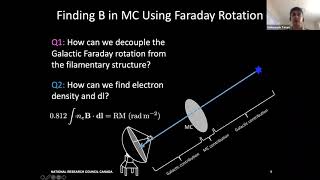
3D Magnetic Field Observations Associated With Filamentary Molecular Clouds - Mehrnoosh Tahani
Exploration of 3D magnetic field observations in filamentary molecular clouds, discussing techniques, results, and implications for understanding cloud morphologies and magnetic field structures.
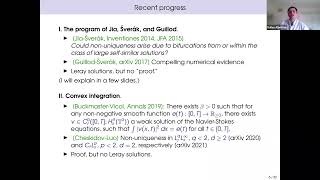
Non-Uniqueness of Leray Solutions of the Forced Navier-Stokes Equations - Dallas Albritton
Explore non-uniqueness in Navier-Stokes equations, focusing on Leray solutions, unstable manifolds, and vortex dynamics in fluid mechanics.
Fluid Equations - Regularity and Kolmogorov’s Turbulence Theory
Explore fluid dynamics, Navier-Stokes equations, and Kolmogorov's turbulence theory. Gain insights into regularity results and mathematical confirmations of phenomenological theories.
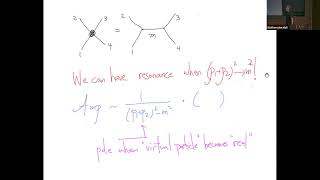
Spacetime and Quantum Mechanics; Particles and Strings; Polytopes, Binary Geometries and Quiver Categories - Nima Arkani-Hamed
Explore connections between particle physics and mathematics, revealing how spacetime and quantum mechanics emerge from fundamental mathematical structures in combinatorics, algebra, and geometry.
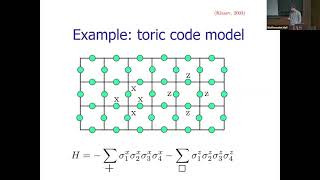
Lattice Edge Theories for Topological Phases of Matter - Michael Levin
Explore lattice edge theories for topological phases, focusing on finite-dimensional edge theories and their unique properties, including ungappable examples with implications for quantum systems.
Quantum Circuits, Cellular Automata and Tensor Networks - Ignacio Cirac
Explore quantum circuits, cellular automata, and tensor networks, focusing on their representations, entanglement properties, and generalizations to quantum channels and measurement-assisted dynamics.
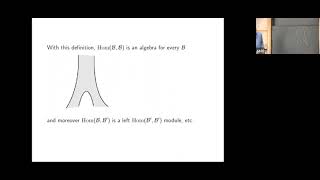
Gauge Theory and the Analytic Approach to Geometric Langlands - Edward Witten
Explore gauge theory's role in geometric Langlands correspondence, comparing categorical and analytic approaches through quantum states, operators, and gauge theory interpretations.