Changing Physics Education with Julia
Revolutionizing physics education by integrating Julia programming, focusing on nonlinear dynamics. Demonstrates how coding enhances understanding, introduces interactive applications, and discusses benefits of real-world exercises.
A Mathematical Look at Electronic Structure Theory - JuliaCon 2021 Workshop
Explore density-functional theory and numerical techniques for solving it using Julia. Learn about discretization, solution algorithms, and practical implementation with hands-on coding exercises.
Discrete and Continuous Mathematics - MIT Computational Thinking Spring 2021 - Lecture 14
Explore discrete and continuous mathematics, bridging concepts through indexing, function evaluation, area calculation, and random walks in computational thinking.
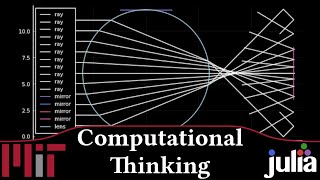
Raytracing in 2D - Week 8 - MIT Fall 2020
Explore 2D raytracing, covering light behavior, reflection, refraction, and Snell's law. Learn to implement these concepts in code using Julia, with practical examples like mirrors and lenses.
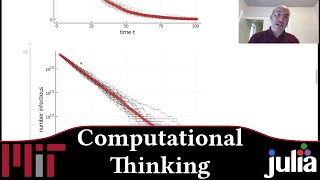
Macroscopic Models of Epidemic Dynamics - Week 6
Explore macroscopic epidemic models, transitioning from stochastic to deterministic approaches. Learn about SIR models, continuous-time dynamics, and differential equations in epidemiology.
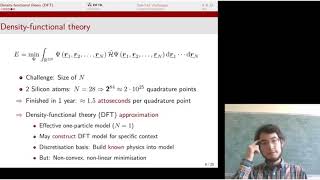
DFTK - A Julian Approach for Simulating Electrons in Solids
Introducing DFTK: A Julia package for density-functional theory simulations, offering flexibility for practical calculations and mathematical development in electronic structure research.
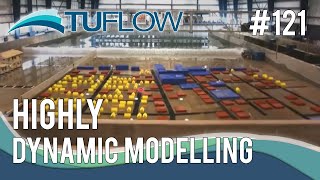
Tsunami and Dam Failure and Non-Newtonian Modelling
Explore advanced hydraulic modelling techniques for tsunamis, dam failures, and non-Newtonian flows. Learn to accurately simulate extreme inundation events using benchmarked methods and real-world case studies.
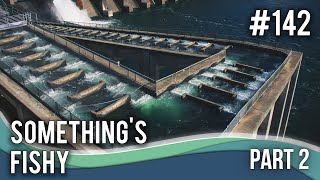
Something's Fishy
Explore fish passage hydraulics for Australian species, covering design considerations, innovative upgrades, and modern modeling techniques to promote effective fish migration in waterways.
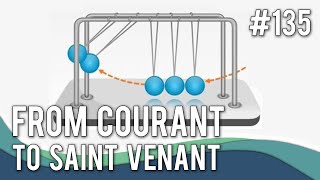
From Courant to Saint Venant
Explore the foundations of hydraulic modeling, from conservation principles to Saint-Venant equations, with real-world analogies and expert insights on key concepts like the Courant Number and solution methods.
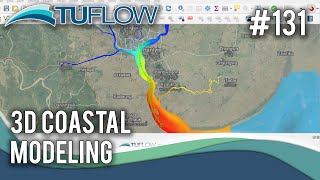
3D Coastal Modelling
Explore 3D coastal modelling approaches, including ocean circulation, model setup, result visualization, and real-world challenges. Learn to extend 2D models to 3D for comprehensive nearshore hydrodynamic analysis.
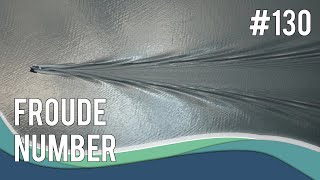
Froude, Dude!
Explore the Froude Number's principles and applications in hydraulic design, from naval architecture to static structures, covering subcritical and supercritical flow concepts.
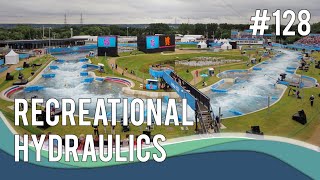
Recreational Hydraulics - Rafting, Wave Pools, & Water Slides
Explore the exciting world of recreational hydraulics, from Olympic whitewater courses to wave pools and waterslides. Learn how engineers apply fluid dynamics principles to create thrilling aquatic experiences.
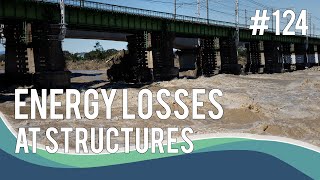
Energy Losses at Structures
Explore energy losses in water structures, from form losses to modeling approaches. Learn about constrictions, piers, bridge decks, and industry-standard techniques for understanding and mitigating hydraulic energy dissipation.
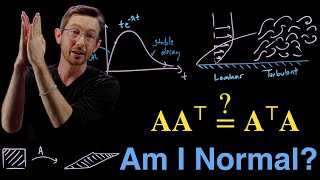
Non-Normal Linear Systems and Transient Energy Growth - Bypass Transition to Turbulence
Explore non-normal linear systems and their role in turbulence, including examples, code demonstrations, and applications in fluid dynamics and bypass transition.
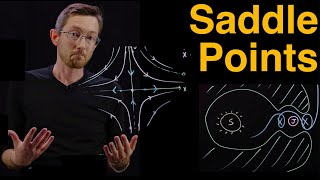
Systems of ODEs - Saddle Points and Instability
Explore unstable saddle points in 2D linear ODEs, their applications in energy-efficient transport, and analysis using eigenvalues, eigenvectors, and phase portraits.
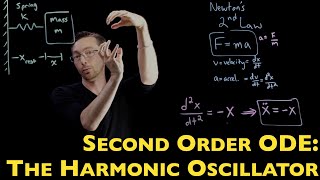
Second-Order Ordinary Differential Equations - Solving the Harmonic Oscillator Four Ways
Explore four methods to solve second-order ODEs for harmonic oscillators: guessing, Taylor series, alternative guessing, and matrix systems. Gain practical problem-solving skills in differential equations.
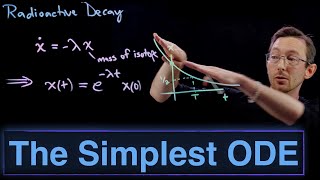
The Simplest Ordinary Differential Equation and Its Exponential Solution
Explore exponential solutions to simple ODEs through real-world examples like population growth, compound interest, and radioactive decay. Gain intuitive understanding of Euler's number and its applications.
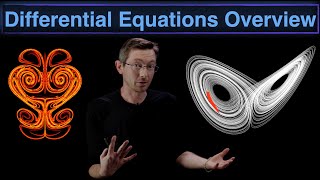
Differential Equations and Dynamical Systems - Overview
Explore dynamical systems and their applications in various fields. Learn classic and modern techniques for modeling real-world phenomena, from fluid dynamics to epidemiology.

Deep Learning - All Optimizers in One Video - SGD with Momentum, Adagrad, Adadelta, RMSprop, Adam Optimizers
Comprehensive exploration of deep learning optimizers, covering gradient descent, SGD, momentum, Adagrad, Adadelta, RMSprop, and Adam, with detailed explanations and comparisons.
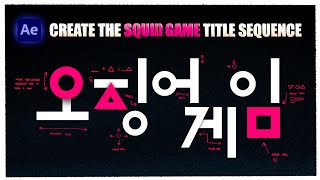
How to Create the Squid Game Title Sequence in After Effects - Tutorial
Learn to recreate Squid Game's iconic title sequence using After Effects. Master shape animation, transitions, trim paths, and screen effects to achieve the show's distinctive visual style.

Matrix Transpose Isn't Just Swapping Rows and Columns
Explore a unique visualization of matrix transpose, focusing on changing perspective rather than swapping rows and columns. Gain insights into covectors, metric tensors, and adjoints in various fields.