Physics-Inspired Algorithms and Phase Transitions in Community Detection - 2014 Symposium
Explore physics-inspired algorithms for community detection, including phase transitions, statistical inference, and belief propagation. Learn about innovative approaches to clustering and network analysis.
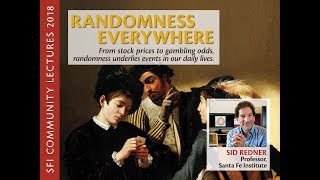
Randomness Everywhere - Understanding Random Walk Models and Their Applications
Explore the fascinating world of randomness with physicist Sid Redner. Discover how random walk models explain everyday phenomena, from stock prices to gambling, and their applications in various fields.
The Information Edge: Creation in Life, the Economy, and the Universe - Lecture 1
Explore the Information Edge principle and its role in creation across the universe, from cosmic structures to economic systems, with MIT professor Seth Lloyd.
The Information Edge: Collapse and Rebirth in Complex Systems - Lecture 2
Seth Lloyd explores the Information Edge's role in cosmic destruction and rebirth, from black holes to mass extinctions, and how complex systems regain balance after collapse.
Naturalness - How Religion Turned into Math
Explore the historical roots and problems of naturalness arguments in physics, examining their influence on theory development and scientific reasoning.
Symmetry and Collective Dynamics - Noether's Theorem and Conservation Laws
Explore Emmy Noether's theorem and its impact on theoretical physics, focusing on symmetry transformations and their role in expressing collective dynamics and conservation laws.
Fluctuations and Order in Randomly Evolving Environments
Explore non-equilibrium systems where giant fluctuations coexist with long-range order, examining particle behavior, interface properties, and applications in various scientific domains.
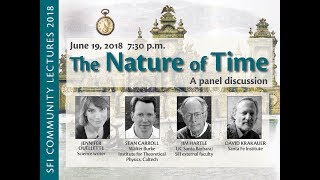
The Nature of Time - Panel Discussion on Physics, Biology, and Culture
Explore the mysteries of time with experts discussing its physical, biological, and cultural aspects, focusing on the arrow of time, entropy, and adaptive systems.
The Search for Life in the Universe
Explore the possibilities of extraterrestrial life and interstellar travel with astrophysics expert Pete Worden. Learn about cutting-edge initiatives, propulsion technologies, and recent discoveries in space exploration.
Computational Tools for Biology: Sandboxes to Think and Play With
Explore computational tools for biology, focusing on Gelbox - a simulation for teaching gel electrophoresis. Learn about DNA nanotechnology, science communication, and the power of interactive simulations in research and education.
Time Design: Exploring Concepts of Time Across Disciplines - InterPlanetary Festival 2018
Explore time's multifaceted nature through biology, archaeology, and physics in this panel discussion featuring experts Stefani Crabtree, Martine Rothblatt, and Van Savage.
Gravitational Waves and Complex Detection Machines - News from the Dark Universe
Explore gravitational waves, their detection, and the complex interferometers used to observe these cosmic ripples. Learn about recent discoveries and the future of gravitational-wave astronomy.
The Geometry of Consonance - Music and Mathematics
Explore the fascinating intersection of music theory and geometry, uncovering how musical chords inhabit unique geometric spaces and how classical compositions trace paths through multidimensional objects.
The Variational Universe - From Strings to Neurons
Explore variational principles in physics and biology, from quantum mechanics to neural systems, revealing nature's efficiency and optimization across scales.
Symmetry Breaking and Non-Equilibrium Phenomena - Lecture 3
Explore symmetry breaking and non-equilibrium phenomena in complex systems, covering topics from brain theory to thermal equilibrium and the El Farol problem.
Coarse-Graining, Renormalization and Universality - Lecture 1
Explore coarse-graining, renormalization, and universality in complex systems. Learn key concepts and applications in mathematical, biological, cognitive, and social sciences.
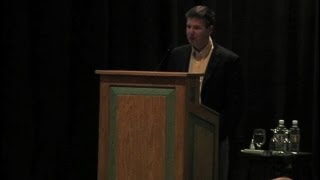
Future Directions in SFI Science: Potential Ideas - 2012 Annual Science Board Symposium
Exploración de direcciones futuras en ciencia de sistemas complejos, abordando temas como computación cuántica, física no equilibrada, diversidad biológica y cultural, y leyes fundamentales de innovación y crecimiento social.
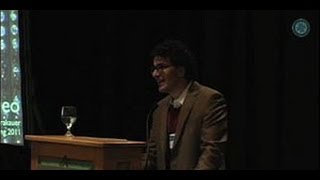
Computation in Natural Systems - Mesoscopic Theories and Information Processing
Explore computation in natural systems, from primate behavior to physics, examining how information processing occurs across scales and the implications for understanding complex systems.
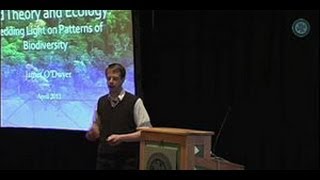
How Field Theory Can Help Solve Problems in Ecology - 2011
Explore how field theory concepts from physics can be applied to solve ecological problems, offering new insights into biodiversity and ecosystem dynamics.

Toward a New Understanding of Aging, Adaptation, and the Arrow of Time
Explore the interplay between biological aging, adaptation, and time through examples from physics research, aiming to identify pathways for healthy aging and formulate a new concept of complex time.
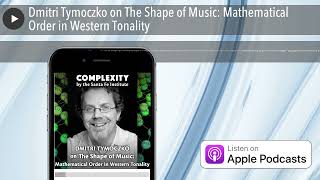
The Shape of Music - Mathematical Order in Western Tonality
Exploring the mathematical structure of Western music, revealing hidden geometries and patterns that connect diverse musical styles from Bach to The Beatles, and their relation to complex systems science.