Postmodernism in Literature
Explore postmodernism's impact on literature, examining key theories, thinkers, and texts. Analyze critical perspectives and contemporary relevance in this comprehensive overview.
Fundamentals of Artificial Intelligence
Comprehensive exploration of AI concepts, from problem-solving and search algorithms to knowledge representation, reasoning, planning, decision-making, and various machine learning techniques.
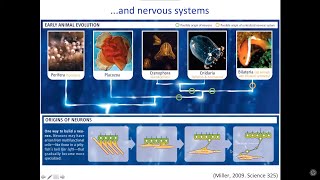
The Evolution of Agency
Explore the emergence of agency in living organisms, challenging reductionist views and proposing a framework for understanding purposeful behavior, free will, and mental causation in biological systems.
Ray Monk on the Lives of Extraordinary Individuals - Wittgenstein, Russell, Oppenheimer
Explore the lives of Wittgenstein, Russell, and Oppenheimer through philosopher Ray Monk's insights, examining their impact, leadership, and the intersection of art, science, and biography.
Rigorous Uncertainty: Science During COVID-19 with David Krakauer
Exploring COVID-19's impact through complexity science, discussing citizen-based medicine, data challenges, group size recommendations, and out-of-equilibrium thinking to reveal hidden interconnections in modern life.
Good Explanations & Diseases of Epistemology
Exploring the nature of explanations, epistemology, and societal knowledge processing. Balancing understanding and prediction in science, and adapting to rapid changes in a complex world.
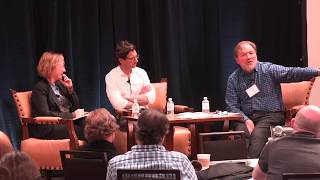
The End of Everything - A Discussion
Explore philosophical perspectives on societal collapse, decentralization, and human resilience with experts discussing the end of everything and potential new social orders.
ECoG Dog's Dream - Electroencephalosophy and Critical Neurophysiology
Explores limitations of scalp EEG for mind reading, proposes ECoG as superior alternative, and discusses potential for groundbreaking advancements in neuroscience through implantable high-density wireless ECoG systems.

A Brief History of Balance - Carlos Gershenson SFI Seminar
Explore the concept of balance across various domains, from physics to philosophy, and its implications for evolution, sustainability, and complex systems.
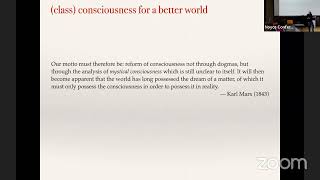
Autodiagnosis and the Dynamical Emergence Theory of Basic Consciousness
Explore the theory of basic consciousness, its emergence, and related concepts like energy landscapes and metastable states in this thought-provoking discussion on the nature of experience.
Could a Purely Self-Supervised Foundation Model Achieve Grounded Language Understanding?
Exploring the potential of self-supervised foundation models for grounded language understanding, discussing semantics, multi-modal streams, and causal abstraction in large networks.
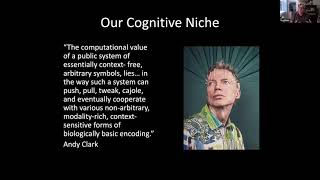
Guy Dove- Language Is a Neuroenhancement
Explore how language enhances cognitive abilities, examining embodied cognition, abstract concepts, and the elastic mind. Gain insights into human intelligence and its implications for AI development.
David Krakauer - What Is Complexity?
Explore complexity, its epistemology, and emergence with SFI President David Krakauer in this insightful lecture celebrating Complexity Explorer's 10th anniversary.
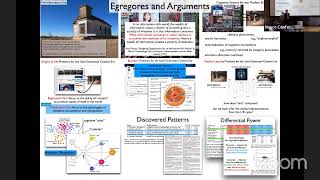
Argument-Making in the Wild
Explore the art of crafting persuasive arguments in real-world contexts, enhancing your ability to communicate effectively and influence others through logical reasoning.
Why Intelligent Reasoning Must Be Embodied
Explore the philosophical perspective on embodied intelligence and its implications for AI, presented by Lisa Miracchi from the University of Pennsylvania's GRASP Lab and MindCORE.
Learning About Possibilities Through Scientific Models
Exploring how scientists use models to study possibilities, examining epistemic and alethic possibilities, and discussing implications for model construction, assessment, and interpretation in scientific research.
Turing Test for Free Will - Determinism and Unpredictability in Decision-Making
Explore the interplay of determinism, randomness, and free will in decision-making processes. Discover a proposed 'Turing test' for free will and its implications for human and artificial intelligence.
The Peculiar Logic of Human Values
Explore the conceptualization of human value systems, including types, subjectivity vs. objectivity, and their impact on behavior and social interactions.
A Cooperative Species: Why Policies Designed for "Wicked Men" Fail - Part 3
Explore how ethical dispositions and cooperative motivations impact societal challenges, challenging Machiavelli's approach and examining the interplay between policy and human behavior.
Appealing to Intuitions - The Necessity and Limitations in Mathematics and Ethics
Explore the role of intuitions in reasoning and decision-making, from mathematics to ethics. Discover why we can't eliminate intuitions despite their limitations and paradoxes.
The Most Human Human - What Artificial Intelligence Teaches Us About Being Alive
Explore the intriguing intersection of AI and human nature, examining what our interactions with machines reveal about our own humanity and consciousness.