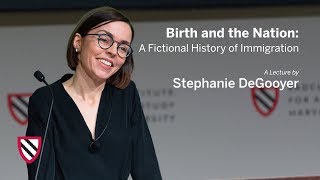
Birth and the Nation - A Fictional History of Immigration - Stephanie DeGooyer - Radcliffe Institute
Exploring how novels can challenge traditional notions of nationality and birth, offering alternative perspectives on citizenship and immigration for a more inclusive global society.
Introduction to Western Political Thought
Explore key Western political thinkers from Plato to Mill, examining their ideas on justice, state, human nature, and governance. Gain insights into the evolution of political philosophy and its enduring impact.
Contemporary Sociology
Explore postmodern sociological thinking through key thinkers and concepts, from structuralism to post-structuralism, examining philosophical roots and contemporary developments in Western thought.
Introduction to Modern Indian Political Thought
The major objective of this course is to introduce the students to some of the key modern Indian thinkers and their ideas which helped in shaping the society and politics of modern India.

Literary Theory and Literary Criticism
The course covers topics on Classical Theory, Romanticism, Realism and Naturalism, Marxism, Criticism, Structuralism, Psychoanalysis, Gender, and Queer Theory, Post Structuralism, Reader Response, and Reception, Post Colonialism, Semiotics, Film Studies…
Introduction to Cultural Studies
This course intends to examine culture, cultural identities and politics of production across various human historical conditions. Culture is examined in this course as an asymmetrical entanglement of material and abstract attributes
The Public Philosopher - Healthcare Policy and the American Dream
Explore healthcare policy, social welfare, and the American Dream in a lively debate led by philosopher Michael Sandel, engaging diverse perspectives on economic and social issues.
The Political Ethics of the Strike
Explore the ethical and historical foundations of workers' right to strike, examining its significance, challenges, and implications for workplace dynamics and social justice.
Jerusalem: What Sharing a City Means
Explore Jerusalem's complexities through a thought-provoking dialogue between Sari Nusseibeh and Homi Bhabha, delving into the challenges and possibilities of sharing this historic city.
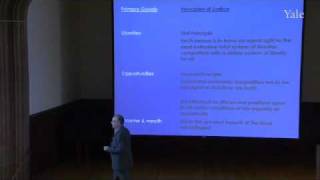
Distributive Justice and the Welfare State - Moral Foundations of Politics
Explore Rawls's difference principle and its implications for distributive justice, examining critiques and comparisons with other philosophical approaches to wealth distribution.

The Burkean Outlook - Edmund Burke's Anti-Enlightenment Philosophy
Explore Edmund Burke's conservative philosophy, emphasizing cautious social change, traditional values, and rejection of Enlightenment ideals in political thought and societal progress.
Contemporary Communitarianism - Moral Foundations of Politics - Lecture 20
Explore contemporary communitarianism and MacIntyre's critique of Enlightenment philosophy, examining emotivism, instrumentalism, and the concepts of practices and virtues in moral foundations.
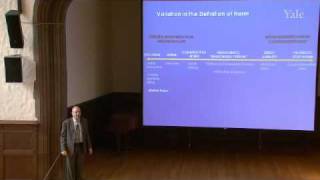
Limits of the Neoclassical Synthesis - Moral Foundations of Politics
Explores ambiguities in Mill's harm principle through examples like prostitution, free trade, and discrimination, revealing how defining and calculating harm involves political choices, challenging the Enlightenment ideal.

Philosophy and the Science of Human Nature - Introduction
Interdisciplinary exploration of human nature, examining happiness, morality, and political philosophy through philosophy, psychology, economics, and literature. Includes thought-provoking examples and unique insights.

Marx and Schumpeter on Capitalism's Dynamic Nature - Lecture 4
Explore Marx and Schumpeter's theories on capitalism's constant evolution, critiquing Marxist ideas and examining creative destruction through historical examples of technological revolutions.

Marx's Theory of History - Foundations of Modern Social Thought
Explore Marx's evolving theory of historical change, focusing on property relations and multi-linear development as presented in the Grundrisse, challenging his earlier uni-linear view of history.

Marx's Theory of Historical Materialism - Lecture 11
Explore Marx's historical materialism, dialectics, and theories of truth. Examine the evolution of his ideas and their impact on understanding social structures and historical development.
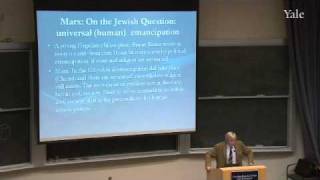
Marx's Theory of Historical Materialism - Lecture 1
Exploración profunda de la teoría de alienación de Marx, su materialismo histórico y su crítica a Hegel, enfatizando la transición del joven Marx al Marx maduro y su visión del cambio social.

Marx's Theory of Alienation - Foundations of Modern Social Thought
Explore Marx's theory of alienation, its roots in Hegelian thought, and how material conditions shape social critique. Understand Marx's intellectual journey and its impact on revolutionary ideas.

John Stuart Mill's Utilitarianism and Social Thought - Lecture 8
Explore John Stuart Mill's influential ideas on utilitarianism, justice, liberty, and women's rights, examining their impact on modern social thought and contemporary debates.

Utilitarianism and Liberty - John Stuart Mill's Philosophy - Lecture 7
Explore Adam Smith's moral philosophy and economic theories, and John Stuart Mill's utilitarianism and views on liberty in this lecture on foundational social thought concepts.