Consciousness as a Coherence-Inducing Operator
Exploring consciousness as an operator that induces coherence in biological information processing, examining its properties, function, and potential for computational simulation.
What Do Theories of Consciousness Predict About the Onset of Infant Consciousness?
Explores predictions of major consciousness theories on infant consciousness onset, examining higher-order, global workspace, integrated information, and recurrent processing theories.
Name, Number and the Foundation of Consciousness
Explores how natural languages and their inner domain of meaning create subject-object differentiation, forming the basis of consciousness through sound-meaning relations grounded in number.
A Structural Turn in Consciousness Studies
Explores the emerging structural approach in consciousness studies, discussing its implications, potential pitfalls, and promise for advancing the field using mathematical and structural tools.
The Fitness-Beats-Truth Theorem - Some Philosophical Reflections
Philosophical exploration of the Fitness-beats-truth theorem, examining veridicality, mathematical representation, and potential self-refutation in the context of perceptual and cognitive models.
Mathematizing Phenomenology Within a Process Framework
Exploring mathematical approaches to phenomenology within a process framework, bridging subjective experiences and objective analysis for a comprehensive understanding of consciousness.
The Emergence of Geometric Worldviews in Qualia Space
Explores how cognitive capabilities, subjective experience, and macroscopic perception lead to geometric worldviews in organisms, using qualia-based measurement spaces and topological concepts.
Consciousness and Free Will - A Physical Hypothesis for Distinguishing Humans from AI
Exploring a physical hypothesis for free will and consciousness based on quantum processes in the brain, distinguishing human cognition from AI through perception of parallel worlds.
Are Subjective Measures of Consciousness Reliable?
Exploring the reliability of subjective consciousness measures through introspection types and evaluating the Perceptual Awareness Scale.
Threads Considered Harmful
Explore a new paradigm for multithreaded programming using tasks and dependencies, eliminating locks and improving composability, determinism, and performance in concurrent software development.
Practical Ethics - Building It Better in 2020 and Beyond
Explore ethical tech practices, their impact on data privacy, and practical tips for building ethical muscles in the digital world. Learn how ethics can coexist with business success.
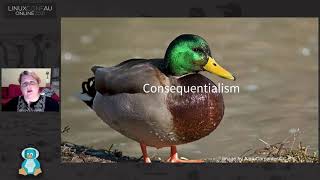
Introduction to Ethics from an Ethicist-in-Training
Explore moral responsibility in tech through philosophical inquiry, focusing on decision-making, ethical frameworks, and real-world dilemmas in the FOSS community.
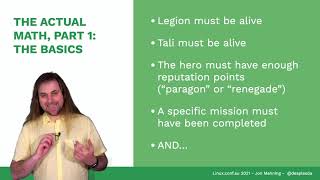
Let's Use an Automated Theorem Prover to Verify Video Games - I Swear This Is More Fun Than It Sounds
Explore using Z3 theorem prover to detect and fix bugs in video game systems. Learn to apply formal logic for diagnosing problems and discovering impossibilities in complex game mechanics.
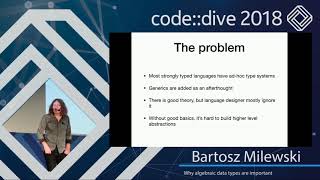
Why Algebraic Data Types Are Important
Explore type theory, category theory, and logic in functional programming, focusing on algebraic data types and their role in enhancing code reliability and expressiveness.
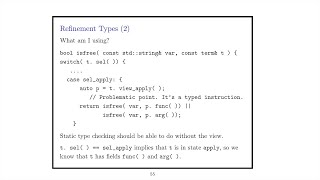
Trees for Logic and Parsing in C++
Explore efficient implementation of recursive tree-types in C++ for logic and parsing, with insights on construction, inspection, and replacement of subtrees.
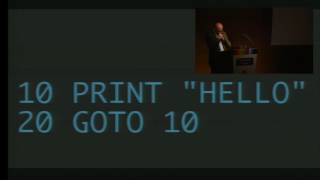
Minds, Machines and Python
Explore AI through logic and language using simple Python programs, focusing on loops, self-reference, and tangled hierarchies as key concepts in understanding intelligence and learning.
Mary Had a Little Lambda
Explore lambda calculus: from simple Python functions to powerful abstractions. Learn to create booleans, integers, operators, and data structures using only lambda functions.
The Essence of Testing
Explore the core principles of software testing, focusing on ScalaTest's evolution, propositional and predicate logic, and property-based testing advancements.
The Algorithm Ate My Homework
Explore ethical implications of AI decision-making through a Talmudic lens. Examine ancient case laws to draw parallels with modern AI challenges and spark crucial conversations about responsibility.
Problem Solving Through Pair Programming
Discover effective pair programming techniques for mentorship, enhancing code quality, and fostering team growth. Learn to create productive, educational, and enjoyable pairing sessions that benefit both mentors and mentees.
Socratic - Documentation Done Right
Explore innovative approaches to software documentation with Socratic, enhancing developer productivity and code understanding through AI-powered tools and methodologies.