
Time Travel Paradoxes in Doctor Who and Futurama - Sci-Phi: Science Fiction as Philosophy
Explore time travel paradoxes through popular sci-fi, examining philosophical implications, Einstein's relativity, and potential solutions like branching timelines and predestination, challenging our understanding of causality and reality.

How Occam's Razor Changed the World of Science - With Johnjoe McFadden
Explore how William of Occam's principle of simplicity revolutionized scientific thinking, from medieval metaphysics to modern physics, and its enduring impact on problem-solving across disciplines.
A Series of Fortunate Events – With Sean B. Carroll
Explore the profound impact of chance on life's evolution and diversity. Sean B. Carroll reveals how random events shape our world, challenging traditional views on purpose and design in nature.

The Forbidden City of Beijing
Explore Beijing's Forbidden City: 600-year-old imperial palace with 98 buildings, influenced by Taoism and feng shui. Discover its unique architecture, historical significance, and transformation into a modern World Heritage Site.

Solving Impossible Puzzles - Math Logic and Games
Explore mathematical logic to solve classic puzzles like the 15 Puzzle and Peg Solitaire. Learn strategies, understand common features, and discover how to approach seemingly impossible challenges using math principles.

Voting & the Electoral College - Logic, Riddles, & Paradoxes in Math and History
Explore paradoxical election outcomes, Arrow's impossibility theorem, and the Electoral College system. Analyze voting methods, mathematical proofs, and counterintuitive results in political decision-making.

Mind-Body Philosophy of the East and West - Spiritual Dualism in the History of Thought
Explore the historical evolution of the soul concept in Eastern and Western thought, from ancient Greek philosophy to modern psychology, and its gradual dismissal in contemporary science.

Books That Matter - The Analects of Confucius - A Bird's-Eye View
Explore Confucius's timeless wisdom, its relevance to modern life, and how it compares to Western philosophy. Gain insights on integrity, knowledge transmission, and the art of studying.

What Are Logical Fallacies - Tips for Better Communication and Debate Skills
Explore common logical fallacies and learn effective strategies to identify, understand, and counter deceptive arguments for improved communication and debate skills.
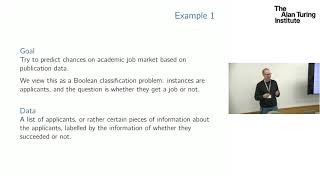
Learning Logically Defined Hypotheses - Martin Grohe, RWTH Aachen University
Explore a declarative framework for machine learning using logic-defined hypotheses, discussing learnability results for various logics over strings, trees, and graphs.

Full Semester Ethics Course Condensed into One Lecture
Condensed ethics course exploring moral philosophy, from Plato to contemporary thinkers. Examines key ethical questions, theories, and arguments to understand the nature and importance of morality.
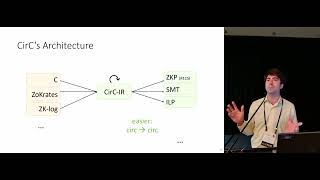
CirC - Compiler Infrastructure for Proof Systems, Software Verification, and More
Explore compiler infrastructure for proof systems and software verification, focusing on CirC's capabilities, multiparty computation, and potential applications in various domains.
The Limits of Proof
Explore proof systems, from classical logic to modern computational approaches, examining their strengths, limitations, and applications in mathematics and computer science.
Toward a Formal Model of Free Will
Explores a formal model of perceived free will using statistical emergence, offering concrete measures for analyzing choice ensembles and free will.
Structure Invention by Conscious Agents
Explore consciousness as fundamental and the physical world as emergent. Learn about Interface Theory of Perception, Conscious Realism, and evolutionary game theory in this thought-provoking talk.
On the Mathematical Basis of Models of Consciousness
Explore the mathematical foundations of consciousness models, examining structures to describe experience and developing a systematic framework based on philosophical concepts.
The Strange Loops Inside Our Brains
Explore the intriguing connection between Gödel's Incompleteness Theorem and consciousness, critically examining Hofstadter's analogies and their implications for understanding the mind-body problem.
Larissa Albantakis – Why a Little Bit of Causal Structure Is Necessary... Even for Functionalists
Explores why causal structure is essential for theories of consciousness, using thought experiments to argue that functionalist accounts lacking causal analysis are inadequate for identifying conscious individuals.
No Substitute for Functionalism
Explores types of variations in consciousness models, proving broad functionalist theories immune to substitution arguments. Discusses implications for consciousness science and functionalism.
A Vector Model of How Consciousness as Integrated Information Makes a Causal Difference
Explore a vector model of consciousness based on Integrated Information Theory, examining how phenomenal experiences can exert causal influence on physical substrates.
Towards a Category-Theoretic Framework for Phenomenal Holism
Exploring phenomenal holism through category theory, examining color experiences across the visual field and addressing theoretical concerns about inverted qualia and experience-substrate relationships.