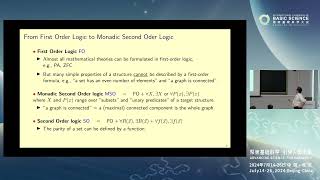
Reverse-Mathematical Reconsideration of Lower-Level Borel Games
Explore determinacy strength of Gale-Stewart games through Reverse Mathematics, examining collapse phenomena in boolean combinations of Fσ sets and their implications.

Guide for Writing a Philosophy Paper
Learn to craft clear, concise philosophy papers with tips on understanding prompts, presenting arguments positively, using repetition effectively, and structuring your writing for maximum clarity and impact.

Functionalism
Explore Putnam's Multiple Realizability argument and functionalist theory of mind, examining mental states as functional states with specific inputs and outputs in philosophy.
René Descartes - Meditation - The Ontological Proof of God's Existence
Explore Descartes' Ontological Argument for God's existence, its comparison to geometric proofs, and potential objections in this philosophical analysis of the fifth Meditation on First Philosophy.
René Descartes - Meditation - A Cosmological Proof of God's Existence
Explore Descartes' cosmological proof of God's existence through his third Meditation, examining the concept of infinite formal reality and its implications for divine existence.
René Descartes - Meditation - I Think, Therefore, I Am
Explore Descartes' famous "I think, therefore I am" argument and its philosophical implications in this lecture on the second Meditation, comparing his views with Aristotle's conception of the human mind.

René Descartes - Meditation - The Method of Doubt
Explore Descartes' method of doubt, dream skepticism, and malicious demon skepticism in his first Meditation, examining how he challenges fundamental beliefs and perceptions.
Does Occam's Razor Rule Out Objective Morality?
Explore the philosophical debate on Occam's Razor and objective morality, examining arguments for moral skepticism and objectivism in this thought-provoking lecture on ethics.
Two Possible Arguments Against the Existence of Objective Morality and Possible Responses
Explores moral skepticism and relativism, examining arguments against objective morality based on persistent disagreement and diverse ethical situations.
Is Moral Skepticism Self-Refuting? - No, but It Has Other Problems
Explore ethical skepticism, nihilism, and relativism, examining their global versions and potential self-defeating nature in this philosophical analysis of moral reasoning.

What Is Philosophy?
Explore deep, non-empirical questions and rational arguments to understand the essence of philosophy and its relevance in academic and professional contexts.

A.J. Ayer's Emotivist Theory of Moral Language
Explore A.J. Ayer's Emotivist Theory, examining moral language and its implications in metaethics. Gain insights into Expressivism and Non-consequentialism in this introductory philosophy lecture.
Aristotle's Nicomachean Ethics - Book I
Explore Aristotle's argument on human flourishing, virtue, and happiness in the Nicomachean Ethics, examining the connection between moral action and personal well-being.

Immanuel Kant's Moral Theory - A Summary With Examples
Explore Kant's moral philosophy, focusing on the Categorical Imperative and comparing it to Utilitarianism. Gain insights into deontological ethics and its practical applications.

Is Pleasure the Only Good Thing? - Nozick's Experience Machine Thought Experiment
Explore Nozick's Experience Machine thought experiment and its challenge to hedonism, examining the value of pleasure and authentic experiences in determining human well-being.

Nietzsche's Genealogy of Morals
Explore Nietzsche's controversial critique of morality, examining the origins and implications of moral values through his genealogical approach.

Does Objective Morality Exist? - A Philosophical Presentation and Discussion
Explore the concept of objective morality through philosophical arguments, examining evidence, reasoning, and implications for ethical decision-making in this thought-provoking presentation.
Explaining Generalisation and Individual Justice - Reuben Binns
Explore the challenges of balancing generalization and individual justice in AI decision-making, focusing on explainability, limitations, and ethical implications in real-world contexts.

What Is Time - Professor Sean Carroll Explains Presentism and Eternalism
Explore the nature of time through presentism and eternalism, examining scientific experiments, philosophical concepts, and thought experiments to understand our perception of past, present, and future.

Is Infinity a Number - Mind-Bending Paradoxes with David Kung
Explore mind-bending paradoxes of infinity through thought experiments like Hotel Infinity, prime numbers, and supertasks. Gain insights into mathematical concepts and their philosophical implications.

What Does It Mean to Die - Technology and Death
Explore how technology reshapes our understanding of mortality, from social media's digital afterlife to brain transplants, challenging traditional notions of life, death, and the pursuit of immortality.