MFEM: High-Performance Finite Element Methods Tutorial - 2024
Explore MFEM, a parallel C++ library for finite element methods. Learn to develop scalable algorithms for various platforms, from laptops to supercomputers.
The Netgen/NGSolve Finite Element Software - Overview and Applications
Explore Netgen/NGSolve finite element software: overview, Python scripting, teaching applications, and recent developments in matrix-valued elements, GPU utilization, and time-dependent problems.
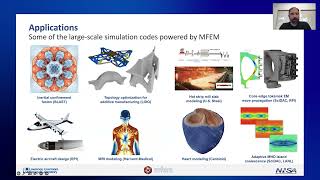
The State of MFEM - Workshop 2022
Explore MFEM's high-order mathematical calculations for scientific simulations, including key capabilities, examples, and future plans. Learn about the project's growth and recent software release.

Palace: Parallel Large-scale Computational Electromagnetics - MFEM Workshop 2023
Explore Palace, a parallel finite element code for full-wave electromagnetics simulations, and its capabilities for large-scale 3D modeling in quantum computing hardware design.
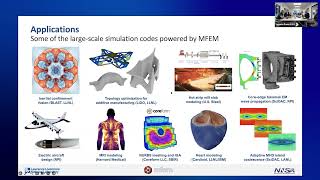
The State of MFEM - Workshop 2023
Explore MFEM's key capabilities, recent developments, and future directions in high-order finite element methods for scientific simulations.
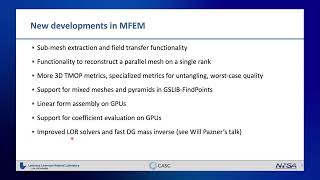
Recent Developments in MFEM - Workshop 2022
Explore recent developments in MFEM, including sub-mesh extraction, GPU-based calculations, and integrations with scientific software libraries for high-order finite element simulations.
Prestissimo: The Next Generation C++ Based Presto SQL Query Engine
Discover how Prestissimo revolutionizes Presto SQL engine with C++ runtime, delivering enhanced performance, efficient memory management, and improved CPU utilization through vectorization and runtime optimizations.
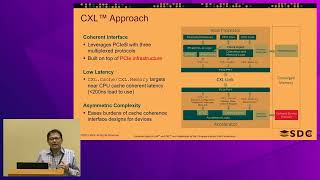
CXL Enabling an Interoperable Ecosystem for Heterogeneous Memory and Computing Solutions
Explore the CXL 3.0 specification's advanced features for heterogeneous computing, including enhanced memory sharing, coherency improvements, and expanded fabric capabilities for high-performance workloads.
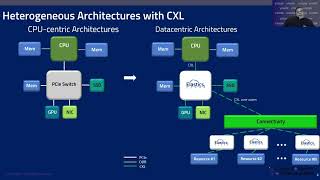
Server Fabrics and the Evolution to CXL 3.0 - Memory and Resource Management in Heterogeneous Computing
Explore the evolution of CXL technology and server fabrics, focusing on memory management, resource pooling, and system architecture improvements for enhanced computing performance.
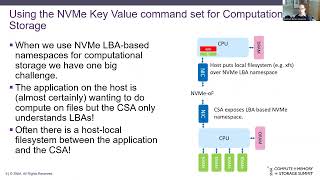
Big-Disk Computational Storage Array for High Performance Data Analytics
Explore high-performance computational storage solutions for data analytics, focusing on UCIe standards, chiplet interoperability, and power-efficient performance across cloud, edge, and client computing infrastructures.
AIUK 2022 Workshop - RADDISH: Real-Time Data Assimilation for Digital Twins
Explore real-time data assimilation for digital twins using particle filtering techniques, with interactive demonstrations and discussions on parallelization, future applications, and implementation challenges.
Advancing GPU Analytics with RAPIDS Accelerator for Apache Spark and Alluxio
Learn to accelerate GPU analytics using RAPIDS for Apache Spark and Alluxio, enabling faster data access and processing for AI and analytics workloads across any cloud environment.
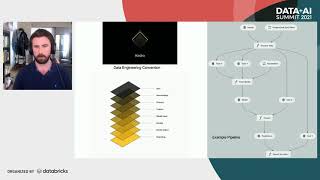
A Collaborative Data Science Development Workflow Using Kedro and MLflow
Explore a collaborative data science workflow using Kedro pipelines, MLflow tracking, and cloud-agnostic GPU containers for efficient model development, training, and production deployment.

Presto on Apache Spark - A Tale of Two Computation Engines
Explore the integration of Presto and Spark, combining low-latency evaluation with robust execution for enhanced SQL experience in both interactive and batch use cases at Facebook scale.
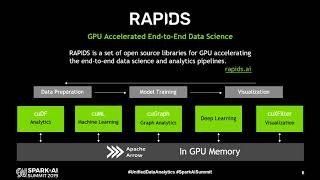
Accelerating Apache Spark with GPUs Using RAPIDS
Explore GPU acceleration for data science with RAPIDS, offering significant performance gains over CPU-only solutions. Learn its functionality, architecture, and integration with Apache Spark for large-scale computation.
Implementing End-to-End Demand Forecasting with Databricks and MLflow
Discover how to implement a scalable demand forecasting solution using Databricks and MLflow, improving retail efficiency and reducing food waste through accurate production and delivery planning.

SIGCOMM 2020 - Reducto - On-Camera Filtering for Resource-Efficient Real-Time Video Analytics
Explore real-time video analytics optimization with Reducto, a filtering technique for efficient on-camera processing. Learn about system design, performance results, and practical applications.
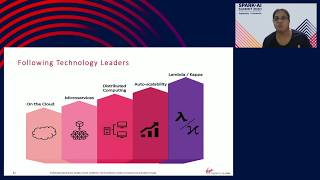
Generative Hyperloop Design - Managing Massively Scaled Simulations for Demand Modeling
Explore large-scale simulation framework for Hyperloop design, utilizing cloud computing, data pipelines, and machine learning to address key technical and business questions for safe and efficient mass transportation.
Designing High-Performance Scalable Middleware for HPC, AI, and Data Science in Exascale Systems and Clouds
Explore high-performance middleware design for exascale systems, focusing on MVAPICH2 project's features and performance in HPC, AI, and data science applications across various platforms.

Depend Upon Docker for AI
Explore Docker's role in Data Science, Machine Learning, and AI, including GPU processing techniques and Industrial AI demos, presented by experts from Baker Hughes.
Inference at Scale with Apache Beam
Learn to deploy and scale machine learning models efficiently using Apache Beam for distributed inference on CPUs and GPUs, with practical insights on parallelizing workloads.