David Cerna: Proof Schema and the Refutational Complexity of Their Cut Structure
Explore proof schemas, refutational complexity, and cut structures in mathematical logic. Gain insights into CERES, ECA, and 1-SMA concepts for advanced theorem proving techniques.
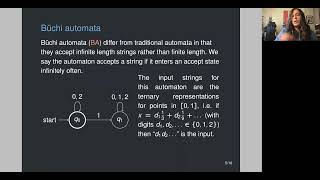
Buchi Automata and Fractals on R
Explore Buchi automata and fractals on R, covering regular languages, model theory, and first-order logic. Gain insights into sparse sets and omega languages in this mathematical journey.
Topics in Pure Model Theory - Lecture 10
Explore advanced concepts in pure model theory, including simple theory, invariant types, and symmetry, with expert insights from Itay Kaplan of The Hebrew University of Jerusalem.
Model Theory: From Logic to Geometric Stability Theory and O-Minimality II
Explore model theory principles, focusing on o-minimality and stability theory, with applications to complex geometry and arithmetic aspects.
Ulrich Kohlenbach - Extraction of Information from Proofs
Explore proof theory and its applications in mathematics, focusing on extracting computational content from nonconstructive proofs for practical problem-solving.
Why 1 Is Never Prime, and Sometimes Neither Are Some of Your Favorites
Explore the concept of prime numbers, focusing on why 1 is not considered prime and examining other surprising non-prime numbers in mathematics.
Open Problems Session - Connections with Logic Workshop
Explore cutting-edge challenges in operator algebras and logic during this interactive session, fostering collaboration and advancing research in mathematical foundations.
Positivity Is Undecidable in Product Algebras
Explore undecidability of positivity in product algebras with William Slofstra, delving into operator theory and its connections to mathematical logic.
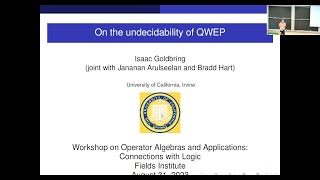
On the Undecidability of the QWEP
Explore the undecidability of QWEP in operator algebras with Isaac Goldbring. Delve into advanced mathematical concepts and their applications in this Fields Institute lecture.
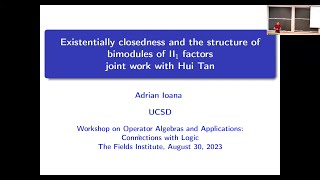
On Existentially Closed II1 Factors
Explore advanced concepts in operator algebras, focusing on existentially closed II1 factors, with insights from Adrian Ioana's research in this specialized mathematical field.

Elementary Equivalence for II1 Factors
Explore elementary equivalence in II1 factors with Srivatsav Kunnawalkam Elayavalli, delving into operator algebras and their connections to logic in this advanced mathematical talk.

The Game of Set and Some Variations
Explore mathematical variations of the classic game Set with Catherine Hsu, including projective and non-abelian versions, offering new challenges and insights for puzzle enthusiasts.

Why Is This 15-Puzzle Impossible? - Numberphile
Professor Steven Bradlow explains the mathematical impossibility of solving certain configurations of the classic 15-puzzle, exploring permutations, invariants, and the fascinating properties of this seemingly simple game.
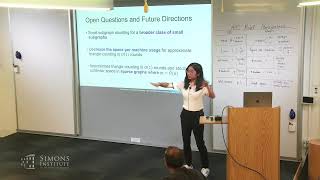
Distributed Graph Techniques in the MPC Model
Explore advanced distributed graph algorithms in the Massively Parallel Computation model, focusing on efficiency and scalability for large-scale data processing.

The Story of Mathematical Proof - From Ancient Greece to Modern Logic
Explore the evolution of mathematical proof across number theory, geometry, topology, and logic, delving into the fascinating gap between natural and real numbers.

How to Think Like a Mathematician - Applying Logic to Real-World Situations
Discover how mathematical thinking can enhance clarity in everyday situations, from fake news to privilege, using logic and precise reasoning to navigate complex issues.
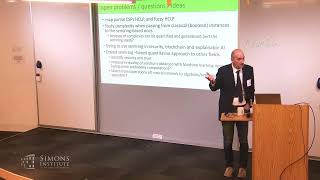
Semiring-Based Soft Constraint Solving and Argumentation
Explore semiring applications in constraint solving and argumentation, focusing on optimizing solutions beyond traditional problem-solving approaches.
An Introduction to Newton’s Method on Semirings
Explore Newton's method generalization for solving polynomial fixpoint equations on omega-continuous semirings, its applications, and characterization of Newton approximants to the fixpoint.
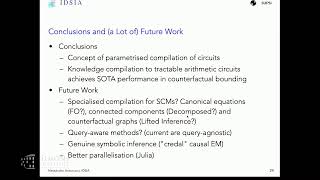
Tractable Bounding of Counterfactual Queries by Knowledge Compilation
Explores bounding partially identifiable queries in causal models using knowledge compilation, offering computational advantages for inference in Bayesian networks with shared structures.
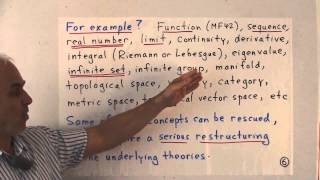
Logical Weaknesses in Modern Pure Mathematics - Real Numbers and Limits - Math Foundations 87
Explores logical weaknesses in modern pure mathematics, focusing on inconsistent rigor and problematic definitions. Challenges conventional views and invites discussion on foundational issues in mathematics.
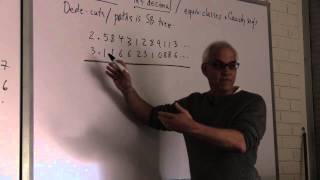
A Socratic Look at Logical Weaknesses in Modern Pure Mathematics
Exploring logical weaknesses in pure mathematics, focusing on continuum, analysis, and set theory. Challenges conventional understanding of limits and introduces computational thinking perspectives.