Embedded Systems - Design Verification and Test
Explore modeling, design, verification, and testing techniques for embedded systems, covering hardware/software partitioning, scheduling, temporal logic, and fault tolerance.

Safety and Liveness of Robot Behaviors
Explore formal methods for designing robots, guaranteeing behavior, and identifying potential issues. Learn about safety and liveness properties in robotic systems, including multi-robot and human-robot interactions.
Transformer Expressivity and Formal Logic
Explore the relationship between transformers and formal logic, uncovering their abilities, limitations, and implications for computational models.
Feedback Control Theory - Architectures and Tools for Real-Time Decision Making II
Explore advanced control systems, design patterns, and optimization techniques for real-time decision making in complex systems. Learn about PID control, robustness, and temporal logic.
Solving Infinite-State Games via Acceleration
Explore novel symbolic semi-algorithms for solving infinite-state games with temporal winning conditions, introducing acceleration techniques to enhance fixpoint-based game-solving methods.
Solving Two-Player Games under Progress Assumptions
Explore solving infinite two-player games with progress assumptions in cyber-physical system design. Analyze complexity classes and efficient algorithms for augmented games.
Deciding Asynchronous Hyperproperties for Recursive Programs
Explore a novel logic for asynchronous hyperproperties, enhancing model checking for recursive programs. Gain insights into temporal logic, automata theory, and pushdown systems.
Sonic Pi - Live Coding as a Tool for Next-Gen Education
Explore Sonic Pi, a free code-based music creation tool, for education and professional use. Learn core computer science concepts through live coding beats and synth riffs.

Algorithmic Verification - Session Preview at POPL 2023
Explore algorithmic verification techniques and their applications in program analysis, presented by expert Umang Mathur at POPL 2023's innovative session preview track.
Model Checking and Temporal Logic - E. Allen Emerson's Turing Award Lecture
Explore E. Allen Emerson's journey to the Turing Award, from early influences to groundbreaking work in model checking and temporal logic in computer science verification.
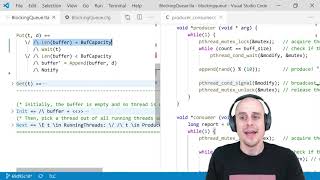
Weeks of Debugging Can Save You Hours of TLA+
Explore TLA+ for reliable system design through a hands-on approach, solving a subtle concurrency issue to demonstrate its power in preventing critical failures and reducing debugging time.
Reactive Synthesis - Open Questions and Challenges
Experts discuss open questions and challenges in reactive synthesis, exploring cutting-edge research and future directions in system modeling and automation.
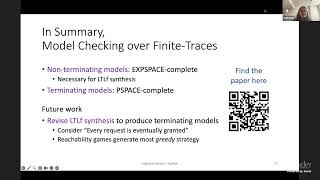
Synthesis and Verification of Finite Horizon Tasks
Explore finite horizon task synthesis and verification techniques, focusing on model and system creation for time-bounded objectives in computational systems.

Historia: Refuting Callback Reachability with Message-History Logics
Explore a novel approach to callback reachability in event-driven frameworks using message-history logics. Learn about targeted specification and goal-directed verification for improved app analysis.
The Essence of Reactivity
Explore abstractions capturing time variance in reactive programming, comparing approaches and demonstrating a generic Haskell interface for different temporal formalisms.
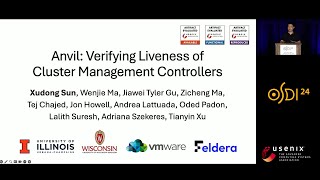
Anvil: Verifying Liveness of Cluster Management Controllers
Innovative framework for verifying liveness in cluster management controllers, ensuring continuous reconciliation to desired states despite failures and asynchrony in cloud environments.

Which Time Is It? - A Graphical Tour of Time Concepts and Operations
Explore time concepts, operations, and mental models to avoid subtle bugs in Ruby programming through a graphical tour of time itself.
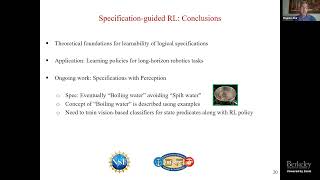
Specification-guided Reinforcement Learning
Explore specification-guided reinforcement learning techniques for synthesizing models and systems, presented by Rajeev Alur from the University of Pennsylvania.
Linear Temporal Logic - From Infinite to Finite Horizon
Explore finite-horizon temporal synthesis in Linear Temporal Logic, its algorithmic advantages, and applications in reactive synthesis and infinite-horizon reasoning.
Synthesis of Privacy-Preserving Systems
Explore privacy-preserving system synthesis, addressing hidden signals, budget constraints, and incomplete information while satisfying specifications and protecting secrets.