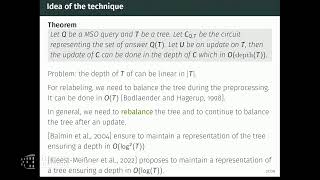
Circuits for Querying Trees - A Little Survey
Explore tree querying via automata and knowledge compilation, covering efficient solutions for enumeration and probabilistic evaluation, along with their limitations.
Datalog and Equality Saturation
Explore connections between Datalog and equality saturation, covering applications, relationships to the chase, and new query evaluation techniques for optimized compiler design.

Playing Lewis Carroll's Game of Logic on the Original 150-Year-Old Board
Oxford mathematicians explore Lewis Carroll's 150-year-old Game of Logic, deciphering rules and playing on the original board. A unique blend of history, logic, and mathematical curiosity.
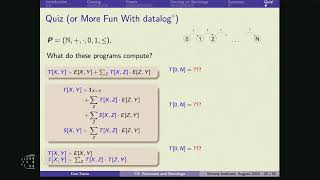
Algebraic Structures in Logic and Query Evaluation - Lecture 3
Explore algebraic structures in logic and query evaluation, focusing on advanced concepts and their applications in database theory and AI.
Algebraic Structures in Logic and Query Evaluation - Part 4
Explore algebraic structures' role in logic and query evaluation, focusing on advanced concepts and their applications in database theory and AI.
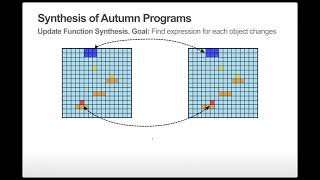
Model-Based Reasoning in Neurosymbolic Programming for Science
Explore model-based reasoning techniques and their applications in neurosymbolic programming for scientific problem-solving.
Deciding Asynchronous Hyperproperties for Recursive Programs
Explore a novel logic for asynchronous hyperproperties, enhancing model checking for recursive programs. Gain insights into temporal logic, automata theory, and pushdown systems.
Orthologic with Axioms - Proof Theory and Algorithms
Explore orthologic with axioms, its proof theory, and algorithms. Discover generalized ortholattice reasoning and its applications in verification condition simplification and normalization.
Interpolation and Quantifiers in Ortholattices
Explore quantifiers and interpolation in orthologic, examining proof systems, quantifier elimination, and efficient interpolant computation for verification algorithms.
Complete First-Order Reasoning for Properties of Functional Programs - OOPSLA 2023
Explore complete first-order reasoning for functional program properties, uncovering theoretical foundations of verification tools and explaining their efficacy, limitations, and user assistance role.
Logic and Decidability in Programming Languages - Session Preview II
Explore logic and decidability in programming languages. Gain insights into theories of arithmetic, linear real rings, and state machines. Discover new minimization algorithms and their applications.
Finding Infinite Counter-Models in Deductive Verification
Explore innovative techniques for finding infinite counter-models in deductive verification, enhancing automated solvers' capabilities and providing valuable insights for verification failures.
Principles of Mathematical Thinking for Everyday Life
Discover key principles of mathematical thinking for everyday life from Fields Medal winner Pierre-Louis Lions, with insights for aspiring mathematicians and math educators.
Sets, Logic and Graphs - Math Terminology - NJ Wildberger
Review of high school math language and notation for sets, logic, and basic graph theory. Covers key concepts like union, intersection, subsets, logical statements, and graph circuits, providing essential foundations for advanced mathematics.
Measuring Weight - Elementary Mathematics Explained
Explore the fundamentals of weight measurement, from ancient techniques to modern systems. Learn about scales, metric units, and practical applications in everyday life and science.
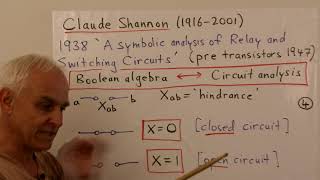
Boolean Algebra and Shannon's Circuit Analysis - Math Foundations - N J Wildberger
Explores Boolean algebra's connection to circuit analysis, focusing on Huntington's formulation and Shannon's groundbreaking 1938 paper linking the two fields.
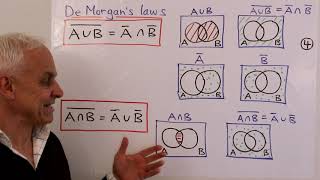
Boolean Algebra and Set Theory - Math Foundations - N J Wildberger
Explore Boolean algebra, set theory, and Venn diagrams. Learn about De Morgan's laws, distributive properties, and their proofs using truth tables and Boole's algebra.
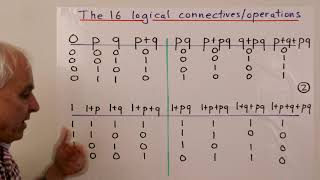
Implication and Logical Operations - Math Foundations - N J Wildberger
Explore 16 logical operations, including AND, OR, XOR, and implication, with applications to Boolean algebra and circuit analysis. Gain insights into Modus Ponens and Boole's algebra for solving electrical engineering problems.
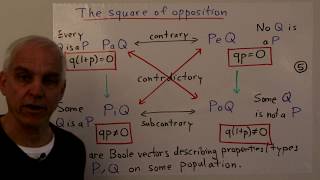
The Algebra of Boole is Not Boolean Algebra - Math Foundations - N J Wildberger
Exploring the Algebra of Boole, its relation to Boolean algebra, and its role in logic and circuit analysis. Discusses syllogisms, the Square of Opposition, and Boole's proofs of Aristotle's arguments.
Sets, Logic and Computability - Math History - NJ Wildberger
Overview of set theory, logic, and computability in late 19th/early 20th century math, covering Cantor's work, Dedekind's constructions, paradoxes, and philosophical schools addressing foundational issues.
Sam Sanders - Uniformity in Mathematics
Explore uniformity in mathematics, from historical examples to modern applications. Examine how uniform theorems challenge traditional logical systems and impact proof methods across various mathematical domains.