Inductive Definitions, Predicativity, and the Mahlo Universe
Explore inductive definitions, predicativity, and the Mahlo universe in type theory with Peter Dybjer. Gain insights into advanced mathematical concepts and their applications.
Structural Rules and Algebraic Properties of Intersection Types
Explore structural rules and algebraic properties of intersection types in lambda calculus, examining their impact on type assignment systems and programming language theory.
Mario Carneiro - Metamath Zero: Export Your Logic
Explore Metamath Zero, a powerful tool for exporting and formalizing mathematical logic, enhancing proof verification and theorem-proving capabilities.
Challenges in Formalising Recent Results in Formal Language Theory
Explore challenges in formalizing recent results linking formal language theory and computational group theory, with insights on making proofs more amenable to formalization.
Ramsey Quantifiers in First-Order Logic - Complexity and Applications to Verification
Exploring Ramsey quantifiers in first-order logic, their complexity, and applications to verification, with focus on liveness and termination in infinite-state systems.
Automated Functional Synthesis: An Ideal Meeting Ground for Symbolic Reasoning and Machine Learning
Explores Manthan, a data-driven approach combining machine learning and symbolic reasoning to improve scalability in functional synthesis, viewing it as a classification problem.
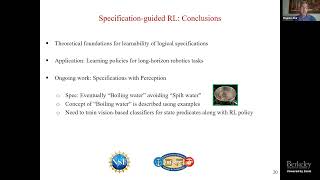
Specification-guided Reinforcement Learning
Explore specification-guided reinforcement learning techniques for synthesizing models and systems, presented by Rajeev Alur from the University of Pennsylvania.
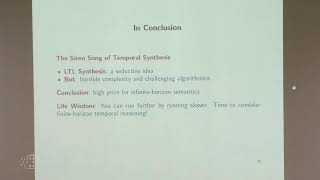
Linear Temporal Logic - From Infinite to Finite Horizon
Explore finite-horizon temporal synthesis in Linear Temporal Logic, its algorithmic advantages, and applications in reactive synthesis and infinite-horizon reasoning.
Synthesis of Privacy-Preserving Systems
Explore privacy-preserving system synthesis, addressing hidden signals, budget constraints, and incomplete information while satisfying specifications and protecting secrets.
Descriptive Complexity for Distributed Computing and Neural Networks
Explore logics capturing distributed computing and neural network models, including graph neural networks. Dive into game-theoretic semantics and computational logic connections.
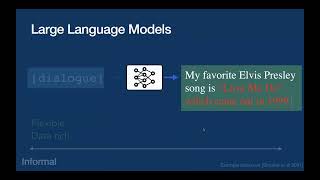
Bridging Informal and Formal Mathematical Reasoning with Neural Language Models
Explore neural language models for mathematical reasoning, bridging informal and formal approaches through NaturalProver and Draft, Sketch, and Prove techniques.
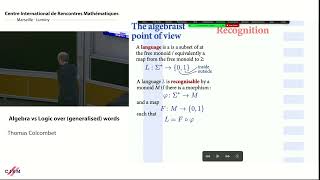
Algebra vs Logic over Generalized Words
Explore algebraic and logical perspectives on generalized words, comparing approaches and examining key concepts in discrete mathematics and theoretical computer science.
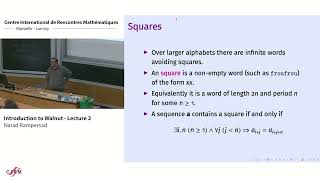
An Introduction to Walnut - Lecture 2
Explore Walnut, a tool for automata-based proofs in number theory and combinatorics. Delve into advanced techniques and applications in this comprehensive mathematical lecture.
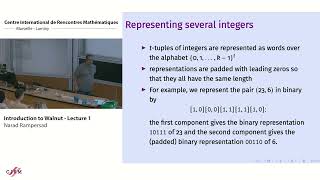
An Introduction to Walnut - Lecture 1
Explore Walnut, a tool for automata-based decision procedures in number theory and combinatorics on words. Learn its applications and fundamental concepts.
Definition and Content in Frege's Logic - OCIE Seminar
Explore Frege's logic, focusing on definition's role in mathematics. Examine key concepts, including cardinal number definition and its implications for logicism, conservativity, and Russell's Paradox.
Queering Consequence: A Framework for Liberatory Logics
Explore gender critical kinds and their impact on logical revision, examining feminist approaches and technical implications for developing gender critical logical frameworks.
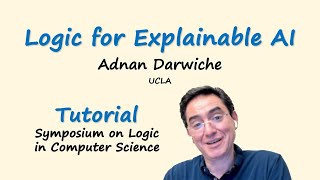
Logic for Explainable AI - Tutorial
Explore a comprehensive theory of explainable AI using symbolic logic, covering necessary and sufficient conditions for decisions, minimal perturbations, and applications to various classifier types.
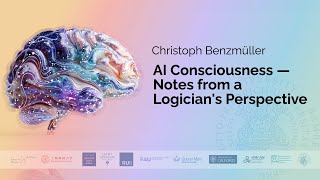
AI Consciousness - Notes from a Logician's Perspective
Explore logical self-reflection in AI systems through the LogiKEy framework, examining how logical formalisms can analyze their own consistency using nested embeddings in higher-order logic.
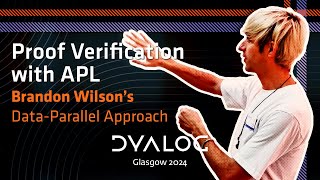
Data Parallel Proof Verification in APL - Using Metamath for Mathematical Databases
Discover how APL enables data-parallel verification of mathematical proofs using Metamath, exploring formal verification methods, proof structures, and efficient processing of large mathematical databases.
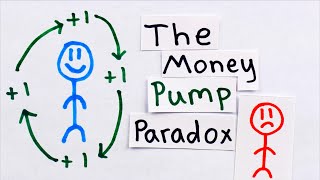
The Paradox of Intransitive Preferences in Rational Choice Theory
Explore the fascinating concept of intransitive preferences in rational choice theory, examining the money pump paradox and its implications for mathematical decision-making models.