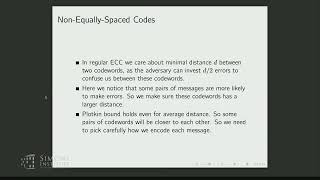
Binary Codes with Resilience Beyond 1/4 via Interaction
Explore advanced error-correcting codes for two-way communication, achieving resilience beyond 1/4 corruptions with constant rate and minimal receiver interaction.
Signal, if You Can't - Error Correction in Fully Corrupted Networks
Explore signaling methods for performing computations in asynchronous networks with corrupted messages, focusing on error-correction techniques for damaged transmissions.
Gilbert and Varshamov Meet Johnson - List Decoding Nearly-Optimal Binary Codes
Explore advanced error-correcting codes, focusing on Ta-Shma's breakthrough and improved list-decoding algorithms that approach the Johnson bound for binary codes with optimal distance and rate.
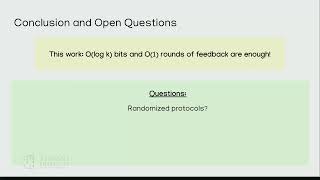
Binary Error Correcting Codes with Minimal Noiseless Feedback
Explores optimal constructions and lower bounds for limited feedback error-correcting codes, improving upon classical models for both error and erasure settings.
List Decoding of Tanner and Expander Amplified Codes
Explore advanced error-correcting code techniques, focusing on list decoding for Tanner and expander amplified codes, with insights from Shashank Srivastava's research.
How Work Works and Other Curiosities - Exploring Software Engineering Principles
Explore the science behind effective software engineering practices, from team structures to microservices, using insights from information theory and complexity science to optimize value delivery.
Back to the Future: The Evolution of Coding Theory Through Reed Muller Codes
Explore the evolution of coding theory through Reed Muller codes, from sphere packing to iterative algorithms and quantum computing applications.
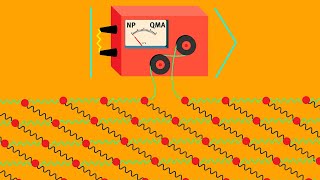
Logical Quantum Processor Based on Reconfigurable Atom Arrays
Explores advancements in quantum computing using neutral atom arrays, demonstrating improved error correction and logical qubit processing for enhanced algorithmic performance.
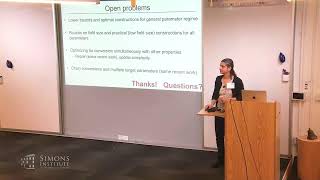
Convertible Codes: Adaptive Coding for Large-Scale Data Storage
Explore adaptive coding techniques for efficient data storage, focusing on locally repairable convertible codes that offer protection against failures and flexibility in modifying parameters over time.
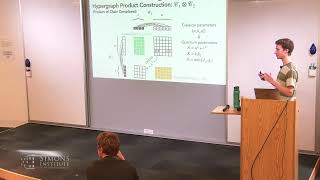
Introduction to qLDPC Codes
Explore quantum low-density parity-check codes, their applications in quantum error correction, and recent advancements in the field of quantum coding theory.
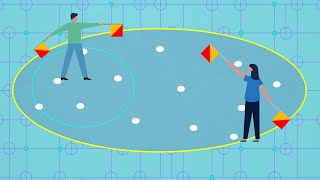
Higher Order MDS Codes - Advances in Error-Correcting Code Theory
Explore advanced concepts in error-correcting codes, focusing on Higher Order MDS Codes and their applications in data integrity and communication systems.
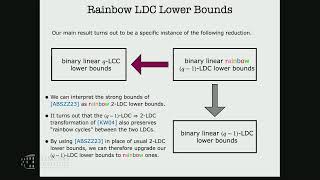
Near-Tight Bounds for 3-Query Locally Correctable Binary Linear Codes via Rainbow Cycles
Explores advanced bounds for 3-query locally correctable binary linear codes, improving previous results using rainbow cycles in edge-colored graphs and covering radius of dual codes.
Noise, Complexity, and Information Dynamics in Quantum Circuits - IPAM at UCLA
Explores noise propagation in quantum systems, introducing an information dynamics framework and presenting a classical algorithm for simulating noisy quantum circuits efficiently.
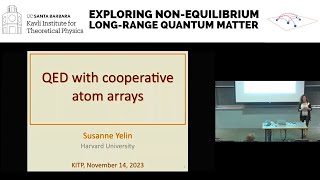
QED with Cooperative Atom Arrays and Applications - Susanne Yelin
Explore quantum electrodynamics with cooperative atom arrays, focusing on applications and recent advancements in quantum many-body systems with long-range interactions.
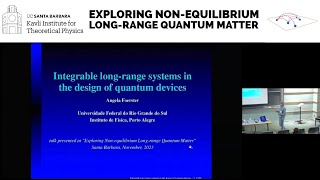
Design of Integrable Long-Range Quantum Devices - Angela Foerster
Explore the design of integrable long-range quantum devices in this talk by Angela Foerster, covering novel phases and out-of-equilibrium phenomena in quantum many-body systems with long-range interactions.
How Did Life Arise from Increasing Entropy?
Explores how life and evolution align with increasing entropy, discussing energy dissipation, complexity formation, and the potential physics behind life's origins in the universe.

The Startling Reason Entropy and Time Only Go One Way
Explore the fascinating connection between entropy, probability, and the unidirectional flow of time. Discover why natural phenomena tend towards lower energy states and how this relates to the universe's increasing disorder.
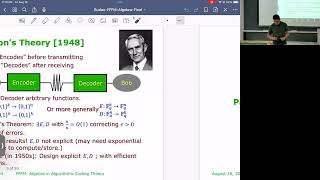
Algebra in Algorithmic Coding Theory
Explore algebraic techniques in algorithmic coding theory, focusing on error-correcting codes and their applications in computer science and information theory.
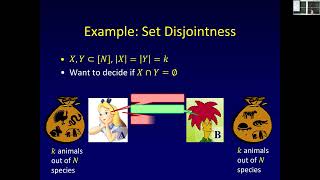
Communication and Information Complexity
Explore the intersection of communication and information complexity with Princeton's Mark Braverman, delving into cutting-edge research and theoretical advancements in this field.
Review of Classical and Quantum Information Theory - Lecture 1
Explore classical and quantum information theory foundations in this lecture, covering key concepts and their applications in modern physics and computing.
Review of Classical and Quantum Information Theory - Lecture 3
Explores advanced concepts in classical and quantum information theory, focusing on their applications in quantum gravity and many-body physics. Ideal for researchers in theoretical physics and quantum computing.