Coding for DNA Storage with Nanopore Sequencing
Explore theoretical foundations for synthetic DNA data storage using nanopore sequencing, including channel models, noise characteristics, and coding schemes for practical archival applications.
Low-Density Parity-Check Codes and Spatial Coupling for Quantitative Group Testing
Explores sparse codes-on-graphs for quantitative group testing, proposing LDPC codes with single parity-check codes and spatial coupling. Analyzes performance improvements and compares schemes through density evolution.
Mackay-Neal Codes for High-Speed Wireless and Free-Space Optical Links
Explores rate-adaptive MacKay-Neal codes using protographs and distribution matchers for flexible, high-performance wireless and optical communication systems, achieving near-Shannon limit performance across various rates.
Non-binary LDPC Codes for Information Reconciliation in QKD Protocols
Explore new channel coding techniques for decentralized storage systems with adversarial nodes, focusing on non-binary LDPC codes in quantum key distribution protocols.
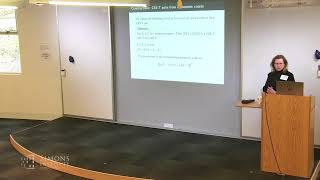
Binary CSS-T Codes: Characterizations and Posets
Explore characterizations and posets of binary CSS-T codes, delving into their mathematical properties and applications in coding theory.
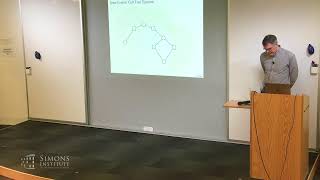
Dynamic Denoising for AMP Applied to Sparse Regression Inner Codes with Outer Codes
Explores dynamic denoising in AMP for sparse regression codes with outer codes, discussing performance improvements, state evolution approximations, and extensions to multi-user scenarios and multiple measurement vectors.
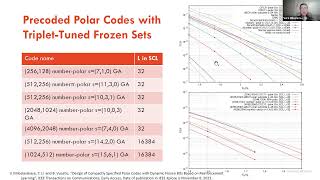
Precoded Polar Codes With High Error-Correction Capability
Explore recent advancements in precoded polar codes, focusing on low-complexity design, high error-correction capability, and efficient decoding for improved communication systems.
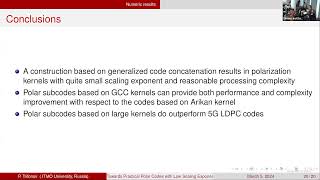
Towards Practical Polar Codes with Low Scaling Exponent
Explore advanced techniques for improving polar codes, focusing on reducing scaling exponents and enhancing practical implementations in coding theory.
Maximizing Mutual Information in Flash Memories
Explores optimizing Flash memory performance through mutual information maximization, focusing on LDPC codes and device longevity in the context of multi-bit cell storage and read operations.
Construction and Decoding of Short Codes
Explore advanced techniques for constructing and decoding short-length codes, including staircase matrix codes, ordered statistic decoding, and innovative algorithms for polar codes.
Parameterized Inapproximability of the Minimum Distance Problem over All Fields
Explores inapproximability of Minimum Distance Problem for linear codes over finite fields, proving W[1]-hardness. Extends results to Shortest Vector Problem on integer lattices.
List-Decoding Random Code Ensembles - Advances in Error-Correcting Codes
Explore advanced error-correcting code theory, focusing on list-decoding techniques for random code ensembles. Gain insights into cutting-edge research in coding theory.
An Exponential Lower Bound for Linear 3-Query Locally Correctable Codes
Explores exponential lower bounds for linear 3-query locally correctable codes, improving previous results and approaching best-known constructions. Discusses implications for error-correcting codes and related conjectures.
Fast List-Decoding of Univariate Multiplicity and Folded Reed-Solomon Codes
Explore advanced techniques for efficient list-decoding of Reed-Solomon codes, focusing on univariate multiplicity and folded variants in error-correcting code theory.
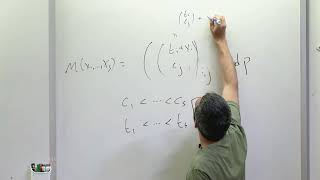
Tree Codes - Advances in the Theory of Error-Correcting Codes
Explore error-correcting codes and their theoretical advancements, focusing on tree codes and their applications in communication systems.
Relaxed Local Correctability from Local Testing
Explore relaxed locally correctable codes with polylogarithmic query complexity, bridging the gap between lower and upper bounds using locally testable codes at multiple scales.
Coding Theory in Almost Linear Time and Sublinear Space
Explore efficient error-correcting codes with near-linear time and sub-linear space encoding/decoding algorithms. Learn about innovative techniques in hashing, locally correctable codes, and derandomization.
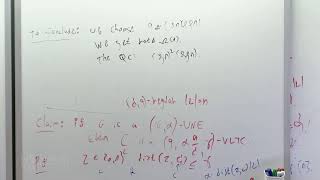
Asymptotically-Good RLCCs with (log n)^{2+o(1)} Queries
Explore asymptotically good relaxed locally correctable codes with improved query complexity, advancing error-correcting code theory through novel techniques and insights.
Codes with the Multiplication Property - Advances in Error-Correcting Codes Theory
Explore error-correcting codes with multiplication properties, focusing on recent advancements and theoretical implications in coding theory.
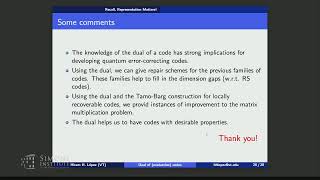
Dual of Evaluation Codes in Error-Correcting Theory
Explore the mathematical concept of dual codes in error correction, focusing on evaluation codes and their properties in coding theory.
Constant Query Local Decoding Against Deletions Is Impossible
Explores impossibility of constant query locally decodable codes in deletion settings, contrasting with substitution errors. Proves non-existence, impacting error-correcting code theory.