Accelerating AI and ML: Architectures and Systems for Efficient Computing
Exploring domain-specific accelerators for AI/ML, focusing on high-performance computing solutions and innovative frameworks to optimize large-scale distributed deep learning systems.
Cool Genes - Using Genomics and Big Data for Disease Research with Docker
Explore genomics and big data in medical research using Docker. Learn how TGen leverages containerization for bioinformatics workloads, managing large-scale compute clusters to accelerate disease understanding and treatment discovery.
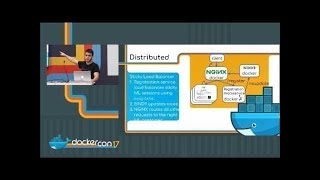
Auto-scalable Microservices for Machine Learning - UnifyID Case Study
Scaling Machine Learning backend for 1M+ users: GPU-intensive computations, containerization on EC2, horizontal scaling, uniform API for ML microservices, and addressing production deployment challenges.
From Arm to Z - Building, Shipping, and Running a Multi-platform Docker Swarm
Learn to build, deploy, and run multi-architecture Docker services using manifest lists, emulation, and heterogeneous Swarms. Gain practical skills for creating cross-platform applications and managing diverse CPU architectures.
Introducing OpenHPC Cross Platform Provisioning Assembly for Warewulf
Explore OpenHPC's cross-platform provisioning assembly for Warewulf, enhancing HPC cluster management and deployment across diverse hardware environments.
High Performance NVMe Offloading in SPDK Using the New vfio-user Protocol
Explore high-performance NVMe offloading techniques in SPDK utilizing the innovative vfio-user protocol, enhancing storage efficiency and performance in modern data centers.
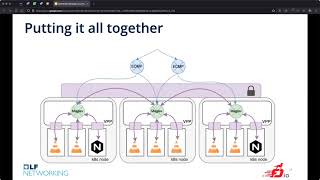
Calico/VPP: High-Performance Kubernetes Networking - LFN Webinar
Explore high-performance Kubernetes networking by combining Calico and VPP for line-rate speeds, enabling advanced capabilities for demanding workloads like big data, 5G, and virtual network functions.
Swing - Short-cutting Rings for Higher Bandwidth Allreduce
Innovative algorithm enhances allreduce performance on torus networks, reducing communication hops and improving bandwidth by up to 3x for various data sizes and network configurations.
MegaScale - Scaling Large Language Model Training to More Than 10,000 GPUs
Innovative system for training large language models on 10,000+ GPUs, addressing efficiency and stability challenges through full-stack optimization and advanced diagnostic tools.
Resiliency at Scale: Managing Google's TPUv4 Machine Learning Supercomputer
Explore Google's TPUv4 supercomputer infrastructure, focusing on fault resiliency, dynamic reconfiguration, and high system availability for machine learning training at massive scale.

Fine-tuning LLMs 30x Faster - Unsloth AI's Approach
Discover techniques to accelerate LLM fine-tuning 30x with Daniel Han from Unsloth AI. Explore bug-hunting processes, optimization strategies, and insights into ML research reproducibility.

Optimizing a Ray Tracer by Building a Bounding Volume Hierarchy (BVH)
Optimize ray tracing performance by building a Bounding Volume Hierarchy (BVH). Learn techniques like GPU-friendly data structures, iterative traversal, and surface area heuristics to render complex scenes efficiently.
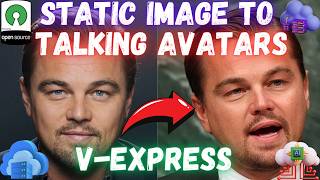
V-Express AI Talking Avatar Generator Tutorial - Cloud Installation and Usage Guide
Learn to use V-Express, an open-source tool for creating AI-powered talking avatars from static images. Covers installation and usage on various cloud platforms, including Massed Compute, RunPod, and Kaggle.
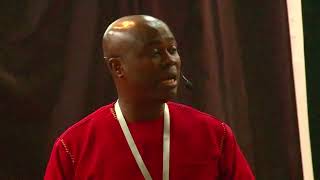
Romancing with AI - An Overture to a Symbiotic Future
Exploring AI's transformative potential in Ghana, addressing fears, and emphasizing ethical development for sectors like agriculture, healthcare, and education. Introduces innovative solutions and advocates for inclusive governance.

Fine-Tuning Llama 3 on a Custom Dataset for RAG Q&A - Training LLM on a Single GPU
Learn to fine-tune Llama 3 on custom datasets for improved LLM performance in specific tasks, using a single GPU. Covers dataset preparation, model setup, training, and evaluation.
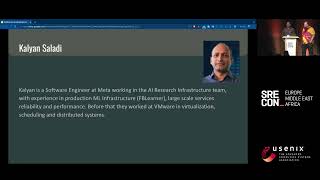
Building a 5-Exaflop Supercomputer for Meta-AI Research and Large-Scale Model Training
Explore the architecture, construction, and operation of Meta's 5-exaflop AI Research SuperCluster, supporting large-scale model training with insights on monitoring and observability for cutting-edge AI development.
The Future of AI: LLMs, AGI, and Beyond - Part 2
Exploring AI's evolution, LLMs, and AGI with insights on enterprise adoption, vector databases, and the interplay of art and technology. Delves into key concepts shaping AI's future trajectory.
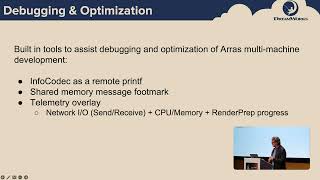
Arras - MoonRay's Distributed Computational Framework for Ray-Trace Rendering
Explore Arras, a scalable framework enabling distributed computations for ray-trace rendering. Learn how it enhances MoonRay's capabilities, allowing for unlimited computational power and accelerating processor-intensive operations in film production.
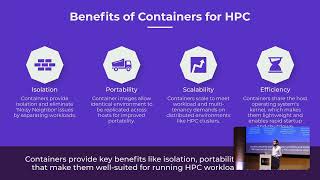
HPC with Containers on Ubuntu - Enroot and Pyxis Implementation
Learn to install and configure Enroot and Pyxis for running containerized applications on Slurm clusters, simplifying HPC workflows and enabling Ubuntu-based containers across diverse infrastructures.

Breaking Down Barriers to High-Performance Computing
Exploring initiatives to enhance Ubuntu for scientific computing and HPC, discussing open-source projects, promoting wider adoption, and addressing challenges in the HPC ecosystem.
Shrinking Deep Learning Models: Techniques and Energy Considerations
Explore techniques to shrink deep learning models, reduce energy consumption, and run advanced architectures on commodity hardware. Gain insights into model efficiency and accessibility.