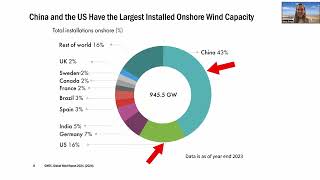
The Most Important Things You Need to Know About Wind Energy
Comprehensive overview of wind energy: technology, economics, environmental impacts, and future prospects. Gain insights into this renewable energy source's significance and potential.
Underactuated Robotics - Spring 2009
This course discusses nonlinear dynamics and control of underactuated mechanical systems, with an emphasis on machine learning methods.
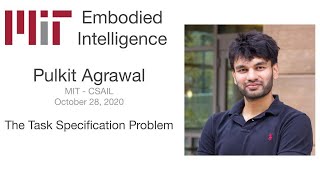
The Task Specification Problem
Exploring challenges in AI task specification, focusing on aligning human communication with machine understanding to improve robustness, transfer, and feature learning in AI systems.
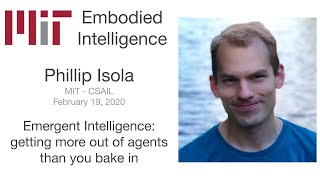
MIT EI Seminar - Phillip Isola - Emergent Intelligence- Getting More Out of Agents Than You Bake In
Explore emergent intelligence in AI through unsupervised learning, generative modeling, and self-assembling agents. Discover surprising outcomes beyond explicit programming in representation, video generation, and creature development.
EI Seminar - Recent Papers in Embodied Intelligence
Explore cutting-edge research in embodied intelligence, covering topics like experiment design, neuro-symbolic models, robot design, speech recognition, and social perception.
Introduction to EECS I
Integrated introduction to electrical engineering and computer science, covering software engineering, linear systems, electronic circuits, and decision-making through lectures and recitations.

Fundamentals of Photovoltaics, Fall 2011
Comprehensive exploration of photovoltaic fundamentals, covering solar resources, cell design, materials, manufacturing, efficiency, economics, and advanced concepts in renewable energy technology.

On Building General, Zero-Shot Robot Policies - EI Seminar
Explore the development of zero-shot robot policies for real-world tasks. Gain insights into Robot Utility Models (RUMs) and their ability to generalize to new environments without finetuning, achieving 90% success in novel settings.

Building an 8-Bit Breadboard Computer
Learn to build an 8-bit computer from scratch using breadboards, covering clock design, registers, ALU, RAM, program counter, and CPU control logic. Gain hands-on experience in digital electronics and computer architecture.
Engineering Graduate Symposium: 3 Minute Thesis Competition
Engineering graduate students present their research in 3-minute talks, competing for prizes. Event includes keynote addresses and judging based on comprehension, content, engagement, and communication skills.
Harmony: Chords and How to Build Them - Lecture 7
Explore harmony in Western music: chord formation, progressions, and modulation. Develop listening skills to identify harmonic changes across diverse musical styles.

Global Climate and the Coriolis Force - Lecture 13
Explore Earth's atmospheric circulation, Coriolis force, and geostrophic balance. Understand climate dynamics, cloud patterns, and the impact of Earth's rotation on global weather systems.

Introduction to Atmospheres - Earth's Climate System
Explore Earth's climate system through atmospheric and oceanic studies, with a focus on Hurricane Irene's impact and the fundamental nature of our atmosphere.
Vertical Structure of the Atmosphere and Residence Time - Lecture 4
Explore atmospheric layers, their properties, and interactions with solar radiation. Learn about ocean and Earth layers, systems analysis, and the hydrologic cycle's residence time.
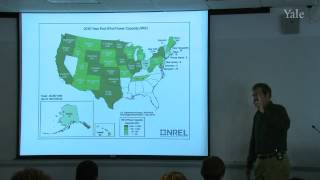
Renewable Energy Sources: Wind, Solar, Biomass, and Geothermal
Explore wind, solar, biomass, and geothermal energy sources, their technologies, and applications. Learn about electricity generation methods and the potential of renewable energy in addressing environmental challenges.
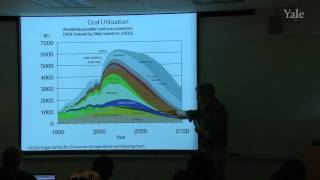
Energy Resources and Renewable Energy - Lecture 33
Explora recursos energéticos actuales, incluyendo carbón, petróleo, gas natural, energía nuclear e hidroeléctrica. Analiza su uso, impacto ambiental y tendencias futuras en la producción de energía.

Renewable Energy Policies and Challenges - Lecture 23
Explores renewable energy policies, focusing on wind power challenges and benefits. Examines the Cape Wind project, addressing siting issues, environmental impacts, and property rights conflicts.

Past and Future of Nuclear Power - Lecture 22
Explores nuclear energy's global impact, risks, and challenges, including waste storage, proliferation, and disasters like Chernobyl, while comparing it to coal-fired plants' risks.

Critiquing LEED Certification: Design and Green Architecture - Lecture 21
Explore the LEED certification system's strengths and limitations in green building, examining energy efficiency, environmental health, and the role of non-profit organizations in architectural standards.

England, Britain, and the World - Economic Development 1660-1720
Explore Britain's economic boom (1660-1720): agricultural specialization, urbanization, overseas trade expansion, manufacturing growth, and the emergence of a national market economy.

Biomechanics and Locomotion in Biomedical Engineering - Lecture 19
Explore biomechanics of various modes of motion, from flight to walking, and their applications in biomedical engineering, including artificial hip design and efficient locomotion.