
Investment Banking: Principles, Regulation, and Career Paths - Lecture 19
Explore investment banking principles, regulations, and career paths with insights from industry experts. Gain understanding of shadow banking, repo markets, and Wall Street's role in the financial crisis.

Economic Motivations for Fertility - Lecture 19
Explore economic factors influencing fertility rates, including children as goods, education's role, and modernization's impact on family planning decisions and resource allocation.

Human and Environmental Impacts of Population Growth
Explore population growth's impact on the environment and global economy, examining overconsumption, poverty, and the challenges of balancing development with sustainability.
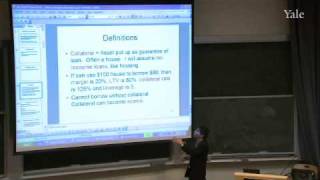
The Leverage Cycle and the Subprime Mortgage Crisis - Financial Theory
Explore the Leverage Cycle theory and its role in the 2007-09 financial crisis. Learn how collateral requirements impact asset prices and contrast this with traditional financial theories.
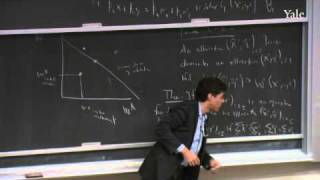
Efficiency, Assets, and Time in Financial Theory
Explore economic theories justifying free markets, from utility maximization to Pareto efficiency, and examine the introduction of time and assets into equilibrium models by Irving Fisher.

Computing Equilibrium in Financial Theory - Lecture 3
Explore economic decision-making through equilibrium calculations in simple and financial economies, using theoretical and computational methods to understand market dynamics and agent behavior.

Utilities, Endowments, and Equilibrium in Financial Theory - Lecture 2
Explore economic modeling, supply and demand, and general equilibrium theory. Understand the importance of models in economics and their application to various markets and financial systems.
Introduction to Financial Theory - Why Study Finance?
Explore financial theory's history, efficient markets hypothesis, leverage cycle, and real-world applications through lectures and experiments. Gain insights into the field's relevance and limitations.

Institutions and Incentives in Mortgages and Mortgage-Backed Securities
Exploración histórica y análisis de crisis financieras, enfocándose en el mercado hipotecario. Se examinan datos recientes y se evalúan las causas de la crisis económica actual.
Marx and Schumpeter on Capitalism's Dynamic Nature - Lecture 4
Explore Marx and Schumpeter's theories on capitalism's constant evolution, critiquing Marxist ideas and examining creative destruction through historical examples of technological revolutions.

Thomas Malthus and the Theory of Inevitable Poverty - Lecture 2
Explore global economic development, demographic transitions, and their impact on poverty. Analyze Malthus' theories and modern perspectives on population growth and economic progress.

Game Theory: Understanding Others' Perspectives and Strategic Decision-Making - Lecture 2
Explore game theory concepts like dominant strategies, rationality, and common knowledge through real-world examples. Gain insights into strategic decision-making and player interactions.
Nash Equilibrium - Bad Fashion and Bank Runs - Game Theory Lecture 5
Explore Nash equilibrium, its applications, and coordination problems in game theory. Learn how communication can solve issues in social settings and investment scenarios.

Mixed Strategies in Game Theory - Applications in Sports, Dating, and Taxation
Explore mixed strategies in game theory through real-world examples like sports, dating, and taxes. Learn three interpretations and their implications for decision-making and policy applications.
Backward Induction: Chess, Strategies, and Credible Threats in Game Theory - Lecture 15
Explore game theory concepts like Zermelo's theorem, perfect information, and Nash equilibria in sequential games. Learn about backward induction and its implications for strategic decision-making.

Repeated Games: Cheating, Punishment, and Outsourcing - Game Theory Lecture 22
Explores game theory in repeated interactions, focusing on strategies for maintaining cooperation, punishment mechanisms, and applications to business relationships and moral hazard problems.

Introduction to Game Theory - Strategies, Payoffs, and Strategic Thinking
Explore game theory fundamentals through interactive play, learning strategic thinking, decision-making, and real-world applications. Understand key concepts like dominant strategies and coordination problems.

Evolutionary Stability: Cooperation, Mutation, and Equilibrium in Game Theory - Lecture 11
Explore evolutionary stability in game theory, examining cooperation, mutation, and equilibrium concepts. Learn how biological strategies relate to economic principles like Nash equilibrium and domination.

Nash Equilibrium - Location, Segregation and Randomization in Game Theory
Explore game theory concepts like Nash equilibrium, segregation, and mixed strategies through candidate-voter models, Schelling's location game, and rock-paper-scissors, revealing how individual choices impact societal outcomes.

Sequential Games: Moral Hazard, Incentives, and Backward Induction
Explore sequential games, moral hazard, and incentive design through borrower-lender scenarios. Learn backward induction, commitment strategies, and their applications in game theory.
Best Responses in Game Theory - Soccer Penalties and Business Partnerships
Explore game theory concepts through soccer penalty kicks and business partnerships, focusing on best responses and introducing Nash Equilibrium.