Mean Field Games and Smart Grids - Distributed Control Solutions for the Future Power Network
Explore mean field games for distributed control in smart grids, covering energy arbitrage, thermostatically controlled loads, and transmission expansion planning. Gain insights into optimizing future power networks.
Role of Flexible Demand Technology in Modern Electricity Markets - A Game-Theoretic Perspective
Explores flexible demand technology's role in modern electricity markets using game theory, focusing on decarbonization challenges, system benefits, and impacts on market dynamics and investment planning.
Managing Grid Frequency Using Noisy On-Off Appliances - Simon Tindemans, Imperial
Explore innovative techniques for managing grid frequency using household appliances, focusing on flexible refrigeration and stochastic balancing in power systems.
An Optimization Perspective on Mean-Field Games - Wei Zhang, Ohio State University
Explore mean-field games from an optimization perspective, covering theory, applications in energy and environment, and connections to distributed optimization problems.

Cost and Coverage in Genomic Testing Medicine - Economic Perspectives
Explore economic evaluation methods, payer perspectives, and implications for genomic technology adoption in healthcare, focusing on cost-effectiveness analysis and coverage decisions for genetic testing.
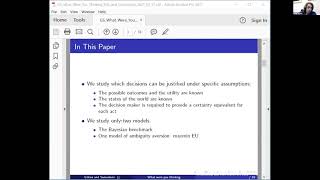
What Were You Thinking? Decision Theory as Coherence Test - Prof. Itzhak Gilboa
Explore decision theory as a coherence test, examining assumptions, Bayesian justification, and geometric interpretation. Gain insights into max mean expected utility and practical applications.
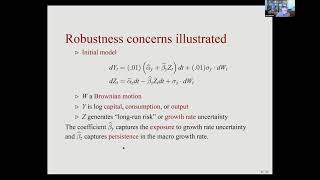
Uncertainty Spillovers for Markets and Policy - Prof. Lars Hansen
Exploring uncertainty's impact on financial markets and economic policy design, focusing on long-term growth limitations and climate change implications through decision theory and uncertainty quantification methods.
Should Currency Be Centralized? - Macroeconomics Made Clear
Explore the debate between centralized and decentralized currency, examining the roles of cryptocurrencies and central banks in shaping economic systems and their impacts on transparency, stability, and public interests.
Mechanism Design with Limited Commitment
Explore dynamic mechanism design with limited commitment, focusing on direct Blackwell mechanisms and their applications in pricing, bargaining, and product personalization.

The Hacker Army: Protecting Your Data Through Bug Bounty Programs
Explore how ethical hackers form a global freelance security team, supporting internal teams through bug bounty programs and keeping us safer online in the face of cybersecurity challenges.
Equilibrium Computation and Machine Learning
Exploring the intersection of Game Theory and Machine Learning, focusing on equilibrium computation challenges and opportunities for advancing both fields.

The Math of Being a Greedy Pig - Numberphile
Explore the mathematics behind the dice game "Pig" with Ben Sparks. Learn optimal strategies, analyze probabilities, and discover the balance between risk and reward in this engaging mathematical exploration.
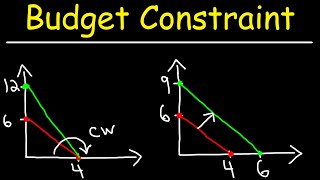
Budget Constraint, Opportunity Cost, and Law of Diminishing Marginal Utility
Explore key economic concepts: budget constraints, opportunity costs, and diminishing marginal utility. Learn to analyze consumer choices and maximize utility within financial limitations.
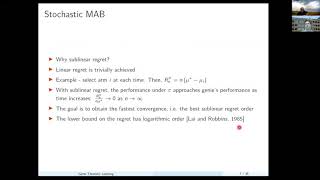
Game Theoretic Learning and Spectrum Management - Part 2
Explore game theory in signal processing, covering multi-arm bandits, adaptive algorithms, and reinforcement learning for spectrum management and network optimization.

Algorithms for Rank-1 Bimatrix Games
Explore algorithms for solving rank-1 bimatrix games efficiently, including polynomial-time methods for finding Nash equilibria and path-following techniques. Discusses complexity, uniqueness, and parameterized approaches.
Introduction to NetLogo by Bill Rand
Learn agent-based modeling with NetLogo to simulate complex systems, explore emergence, and understand when to use ABM for research in social sciences and economics.
Where Does the Statistics of Complex Systems Come From?
Explore the origins of complex systems statistics through sample space reducing processes, Zipf's law, and network diffusion. Gain insights into driven non-equilibrium systems and their statistical properties.

Analysis of Mean-Field Games - Lecture 1
Explore static mean-field games, Nash equilibria, and convergence theorems in large symmetric systems. Learn key concepts and proofs in this advanced applied probability lecture.
Inventing Wellness Programs That Work
Explore innovative wellness programs that effectively address complex health challenges, considering social, economic, and psychological factors for comprehensive solutions.
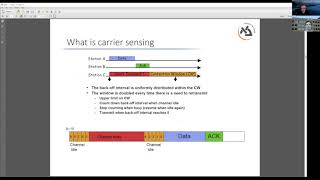
Game Theoretic Learning and Spectrum Management - Part 3
Explore advanced concepts in game theoretic learning and spectrum management, focusing on signal processing applications and cutting-edge research developments.
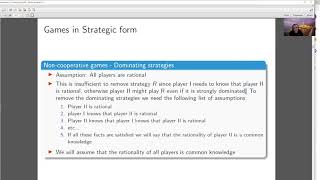
Game Theoretic Learning and Spectrum Management - Part 1
Explore game theoretic learning and spectrum management principles with experts Amir Leshem and Kobi Cohen in this IEEE Signal Processing Society presentation.