Containerization and Orchestration of RISC-V Architectures for Edge-Cloud Computing
Explore containerization and orchestration implementation on RISC-V systems through KubeEdge-V, examining performance metrics and comparing with ARM-based equivalents for edge-cloud computing solutions.
The Amazing Trace: Enhancing Distributed WebAssembly with OTEL
Explore how OTEL tracing enhances distributed WebAssembly in wasmCloud, improving observability and debugging for developers in complex distributed systems.
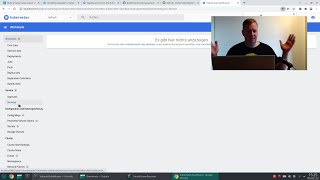
Build a Kubernetes Cloud-Computing Cluster on Raspberry Pi
Learn to set up a Kubernetes cluster for cloud computing using Raspberry Pis and Ubuntu Server, enabling hands-on experience with distributed systems and containerization.
Accelerate Your GenAI Model Inference with Ray and Kubernetes
Explore serving large GenAI models efficiently using KubeRay on Kubernetes with hardware accelerators. Learn to scale workloads, optimize performance, and reduce costs for production-ready AI inference.
Cloud-Based Generative AI Supporting Preliminary Engineering Design
Optimize engineering design with cloud-based generative AI. Learn how Rolls-Royce and Databricks reduced cGAN training time by 30x using distributed computing, MLflow, and Unity Catalog for aerospace compliance.
Scaling RAG and Embedding Computations with Ray and Pinecone
Learn to efficiently scale retrieval augmented generation using Ray Data and Pinecone, enabling rapid embedding generation for LLM applications with distributed processing and vector database integration.
Scheduling Array Operations for GPU and Distributed Computing
Explore array operation scheduling for optimized execution across hardware. Learn about static scheduling, type theory, and parallelization for GPUs and distributed computing.
Predicting and Preventing Chaos with Formal Methods in TLA+ - Lambda Days 2022
Explore formal methods in TLA+ to predict and prevent chaos in distributed computing. Learn how to design robust systems beyond untestable whiteboard drawings and ad-hoc scripts.
Federated Automatic Differentiation - Seminar 96
Explore advanced concepts in federated automatic differentiation with Google researcher Zachary Charles, covering innovative approaches to distributed machine learning and privacy-preserving computation.
A Bayesian Approach for Personalized Federated Learning - Seminar 93
Discover how Bayesian approaches enhance personalized federated learning through innovative statistical methods and practical applications in distributed machine learning environments.
Leveraging Spatial and Temporal Correlations in Distributed Learning - Seminar 91
Explore advanced distributed learning techniques focusing on spatial and temporal correlations, with insights into FedAvg algorithm, client participation, and optimization strategies.
How to Make Your CPU as Fast as a GPU - Advances in Sparsity with Nir Shavit
Explore advances in sparsity and how CPUs can match GPU performance in neural networks. Learn about pruning, efficient algorithms, and the future of sparse architectures in deep learning.

Scaling AI Applications with Ray - Richard Liaw & Eric Liang | ODSC East 2019
Explore Ray, a distributed execution engine for AI workloads. Learn about Tune for hyperparameter optimization and RLib for reinforcement learning, with insights on scalability and practical applications.
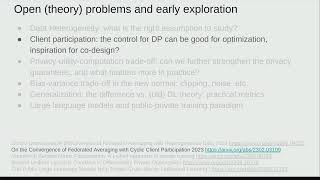
Federated and Collaborative Learning - Session 2
Explore cutting-edge research in federated learning, collaborative AI, and privacy-preserving data analysis with expert talks on fast mean estimation and stable covariance techniques.
Distributed Computing through Combinatorial Topology
Explore distributed computing through combinatorial topology, learning key concepts and their applications to solve distributed problems using algebraic topology techniques.
Topology of Complexes Arising in Models for Distributed Computing
Explore simplicial models in distributed computing, focusing on chromatic subdivisions and their applications to problems like Weak Symmetry Breaking, leading to new mathematical questions.
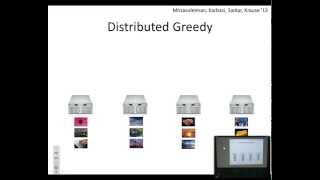
The Power of Randomization - Distributed Submodular Maximization on Massive Datasets
Explore distributed algorithms for submodular maximization in machine learning, focusing on a parallel approach that achieves constant factor approximation guarantees for large-scale problems.
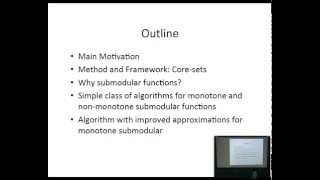
Randomized Composable Core-Sets for Submodular Maximization
Explores randomized composable core-sets for distributed submodular and diversity maximization, presenting improved algorithms and analysis techniques for big data optimization problems.

PyTorch and COVID-19 Research: Advancements in AI and Data Analysis - Keynotes
Explore PyTorch's advancements in machine learning and learn how AI is helping manage COVID-19 research data, featuring insights on industry adoption and scientific information accessibility.
Federated and Collaborative Learning - Session 3
Explore cutting-edge advancements in federated and collaborative learning, including local training methods, online learning with bandit feedback, and insights from leading researchers in the field.
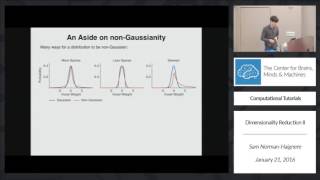
Dimensionality Reduction II
Explore advanced dimensionality reduction techniques, including PCA and negentropy, with practical applications in brain and cognitive sciences. Includes exercises and research discussions.