From Data Engineering to MLOps: Building a Scalable ML Platform - Reverb's Evolution
Discover how Reverb transformed their data engineering team into MLOps, exploring scalable ML platform development, developer experience optimization, and effective monitoring strategies using Ray and Anyscale.

Scaling LLMs on Google Cloud - Synergy Between Ray, TPU, and GKE
Discover how to optimize LLM deployments using Ray, TPUs, and GKE on Google Cloud, focusing on performance optimization, memory management, and large-scale orchestration techniques.
KubeSecRay - Fortifying Multi-Tenant Ray Clusters on Kubernetes
Discover how to secure multi-tenant Ray clusters using KubeSecRay, implementing robust Kubernetes security features for isolation, access control, and resource management in distributed computing environments.

Distributed Mesh Processing and Geometric Deep Learning for Wind Prediction
Discover how Ray's distributed computing powers real-time wind prediction in urban design through mesh processing, geometric deep learning, and CFD data analysis for architectural innovation.
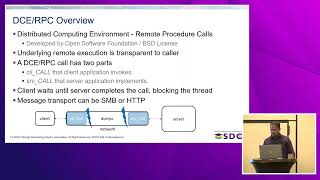
Making DCE/RPC Calls to Active Directory Time Bound Using SMB Redirector
Dive into implementing timeout mechanisms for DCE/RPC calls to Active Directory using SMB redirector, improving system reliability and handling network disruptions effectively.
Towards Collaborative Decentralized Learning
Explore cutting-edge decentralized learning concepts, from federated systems to Byzantine-robust training, with insights into collaborative and personalized optimization approaches.
Data Platform for End-to-End AI Democratization
Explore how data platforms enable AI democratization through unified processing and training architectures, improving efficiency for recommender systems and deep learning workloads.
Custom Chips Needed for Efficient High-Performance Computing
Explore the future of computing power through custom hardware solutions, from manycore systems to silicon development, addressing latency and energy efficiency challenges in high-performance computing.
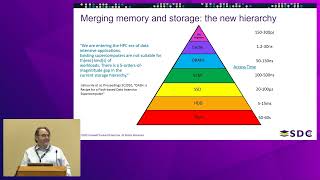
Fabric Attached Memory: Hardware and Software Architecture for HPC Systems
Explore hardware and software architecture of Fabric Attached Memory (FAM) in HPC clusters, focusing on large dataset management, CXL capabilities, and real-time analytics implementation using Arkouda.

LongNet: Understanding Transformer Scaling to 1 Billion Tokens - A Technical Overview
Dive into Microsoft's LongNet transformer architecture, exploring how dilated attention mechanisms enable processing of billion-token sequences and advance the field towards artificial general intelligence.

Multi-Agent AI Coordination and Pathfinding Using Cooperative Reward Shaping
Discover how multiple AI agents coordinate actions through Reinforcement Learning, from pathfinding algorithms to practical applications in transport, underwater networks, and space exploration.

Coding Multi-Agent Reinforcement Learning with PyTorch and JAX - Including ReDel and AgentScope Frameworks
Dive into practical multi-agent reinforcement learning implementation using PyTorch and JAX, featuring new frameworks ReDel and AgentScope for advanced distributed systems and LLM-powered simulations.

Understanding AI Agents - From Basic Concepts to Multi-Agent Systems
Explore AI agents from basic concepts to advanced implementations, covering memory systems, planning capabilities, tool usage, and multi-agent configurations with practical Python examples and real-time demonstrations.

On the Power of Quantum Distributed Proofs
Delve into quantum distributed computing research exploring dQMA protocols, proof size comparisons, and efficiency improvements in network verification systems and quantum communication complexity.
Online Locality Meets Distributed Quantum Computing
Explore the intersection of locally checkable labeling problems across quantum computing models, examining theoretical advantages and limitations in distributed systems and tree structures.
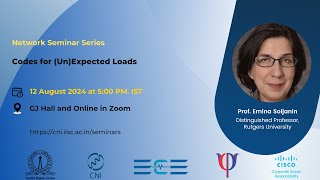
Codes for Unexpected and Expected Loads in Distributed Computing Systems
Explore coding theory applications in distributed computing systems, focusing on erasure coding's role in handling unpredictable data access patterns and optimizing storage efficiency.
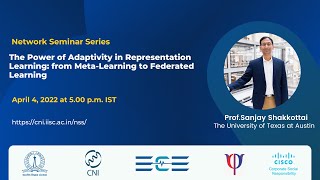
The Power of Adaptivity in Representation Learning - From Meta-Learning to Federated Learning
Delve into advanced machine learning concepts exploring adaptivity in representation learning, focusing on meta-learning and federated learning approaches for model deployment in new environments.
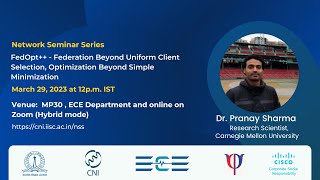
FedOpt++ - Federation Beyond Uniform Client Selection, Optimization Beyond Simple Minimization
Delve into advanced federated learning concepts, exploring cyclic client participation patterns and minimax optimization for distributed machine learning applications and theoretical frameworks.
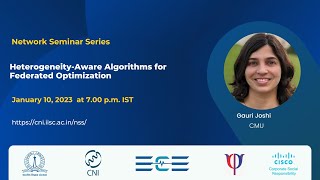
Heterogeneity-Aware Algorithms for Federated Learning and Distributed Optimization
Delve into advanced federated learning algorithms, focusing on heterogeneity challenges in distributed model training and innovative solutions for edge computing optimization.
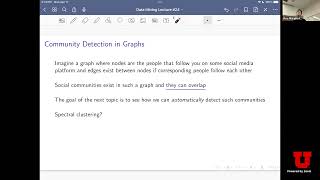
MapReduce and Distributed Computing for Data Mining - Spring 2023
Master distributed computing fundamentals through MapReduce, exploring cluster computing challenges, file systems, and practical applications like PageRank and community detection algorithms.
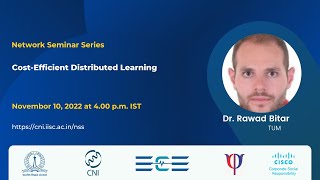
Cost-Efficient Distributed Learning
Discover strategies for optimizing distributed gradient descent algorithms by managing worker responses and implementing adaptive techniques to balance computational efficiency with model quality in machine learning systems.