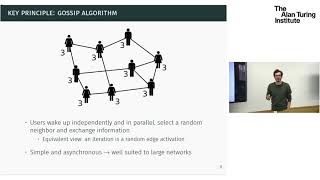
Privacy-Preserving Algorithms for Decentralised Collaborative Learning - Dr Aurélien Bellet
Explore privacy-preserving algorithms for decentralized collaborative learning, focusing on large-scale machine learning, distributed methods, and privacy protection in connected device data analysis.

Amin Vadhat - Coming of Age in the Fifth Epoch of Distributed Computing
Explore the evolution of distributed computing, focusing on Google's innovations in software-defined networking and future trends in infrastructure and programming models.
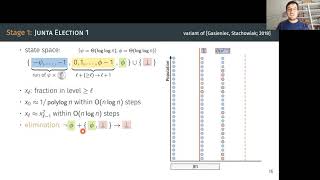
Optimal Time and Space Leader Election in Population Protocols
Explores optimal time and space complexity for leader election in population protocols, presenting a novel algorithm achieving O(n log n) interactions with Θ(log log n) states per agent.
Deep Learning Applications by Rina Panigrahy
Explore deep learning applications, from basic concepts to advanced techniques. Learn about neural networks, optimization methods, and real-world uses in image and speech recognition.
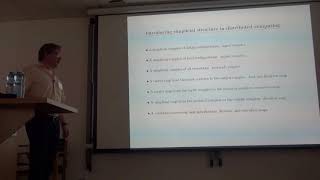
Topology of Complexes and Distributed Computing
Exploring simplicial models in distributed computing, focusing on chromatic subdivisions and Weak Symmetry Breaking, with insights into combinatorial-simplicial questions and related mathematical challenges.

Impossibility Results for Distributed Computing I
Explore key impossibility results in distributed computing, focusing on fundamental limitations and theoretical challenges in the field.
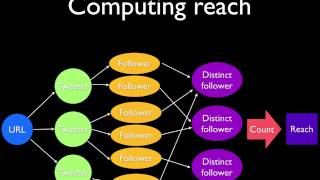
Storm: Realtime Distributed Computing with Nathan Marz - ETE 2012
Explore Storm for real-time data processing, covering concepts, development, deployment, fault-tolerance, and practical applications in distributed computing environments.

Spark NLP - State-of-the-Art Natural Language Processing at Scale
Discover scalable NLP techniques using Apache Spark, covering core algorithms, BERT embeddings, and multi-lingual challenges. Learn to build efficient pipelines for various NLP tasks through practical demonstrations.

User Behavior Hashing for Audience Expansion - Deep Learning Approach
Explore deep learning-based hashing for sequential behavior data, utilizing Spark for large-scale preprocessing and distributed inference on Databricks with Pandas UDF.

Scalable AutoML for Time Series Forecasting Using Ray
Explore scalable AutoML for time series forecasting using Ray, covering feature generation, model selection, and hyper-parameter tuning. Learn from real-world applications and experiences in various industries.
Tuning Machine Learning Models - Scaling, Workflows, and Architecture
Automating and scaling ML model tuning using Hyperopt and Apache Spark. Best practices for workflows, architecture, and optimization in hyperparameter tuning for improved performance and accuracy.

Apache Spark NLP for Healthcare - Building Real-World AI Systems
Explore real-world healthcare AI systems using NLP, covering patient risk prediction, diagnosis automation, and revenue optimization. Learn key considerations for building domain-specific models and scalable ML pipelines.
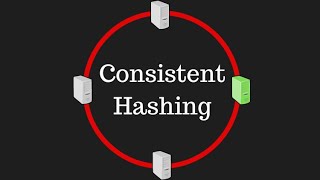
Consistent Hashing - The Backend Engineering Show
Explore consistent hashing in distributed systems, focusing on its application in databases like Cassandra and DynamoDB. Learn about implementation, advantages, and limitations.
Quick to Production: Integrating Spark and TensorFlow for Efficient MLOps
Learn to quickly deploy deep learning models using Spark and TensorFlow, simplifying MLOps for data scientists. Explore distributed computing, feature engineering, and leveraging TensorFlow ecosystem libraries for efficient model production.
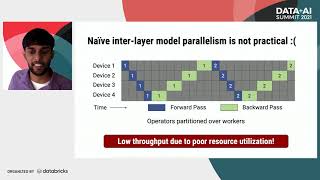
Efficient Large-Scale Language Model Training on GPU Clusters
Explores advanced techniques for efficient large-scale language model training on GPU clusters, discussing parallelism methods, novel scheduling, and performance optimization to achieve unprecedented model sizes and training speeds.
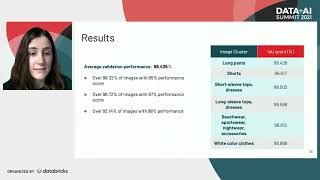
Automated Background Removal Using PyTorch - Wehkamp's Image Processing Pipeline
Discover an automated pipeline for efficient background removal in product images using PyTorch and machine learning, enhancing visual experiences for e-commerce customers.
Kubernetes as a Substrate for ATLAS Compute
Exploring Kubernetes' potential for ATLAS experiment computing, including batch processing, GPU resource management, and interactive analysis clusters for high-energy physics research.

Building Armada - Running Batch Jobs at Massive Scale on Kubernetes
Explore Armada: a system for massive-scale batch job execution on Kubernetes, enabling efficient utilization of GPUs and CPUs for advanced data science and machine learning in financial markets.
Enabling HPC and ML Workloads with Latest Kubernetes Job Features
Explore new Kubernetes Job API features for distributed Batch/AI/HPC workloads, including Indexed Jobs and Pod Failure Policy, with real-world examples from DeepMind and Lawrence Livermore National Laboratory.
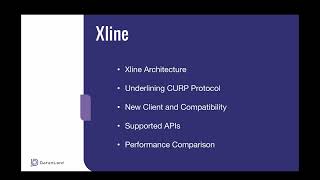
Geo-distributed Metadata Management System for Sky Computing
Explore geo-distributed metadata management systems for Sky Computing, addressing cluster and service failures through innovative protocols and APIs.
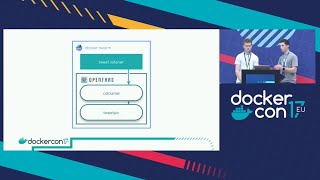
Repainting the Past with Distributed Machine Learning and Docker
Explore cutting-edge machine learning techniques to colorize black and white videos using distributed computing with Docker, revolutionizing historical footage preservation at reduced costs.