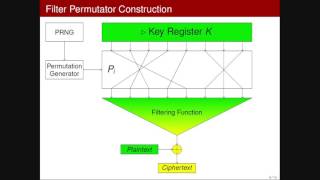
Towards Stream Ciphers for Efficient FHE with Low-Noise Ciphertexts
Explores efficient stream ciphers for fully homomorphic encryption, focusing on low-noise ciphertexts. Discusses hybrid frameworks, performance metrics, and novel contributions to improve noise management in encryption.

Sanitization of FHE Ciphertexts
Explore advanced techniques for sanitizing fully homomorphic encryption ciphertexts, including noise flooding alternatives and efficient methods for maintaining circuit privacy in FHE systems.
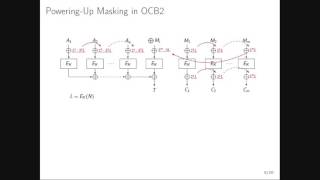
Improved Masking for Tweakable Blockciphers with Applications to Authenticated Encryption
Explore advanced masking techniques for tweakable blockciphers and their application in authenticated encryption, enhancing security and efficiency in cryptographic systems.
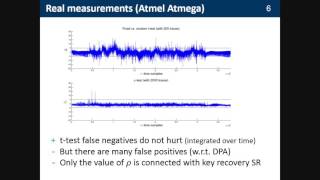
From Improved Leakage Detection to the Detection of Points of Interests in Leakage Traces
Explore advanced techniques for detecting leakage in cryptographic implementations, from improved detection methods to identifying points of interest in leakage traces.
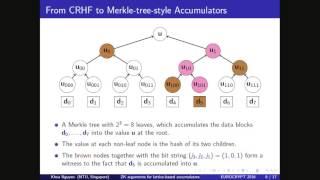
Zero-Knowledge Arguments for Lattice-Based Accumulators - Logarithmic-Size Ring Signatures and Group Signatures Without Trapdoors
Explore lattice-based cryptography with zero-knowledge arguments for accumulators, focusing on logarithmic-size ring signatures and group signatures without trapdoors.
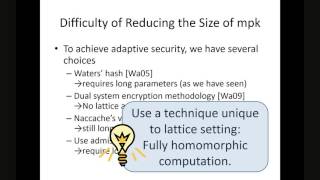
Adaptively Secure Identity-Based Encryption from Lattices with Asymptotically Shorter Public Parameters
Explore advanced cryptography techniques focusing on adaptively secure identity-based encryption from lattices, featuring asymptotically shorter public parameters.
Online - Offline OR Composition of Sigma Protocols
Explore advanced cryptographic techniques for efficient and secure communication protocols, focusing on Sigma protocols and their online/offline composition.
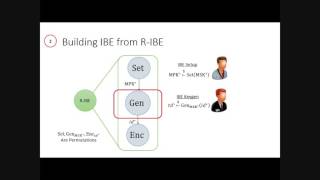
On the Power of Hierarchical Identity-Based Encryption
Explore hierarchical identity-based encryption, its security definitions, black-box separations, and compression techniques. Learn about adaptive security issues and their solutions.

Secure Computation from Elastic Noisy Channels
Explore secure computation using elastic noisy channels, covering ideal and real-world scenarios, unfair noisy channels, elastic erasure channels, and elastic binary symmetric channels.
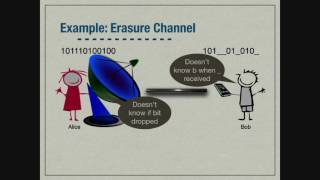
All Complete Functionalities are Reversible
Explore the concept of reversibility in complete functionalities, examining its implications and applications in cryptography and secure computation.
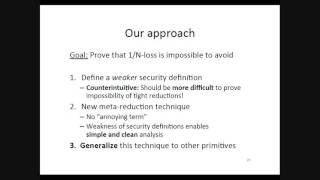
On the Impossibility of Tight Cryptographic Reductions
Explore the limitations of tight cryptographic reductions and their implications for security proofs in cryptography.
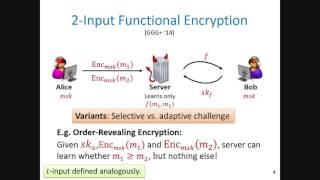
Multi-input Functional Encryption in the Private-Key Setting
Explore advanced cryptography concepts including multi-input functional encryption, focusing on private-key settings, input aggregation, and key encapsulation techniques.
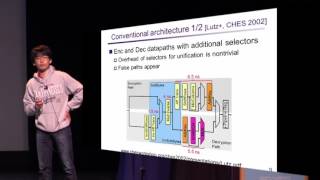
A High Throughput Gate AES Hardware Architecture by Compressing Encryption and Decryption Datapaths
Explore a high-throughput AES hardware architecture that compresses encryption and decryption datapaths, enhancing efficiency and performance in cryptographic systems.
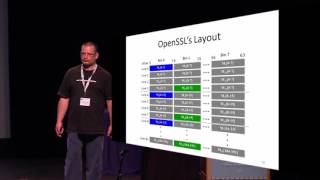
CacheBleed - A Timing Attack on OpenSSL Constant Time RSA
Explore a timing attack on OpenSSL's constant-time RSA implementation, uncovering vulnerabilities in cryptographic systems and their potential impact on security.
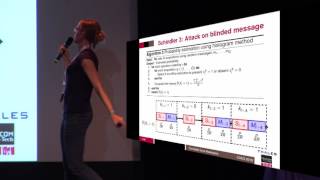
Correlated Extra Reductions Defeat Blinded Regular Exponentiation
Explore cryptographic vulnerabilities in blinded regular exponentiation, focusing on correlated extra reductions and their impact on security.
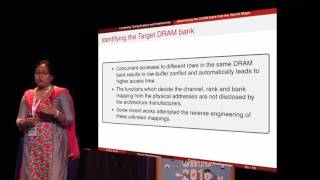
Curious Case of Rowhammer - Flipping Secret Exponent Bits Using Timing Analysis
Explore the Rowhammer vulnerability and its impact on cryptographic systems through timing analysis, revealing potential security risks in modern hardware.
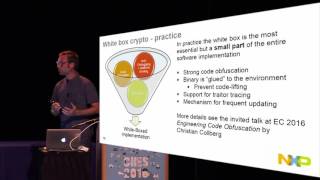
Differential Computation Analysis - Hiding Your White Box Designs Is Not Enough
Explore differential computation analysis for white-box cryptography, covering attack models, implementations, code lifting, and visualization techniques to enhance security measures.
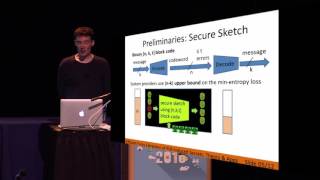
Efficient Fuzzy Extraction of PUF Induced Secrets - Theory and Applications
Explore efficient fuzzy extraction techniques for PUF-induced secrets, covering theoretical foundations and practical applications in cryptographic systems.
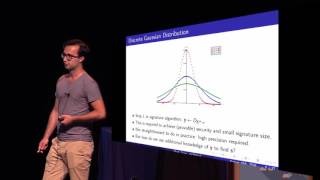
Flush, Gauss, and Reload - A Cache Attack on the BLISS Lattice-Based Signature Scheme
Explore a cache attack on the BLISS lattice-based signature scheme, examining vulnerabilities and potential security implications for post-quantum cryptography.
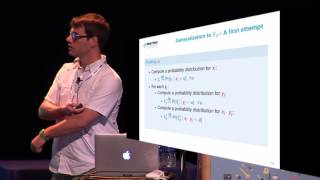
Horizontal Side Channel Attacks and Countermeasures on the ISW Masking Scheme
Explore horizontal side channel attacks on ISW masking scheme, examining vulnerabilities and potential countermeasures to enhance cryptographic security.
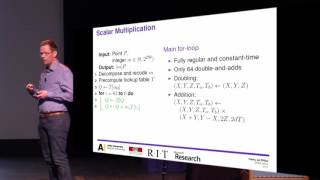
FourQ on FPGA - New Hardware Speed Records for Elliptic Curve Cryptography over Large Prime Character
Explore FourQ, a cutting-edge elliptic curve cryptography method, and its implementation on FPGA for unprecedented speed in large prime character systems.