Catalysis - Automated Multiscale Modeling and Active Exploration of Chemical Space
Revolutionizing catalysis through automated multiscale modeling and active exploration of chemical space, accelerating material discovery and optimizing processes from first principles to reactor scale.
High-Dimension Perspective on Extracting & Encoding Information in Chemical Systems
Explore high-dimensional data extraction and encoding in complex chemical systems, focusing on exascale computing opportunities, multiscale correlations, and challenges in feature selection and interpretability.
From Electrons to the Simulation of Materials - IPAM at UCLA
Explore computational workflows for predicting complex materials properties, from phase diagrams to nanostructures, using density functional theory and machine learning potentials.
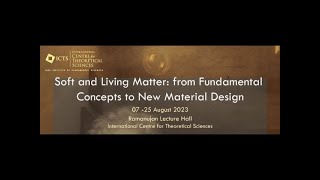
Grafted Nanoparticle Melts as Novel Gas Separation Media - Lecture 3
Exploring grafted nanoparticle melts for innovative gas separation techniques. Lecture delves into advanced materials science, focusing on nanoparticle applications in molecular filtration and separation processes.

Polymer Material Design for Gas Separations - Lecture 2
Explore polymer material design for gas separations, focusing on advanced techniques and applications in membrane technology for efficient molecular separation processes.
Cyclica Recursion - Innovations in Drug Discovery
Explore cyclic recursion in machine learning for drug discovery, featuring innovative approaches and industry applications in pharmaceutical research.
The Effect of Osmotic Pressure on Collagen Mimetic Sequences
Groundbreaking analysis of collagen molecule behavior upon dehydration using collagen mimetic peptides. Reveals sequence-dependent elongation or contraction, crucial for understanding biological materials.
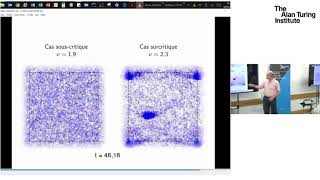
From Micro to Macro in Collective Dynamics
Explore methods for modeling collective dynamics, from microscopic to macroscopic scales. Learn techniques for analyzing complex systems in various scientific fields.
Toy Chemistry - Three Bonds
Explore a computational model of chemical bonding, examining bond formation probabilities and their impact on molecular structures.
Computational Problems for Intro Physics: Spring Molecule Energies - Matter and Interactions Supplement
Explore energies in spring-bonded atoms through computational problems, supplementing Matter and Interactions physics courses with hands-on coding exercises.
Classical Quantum Chemistry and QIS Applications - Part I
Explore quantum chemistry fundamentals and their applications in quantum information science with Prof. Anna Krylov in this comprehensive lecture from IPAM's Winter School.
Classical Quantum Chemistry and QIS Applications - Part 2
Explore advanced quantum chemistry concepts and their applications in quantum information science, focusing on cutting-edge research and theoretical frameworks.
Generalizable Sampling of Conformational Ensembles with Latent Space Dynamics
Explore innovative techniques for sampling conformational ensembles using latent space dynamics, enhancing our understanding of complex molecular systems and their behavior.
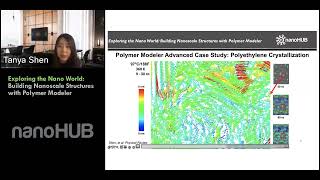
Exploring the Nano World: Building Nanoscale Structures with Polymer Modeler
Explore nanoscale polymer structures using atomic-level simulations. Learn about crystal structures, polymer science paradigms, and use an interactive Polymer Modeler to understand polyacrylonitrile processing and crystallization.
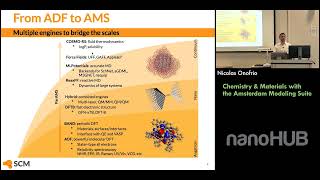
Chemistry and Materials with the Amsterdam Modeling Suite
Explore atomistic simulations using Amsterdam Modeling Suite. Learn about AMS driver, DFT engines, force fields, and PARAMS for novel molecular interactions. Gain insights through demos and practical applications.
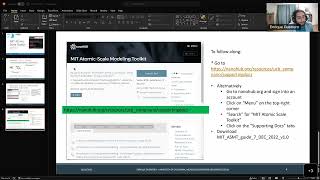
Teaching and Learning with the MIT Atomic Scale Modeling Toolkit - Classical and Quantum Atomic Modeling
Explore classical and quantum atomic modeling using MIT's toolkit. Perform molecular dynamics, Monte Carlo simulations, and quantum chemistry computations. Learn practical applications for various physics and chemistry courses.
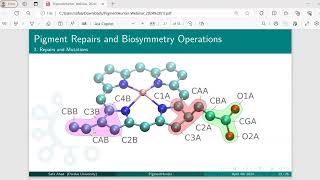
Building a Graphical Interface for Exploring Protein Dynamics and Spectroscopy - PigmentHunter
Explore protein dynamics and spectroscopy with PigmentHunter, a user-friendly nanoHUB tool for simulating excitonic spectra of chlorophyll proteins. Learn its interface, workflow, and applications in molecular dynamics and spectral analysis.
Simulation of Chemical Reactions on a Quantum Computer
Explore quantum computing algorithms for calculating scattering matrix elements in chemical reactions, focusing on the Møller operator formulation and its application to hydrogen exchange.
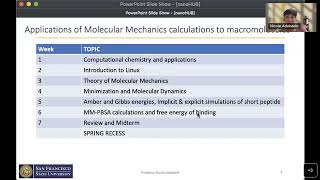
Teaching Electronic Structure Methods in Chemistry Using Simulation Tools in nanoHUB
Explore electronic structure methods in chemistry using nanoHUB simulation tools. Learn to teach computational chemistry concepts and gain hands-on practice with Hartree-Fock and basis sets using ORCA.
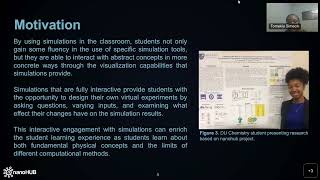
Introduction to Computational Chemistry Using the NUITNS Simulation Toolkit in nanoHUB
Explore computational chemistry using NUITNS toolkit on nanoHUB. Learn to integrate simulations in undergraduate chemistry courses and analyze nanodiamonds through hands-on demonstrations and practical applications.
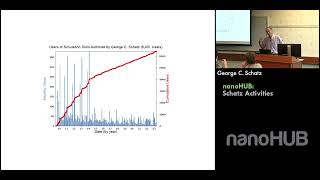
Teaching Chemistry Tools on nanoHUB - Overview by George Schatz
Explore nanoHUB tools for teaching chemistry, including DDSCAT, QC-Lab, and Nanosphere Optics Lab. Learn about applications in optics, spectroscopy, and molecular modeling from Prof. George Schatz.