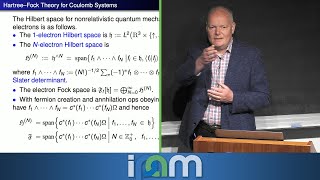
The Hartree-Fock Approximation and Its Generalizations - IPAM at UCLA
Explore Hartree-Fock approximation in quantum mechanics, covering accuracy, variational principles, generalizations, and symmetries. Gain insights into advanced theoretical concepts and applications.
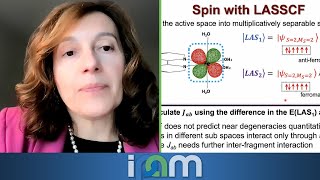
Localized-Wave-Function Methods in Quantum Chemistry and Their Extension to Quantum Computers
Explore localized wave-function methods in quantum chemistry, their applications to large systems, and potential extensions to quantum computing algorithms for improved efficiency and accuracy.
Post-DFT Green's Function Embedding - IPAM at UCLA
Explore post-DFT Green's function embedding for correlated solids, focusing on self-energy embedding theory (SEET) and its applications in molecular systems and periodic solids.
High Accuracy Wavefunctions Using Deep-Learning-Based Variational Monte Carlo
Explore deep learning-based variational Monte Carlo for high-accuracy wavefunctions in computational chemistry, featuring novel architecture and improved methods for ground state energy calculations.
Conditional Probability Density Functional Theory - IPAM at UCLA
Explore conditional probability density functional theory for electronic structure calculations, addressing challenges in DFT and offering insights into ground-state correlations and warm dense matter simulations.
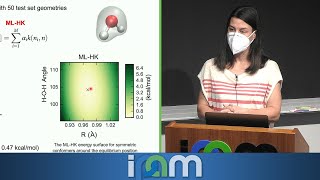
Molecular Electron Densities via Machine Learning - IPAM at UCLA
Explore machine learning techniques for predicting molecular electron densities and energies, with applications in quantum mechanics and molecular dynamics simulations.
Generating Reference Data and Controlling Accuracy in DFT and Hybrid DFT Simulations
Explore advanced techniques in DFT simulations, including all-electron approaches, pseudopotential validation, and hybrid DFT acceleration methods for improved accuracy and efficiency in quantum mechanics calculations.
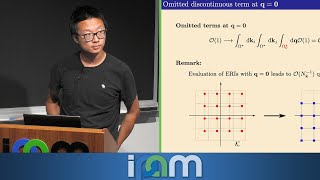
Finite-Size Error and Its Correction in Energy Calculations for Periodic Systems
Explore finite-size errors in periodic systems, focusing on Hartree-Fock and MP2 theories. Learn about convergence rates, Madelung-constant correction, and the staggered mesh method for improved calculations.
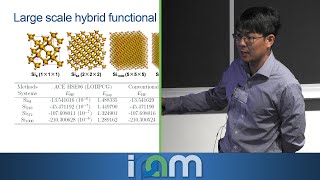
Large Scale Hybrid DFT Functionals - Fast Algorithms and Finite-Size Effects - IPAM at UCLA
Explore accelerating DFT calculations with hybrid functionals and finite-size effects in Hartree-Fock calculations for periodic systems in this advanced mathematics lecture.
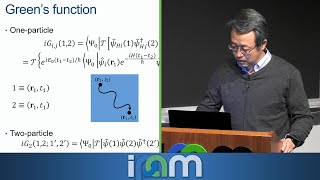
Low Rank Approximation in Electron Excitation Calculations - IPAM at UCLA
Explore low rank approximation techniques for efficient electron excitation calculations, focusing on the Interpolative Separable Density Fitting method and its applications in quantum mechanics.
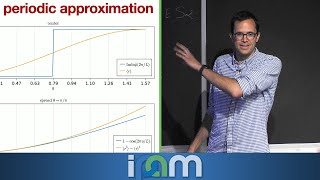
Localization Methods - Perspectives on Initialization and Optimization - IPAM at UCLA
Explore Wannier localization in quantum mechanics, its mathematical formulation, challenges, and new approaches for efficient orbital localization in condensed matter systems.

Systematically Improvable Models from Alchemical Perturbations - IPAM UCLA
Explore systematic improvements in quantum models using alchemical perturbations, connecting chemical spaces and simplifying material design through novel approaches and fundamental constraints.
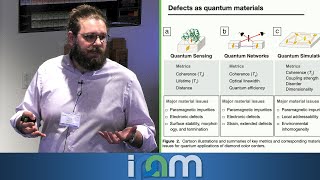
Quantum Embedding Methods for Correlated Excited States of Point Defects
Explore quantum embedding methods for correlated excited states of point defects, focusing on case studies and challenges in computational approaches for defect systems in quantum technologies.
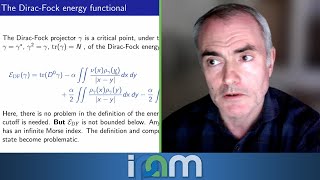
The Ground State of the Dirac-Fock Energy for Molecules and Crystals - IPAM at UCLA
Explore ground state definition for Dirac-Fock energy in molecules and crystals, including existence results and computational algorithms. Insights for theoretical and numerical investigations.
The State of Neural Network Interatomic Potentials - IPAM at UCLA
Explore neural network interatomic potentials in atomistic simulations, their advantages over traditional methods, and challenges in widespread adoption across research domains.
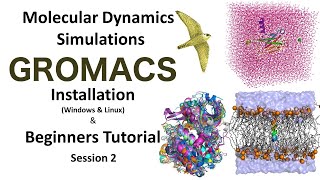
Molecular Dynamics Simulations with Gromacs - Beginner Tutorial Session 2
Learn MD simulation steps, RMSD/RMSF graph generation in Windows using Gromacs. Covers system preparation, energy minimization, equilibration, and analysis for molecular dynamics simulations.
Estimate Transport Coefficients From Short Equilibrium Molecular-Dynamic Simulation
Discover optimal methods for estimating transport coefficients in molecular dynamics simulations, enhancing efficiency and accuracy in quantum mechanics research.
Multi-Center Decomposition of Molecular Densities: A Mathematical Perspective
Explore mathematical perspectives on molecular density partitioning, focusing on Iterative Stockholder Atom methods. Learn about new schemes, convergence results, and applications in quantum mechanics.
Stochastic Vector Methods for Extended Systems - IPAM at UCLA
Explore stochastic vector approaches for electronic structure in condensed matter systems, reducing complexity and enhancing efficiency in computational quantum mechanics.
Fast Algorithm for the Strong-Interaction Limit of Density Functional Theory
Explore a novel algorithm for computing the strong-interaction limit in density functional theory, enhancing accuracy in modeling strongly correlated systems and overcoming computational challenges.
Machine Learning for Atomic-Scale Modeling - Potentials and Beyond - IPAM at UCLA
Explore machine learning techniques for atomic-scale modeling, addressing challenges in chemical diversity and integrating functional properties beyond interatomic potentials for advanced materials simulation.