Introduction to the Dynamics of Disordered Systems - Equilibrium and Gradient Descent - Part 3
Explore equilibrium dynamics and gradient descent in disordered systems, focusing on theoretical concepts and practical applications in statistical physics and optimization.
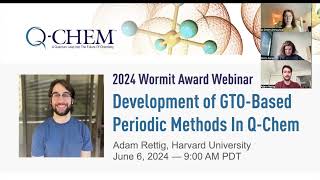
PBC Development in Q-Chem - 2024 Wormit Award
Explore advancements in Q-Chem's PBC package for periodic systems, including hybrid DFT speedup and MPI parallelization. Learn about current functionality and future development directions.
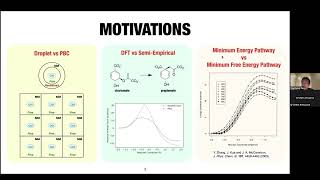
Multiscale Free Energy Simulations of Biochemical Reactions Using QMHub - Webinar 72
Explore QMHub for efficient QM/MM simulations in biochemical reactions, combining enhanced sampling and machine learning for accurate modeling of biomolecular systems.
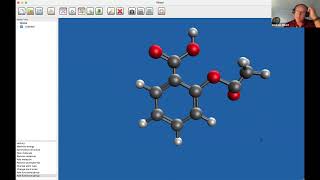
Introduction to IQmol - 2024 Virtual Winter School in Computational Chemistry - Session 1
Crash course on IQmol: build molecules, submit calculations, analyze results. Includes overview and hands-on lab exercise for Q-Chem's graphical interface.
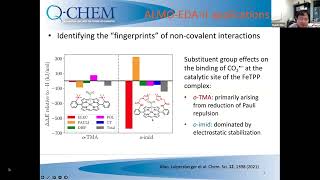
Energy Decomposition Analysis Techniques in Q-Chem - Session 3
Explore energy decomposition analysis techniques in Q-Chem, including the new force decomposition analysis method, with Yuezhi Mao from UC San Diego.
Q-Chem: An Engine for Innovation - 2024 Virtual Winter School in Computational Chemistry
Explore recent developments and new features in Q-Chem code with Martin Head-Gordon from UC Berkeley, highlighting advancements in computational chemistry software.
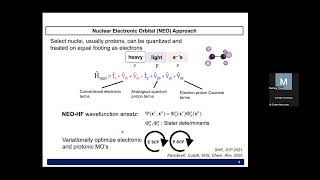
Development of Nuclear-Electronic Orbital Methods in Q-Chem 6
Explore advanced nuclear-electronic orbital methods in Q-Chem 6, including NEO-PCM and NEO-QM/MM approaches, for capturing nuclear quantum effects in chemical and biological applications.
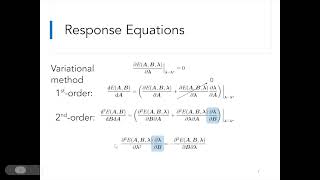
Calculating NMR Shielding with GIAO - Q-Chem Webinar 70
Explore numerical finite difference approach for NMR shielding calculations using gauge-including atomic orbitals. Learn theory, implementation, and results with κ-MP2 and MP2.X methods in Q-Chem software.
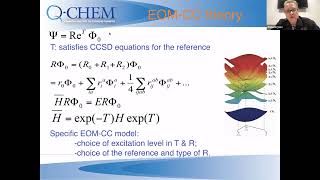
Coupled Cluster Methods for Excited States to Model Spectroscopy - 2023 VWSCC Session 09
Explore excited state equation of motion coupled cluster methods for modeling spectroscopy with Prof. Anna Krylov. Learn advanced techniques for computational chemistry applications.
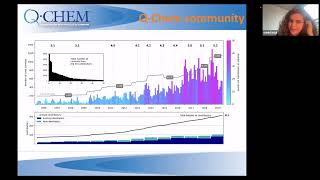
Introduction to Q-Chem Software Package - Session 1
Explore Q-Chem software: features, community, and applications in computational chemistry. Learn about ground state methods, excited states, and molecular dynamics simulations.
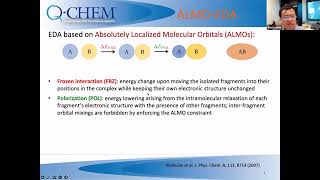
Energy Decomposition Analysis Techniques and Applications - Session 5
Explore energy decomposition analysis techniques, covering theory and applications in Q-Chem software, with Prof. Yuezhi Mao from the University of San Diego.
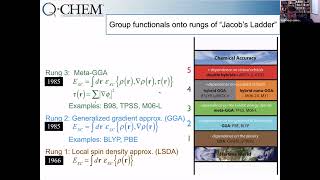
Density Functional Theory Overview - 2023 Virtual Winter School in Computational Chemistry
Explore density functional theory methods with Prof. Martin Head-Gordon, covering key concepts, functional design, and performance analysis in computational chemistry.
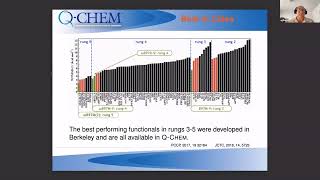
New Features in Q-Chem 6 - 2023 Virtual Winter School in Computational Chemistry
Explore the latest advancements in computational chemistry software with insights on Q-Chem 6.0 and upcoming features in version 6.1, enhancing your research capabilities.
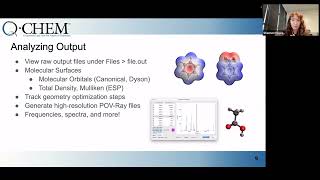
Introduction to IQmol: Building Molecules and Analyzing Results - Session 2
Crash course on IQmol: build molecules, submit calculations, analyze results. Hands-on tutorial for Q-Chem's graphical interface, with practical exercises and installation guidance.
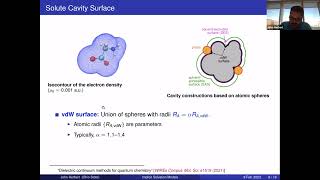
Solvent Models in Molecular Quantum Chemistry Calculations - Session 8
Explore solvent models in quantum chemistry with Prof. Herbert, covering continuum electrostatics, solvation energies, and applications to ionization and excitation processes.
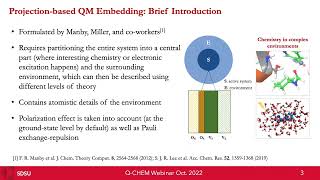
Projection-based Quantum Mechanical Embedding Methods in Q-Chem - Webinar 67
Explore projection-based embedding theory in Q-Chem for accurate quantum mechanical modeling of chemical processes in condensed-phase systems, presented by expert Yuezhi Mao.
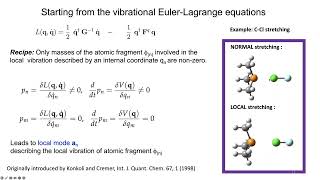
Decoding Chemical Information from Vibrational Spectroscopy Data - Q-Chem Webinar 66
Explore local vibrational mode theory for analyzing chemical bonding using LModeA software. Learn underlying principles and practical applications in quantum chemistry and spectral analysis.

Introduction to Coupled Cluster EOM Exercises - 2023 Virtual Winter School in Computational Chemistry
Introduction to coupled cluster exercises, guiding participants through practical applications of concepts from the previous lecture on coupled cluster calculations.
Molecular Properties and Spectra Using DFT and TDDFT - Session 6
Explore DFT and TDDFT applications in molecular properties and spectra with Prof. Martin Head-Gordon. Covers first/second-order properties and excited states, with accompanying lab exercise.
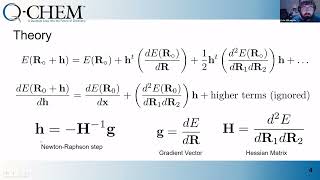
Geometry Optimization in Q-Chem - 2023 Virtual Winter School in Computational Chemistry
Overview of geometry optimization in Q-Chem, focusing on practical aspects of running calculations and paired with a hands-on lab exercise.
Materials Modeling - Bonding Across Atoms, Code, and People - JuliaCon 2024 Keynote
Exploring computational materials modeling for 21st-century challenges, integrating Julia with existing tools to advance physics, chemistry, and data-driven approaches in materials design.