
Molecular Dynamics Simulation with GROMACS - Installation and Beginner Tutorial
Step-by-step guide to install GROMACS and run a beginner-level molecular dynamics simulation of a protein in water, covering both Windows and Linux platforms.
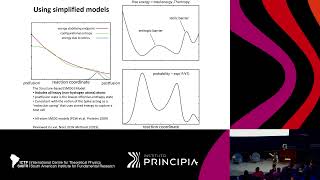
Quantifying Large-Scale Dynamics of Complex Molecular Assemblies
Explore quantitative methods for analyzing large-scale dynamics in complex molecular systems, focusing on advanced techniques and their applications in molecular biophysics.
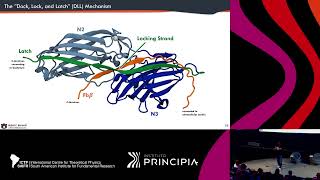
Computational Biophysics Approaches to Mechanosensing
Explore computational biophysics methods for understanding mechanosensing, focusing on cutting-edge approaches and their applications in molecular biology research.
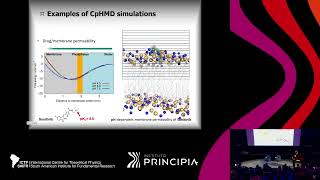
Constant-pH MD Simulations as a Tool to Unveil pH Effects on Biomolecules
Explore constant-pH MD simulations to uncover pH effects on biomolecules. Gain insights into advanced molecular biophysics techniques and their applications.
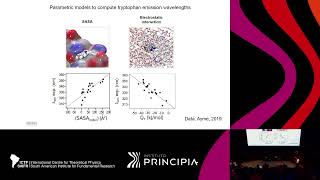
Computational Investigation of Ultrafast Protein-Water Interactions
Explore computational methods for studying ultrafast interactions between proteins and water molecules, uncovering insights into molecular biophysics.
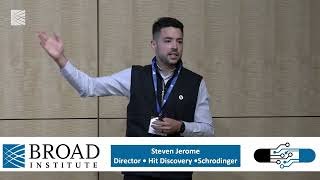
Active Learning for Absolute Binding Free Energy Calculations in Drug Discovery
Explore innovative active learning techniques for absolute binding free energy calculations, enhancing drug discovery processes and efficiency.
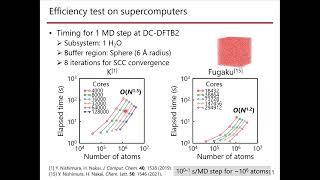
Recently Added Features in DCDFTBMD Program
Explore recent additions to DCDFTBMD program, enhancing molecular dynamics simulations and computational chemistry capabilities.
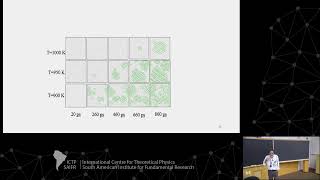
Molecular Dynamics Simulation of Supercooled ZnSe - Structural Relaxation and Crystal Nucleation
Explore molecular dynamics simulation of supercooled ZnSe, focusing on structural relaxation and crystal nucleation processes in condensed matter theory.
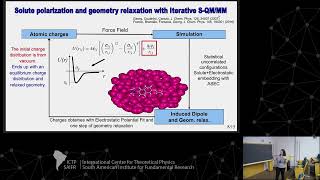
Theoretical Study of Solvent Effects on the Electronic Properties of Mononuclear Ru/Aqua Catalysts for Water Splitting
Explore theoretical approaches to solvent effects on electronic properties of Ru/Aqua catalysts for water splitting in this condensed matter physics talk.
Key Aspects When Modelling Amphiphiles with MARTINI
Explore key aspects of modeling amphiphiles using MARTINI, covering AA-to-CG validation, phase behavior, and transferability in molecular dynamics simulations.
Ion-Pairing in Ionic Liquid-Based Electrolytes
Explore ion-pairing mechanisms in ionic liquid-based electrolytes, focusing on their applications and implications for energy storage and electrochemical systems.
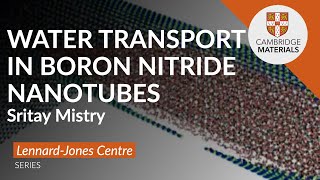
Water Transport in Boron Nitride Nanotube Membranes
Explore water transport in boron nitride nanotube membranes, comparing with carbon nanotubes. Analyze flow resistance factors and simulation challenges to understand contradictions in literature.
Data Science for Assembly Engineering - Sharon C Glotzer
Explore data science applications in assembly engineering, covering self-assembly, crystallization, and machine learning techniques for structural analysis and visualization.
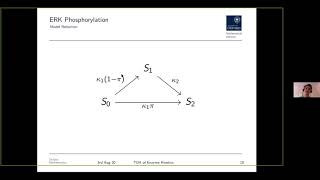
Geometric and Topological Data Analysis of Enzyme Kinetics
Explore geometric and topological data analysis techniques applied to enzyme kinetics, focusing on ERK molecular dynamics and its implications for cancer and developmental defects.
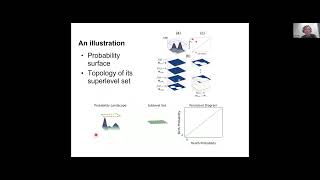
Non-Diffusive Vortexes at Transition State of Activated Process by Persistent Homology
Exploring non-diffusive dynamics in molecular transitions using persistent homology, revealing reactive vortexes and rotational fluxes at transition states of alanine-dipeptide isomerization.
Methods for Computational Biology and Drug Discovery
Explore fundamental computational methods in physics and chemistry, presented by their creators, with insights into their development and applications.
Modeling of Nucleosome Clustering in Euchromatin Resulting from Reader Protein Interactions
Explore nucleosome clustering in euchromatin through modeling interactions between reader proteins. Gain insights into chromosomal organization and dynamics from the Spakowitz lab's research.
Coarse-grained Simulations of Nucleosomes
Explore coarse-grained simulations of nucleosomes to understand chromatin organization and gene regulation through interdisciplinary computational modeling techniques.
Sampling Using Diffusion Processes, From Langevin to Schrödinger
Explore diffusion processes in sampling, from Langevin dynamics to Schrödinger bridges, with insights on geometric methods in optimization and their applications.
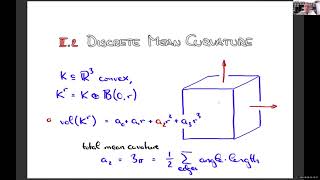
The Intrinsic Volumes of a Space Filling Diagram and Their Derivatives
Explore intrinsic volumes in molecular dynamics, focusing on space-filling diagrams and their derivatives. Learn formulas for weighted volumes and curvatures in Alpha shape representations.
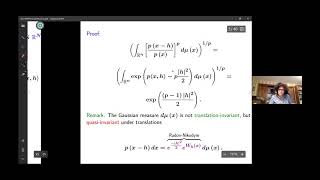
Stochastic Analysis and Geometric Functional Inequalities
Explore methods for proving functional inequalities in hypoelliptic diffusions, including geometric and probabilistic approaches, with applications to Langevin dynamics ergodicity.