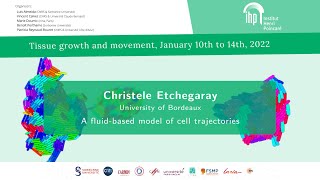
A Fluid-Based Model for Single-Cell Migration
Explore a deterministic model of single-cell migration using fluid dynamics and molecular interactions. Analyze static and motile behaviors through mathematical and numerical approaches.
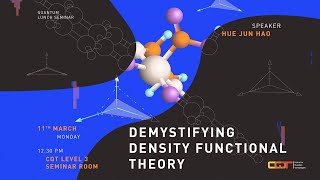
Demystifying Density Functional Theory: From Fundamentals to Applications
Uncover the fundamental principles and applications of Density Functional Theory (DFT), exploring its role in physics, chemistry, and biology while understanding its operational framework and research potential.
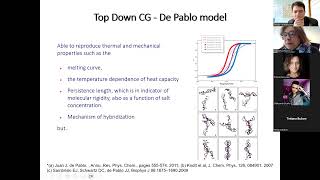
Coarse Graining and Multiscale Modeling of DNA - Part 2
Delve into advanced DNA modeling techniques, exploring coarse graining and multiscale approaches for understanding complex molecular structures and interactions at different computational levels.
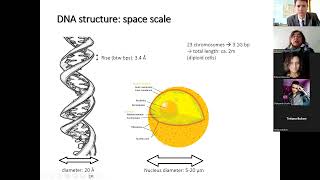
Coarse Graining and Multiscale Modeling of DNA - Part 1
Explore advanced computational techniques for DNA modeling, focusing on coarse-graining methods and multiscale approaches to understand DNA structure and dynamics at different resolutions.
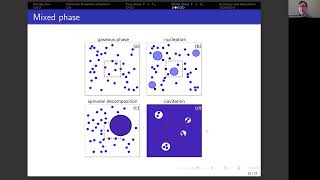
Molecular Dynamics Analysis of Particle Number Fluctuations in First-Order Phase Transitions
Explore molecular dynamics analysis of particle fluctuations during first-order phase transitions through advanced theoretical physics research presented at the XIV Young Scientists Conference.
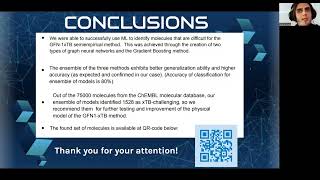
Revealing Inaccuracies of the GFN1-xTB Semi-Empirical Method with Machine-Learning Toolset
Explore machine learning applications in identifying limitations of GFN1-xTB semi-empirical calculations for computational chemistry and molecular modeling.
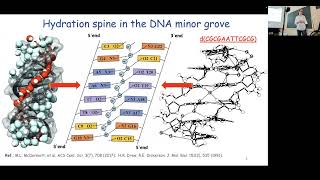
Specific Effects of Alkali Metal Ions on the Vibrational Dynamics of DNA Ion-Hydration
Explore the intricate relationship between alkali metal ions and DNA hydration dynamics through advanced computational physics and vibrational analysis techniques.
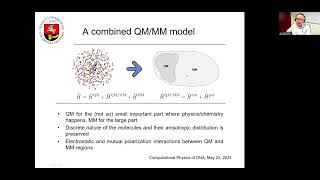
Modelling NMR Properties of Complex Molecular Materials by Means of an Integrated MD-QM/MM Approach
Dive into advanced molecular dynamics and quantum mechanics approaches for modeling NMR properties of complex materials, with focus on integrated MD-QM/MM methodology.
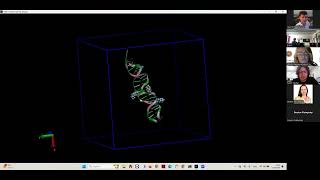
Using ChatGPT in Molecular Dynamics Simulations - Applications to Nucleic Acids
Discover how to leverage ChatGPT for molecular dynamics simulations, focusing on nucleic acids analysis and computational physics applications in DNA research.
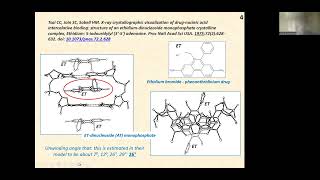
Computer Simulations of DNA-Ligand Intercalation Complexes - Special Features
Dive into advanced computational methods for studying DNA-ligand intercalation complexes, exploring simulation techniques and key molecular interactions in biophysical research.
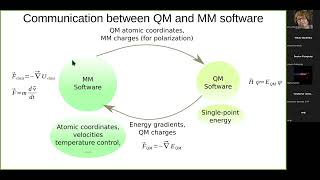
Hybrid Quantum-Mechanics/Molecular Mechanics Simulation Methods and Their Applications to Studying Charge Transfer Processes in Redox Proteins
Dive into advanced QM/MM simulation methods and their practical applications for analyzing charge transfer processes in redox proteins through computational physics approaches.
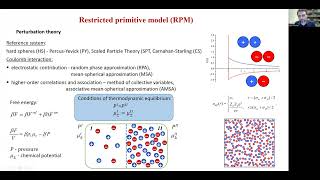
Phase Behavior of Ionic Liquids in Disordered Porous Media
Explore the complex dynamics of ionic liquids within disordered porous media, examining their phase behavior and fundamental physical properties through theoretical physics analysis.
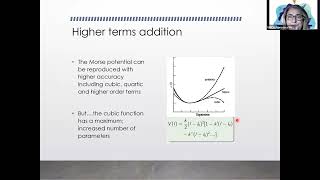
Force Fields and Molecular Dynamics Simulations - Applications to Nucleic Acids
Dive into molecular dynamics simulations and force fields, exploring their practical applications in nucleic acid research through advanced computational physics methods and theoretical frameworks.
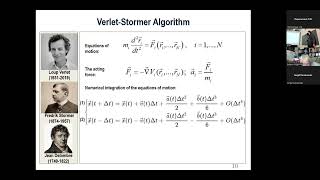
Molecular Dynamics: From the Problem of Hard Spheres to the DNA Macromolecule
Explore molecular dynamics principles and applications, from basic hard sphere models to complex DNA macromolecular structures in this comprehensive physics workshop lecture.

How Materials Science Can Help Create a Greener Future - with Saiful Islam
Explore how materials science advances can drive green technology innovation, from better batteries to efficient solar power, through atomic-scale modeling and structural chemistry insights.

A Hierarchical Approach to Crystal Structure Prediction
Explore a hierarchical approach to crystal structure prediction for organic molecules, focusing on methodology requirements, algorithms, and applications in pharmaceutical and agrochemical industries.
Nonlinear Reduced Basis Methods and Transport in Electronic Structure Calculation
Explore nonlinear reduced basis methods and optimal transport for efficient electronic structure calculations, focusing on a 1D toy model with potential extensions to larger systems.

Uncertainty-Aware Machine Learning Models of Many-Body Atomic Interactions
Explore symmetry-aware machine learning models for atomic interactions, focusing on E(3)-equivariant neural potentials and Bayesian force fields for improved accuracy in materials modeling.

Fully Quantum (Bio)Molecular Simulations: Dream or Reality?
Explore the convergence of quantum mechanics and machine learning in molecular simulations, addressing challenges and future developments for complex (bio)molecular systems.
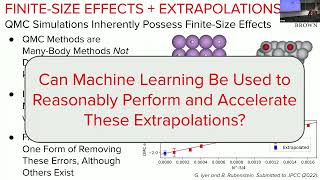
Extending the Reach of Quantum Monte Carlo Methods via Machine Learning
Explore how machine learning enhances quantum Monte Carlo methods for electronic structure modeling, improving force calculations and scaling to larger systems in molecular simulations.
Quantum Time Correlation Functions in an Open-Chain Path Integral Distribution
Explore quantum time correlation functions using open-chain path integrals, offering a new perspective on semiclassical approximations in computational chemistry with potential applications in rate theory and spectroscopy.