Water Transport in Boron Nitride Nanotube Membranes
Explore water transport in boron nitride nanotube membranes, comparing with carbon nanotubes. Analyze flow resistance factors and simulation challenges to understand contradictions in literature.
Breaking the Curse of Dimension in Quantum Mechanical Computations Through Analysis and Probability
Explore quantum mechanical computations, focusing on breaking dimensional constraints through analysis and probability. Learn about density functional theory and recent approaches to tackle existing issues.
Data Science for Assembly Engineering - Sharon C Glotzer
Explore data science applications in assembly engineering, covering self-assembly, crystallization, and machine learning techniques for structural analysis and visualization.
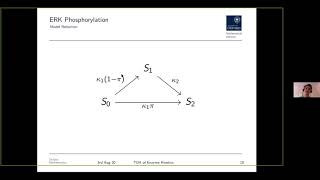
Geometric and Topological Data Analysis of Enzyme Kinetics
Explore geometric and topological data analysis techniques applied to enzyme kinetics, focusing on ERK molecular dynamics and its implications for cancer and developmental defects.

Molecular Docking with AutoDock VINA - Script-Based Method for Multiple Ligands
Learn script-based molecular docking with AutoDock Vina for virtual screening of multiple ligands. Explore conformational space, calculate binding energies, and identify potential lead compounds efficiently.
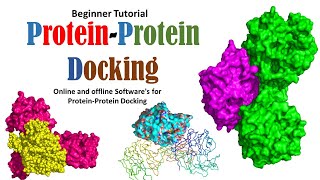
Protein-Protein Docking Tutorial for Beginners Using ClusPro, PatchDock, and Hex
Learn to perform protein-protein docking using validated tools like ClusPro, PatchDock, and Hex. Gain hands-on experience with step-by-step demonstrations and access to relevant literature.
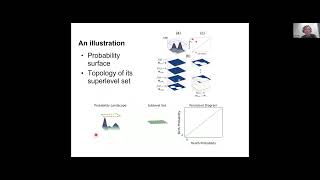
Non-Diffusive Vortexes at Transition State of Activated Process by Persistent Homology
Exploring non-diffusive dynamics in molecular transitions using persistent homology, revealing reactive vortexes and rotational fluxes at transition states of alanine-dipeptide isomerization.
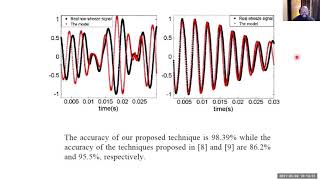
Quasiperiodicity and Persistent Kunneth Theorems
Explore quasiperiodicity in signals, persistent homology, and Kunneth theorems. Learn applications in time series analysis and computational chemistry through topological data analysis.
Methods for Computational Biology and Drug Discovery
Explore fundamental computational methods in physics and chemistry, presented by their creators, with insights into their development and applications.
Modeling of Nucleosome Clustering in Euchromatin Resulting from Reader Protein Interactions
Explore nucleosome clustering in euchromatin through modeling interactions between reader proteins. Gain insights into chromosomal organization and dynamics from the Spakowitz lab's research.
Coarse-grained Simulations of Nucleosomes
Explore coarse-grained simulations of nucleosomes to understand chromatin organization and gene regulation through interdisciplinary computational modeling techniques.
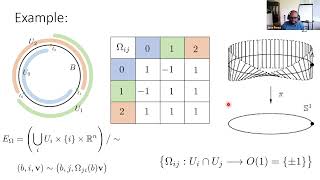
Vector Bundles for Data Alignment and Dimensionality Reduction
Explore vector bundles in data science, focusing on synchronization problems and topology-preserving dimensionality reduction. Applications in computational chemistry and dynamical systems are presented.
Sampling Using Diffusion Processes, From Langevin to Schrödinger
Explore diffusion processes in sampling, from Langevin dynamics to Schrödinger bridges, with insights on geometric methods in optimization and their applications.
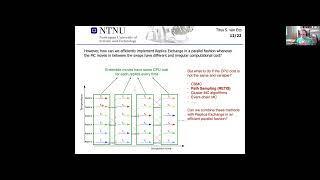
Exchanging Replicas with Unequal Cost, Infinitely and Permanently
Innovative replica exchange method for parallel simulations with varying computational costs, enhancing efficiency in Monte Carlo algorithms and path sampling techniques.
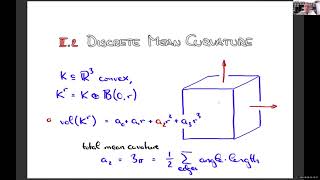
The Intrinsic Volumes of a Space Filling Diagram and Their Derivatives
Explore intrinsic volumes in molecular dynamics, focusing on space-filling diagrams and their derivatives. Learn formulas for weighted volumes and curvatures in Alpha shape representations.
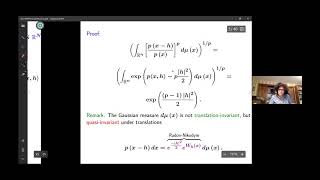
Stochastic Analysis and Geometric Functional Inequalities
Explore methods for proving functional inequalities in hypoelliptic diffusions, including geometric and probabilistic approaches, with applications to Langevin dynamics ergodicity.
Entropy Techniques for Nonlinear Partial Differential Equations - A Few Examples
Explore entropy techniques for nonlinear PDEs, focusing on Fokker-Planck equations. Learn applications in polymeric fluids, molecular dynamics, and high-dimensional algorithms.
Speeding up Langevin Dynamics by Mixing
Explore a method to accelerate Langevin dynamics using mixing drift, improving convergence to stationary distribution in polynomial time for systems with multiple local minima.
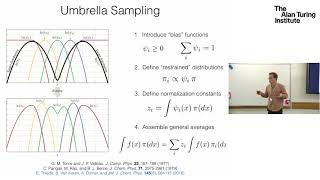
Stratification for Markov Chain Monte Carlo
Explore advanced Markov Chain Monte Carlo techniques, focusing on stratification methods for complex systems modeling and statistical inference in various scientific domains.
Constrained Stochastic Processes: From Brownian Motion to Run-and-Tumble Particles
Explore constrained stochastic processes, including Brownian motion, Lévy flights, and run-and-tumble particles. Learn effective dynamics for generating constrained trajectories in various scenarios.
Optimal Transport and High-Dimensional Probability - Langevin Dynamics via Calculus
Explore optimal transport, high-dimensional probability, and Langevin dynamics through advanced calculus techniques in this mathematical deep dive.