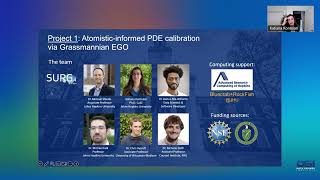
Leveraging Latent Representations for Predictive Physics-Based Modeling
Explore advanced techniques for leveraging latent representations in predictive physics-based modeling, focusing on surrogate models, inverse problems, and transfer learning for complex PDEs.
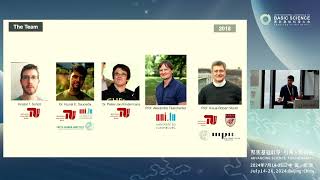
SchNet - A Deep Learning Architecture for Molecules and Materials
Explore SchNet, a deep learning architecture for modeling atomistic systems, and its applications in predicting molecular and material properties across chemical space.
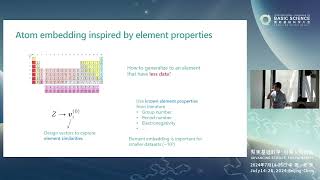
Accelerating Materials Design with Crystal Graph Neural Networks
Explore Crystal Graph Convolutional Neural Networks for predicting material properties and their impact on graph neural networks and transformers in materials design.
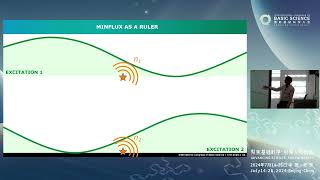
Accessing the Nanoscale with MINFLUX Light Microscopy
Explore MINFLUX, a groundbreaking light microscopy technique achieving nanometer-scale precision in superresolution imaging and single-molecule tracking, revolutionizing cellular observations.
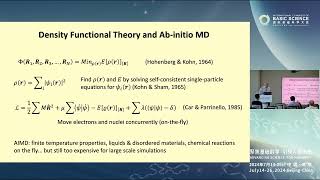
DP-GEN: An Optimal Active Learning Protocol for Constructing Interatomic Potentials - Materials Simulation
Explore DP-GEN, an innovative active learning protocol revolutionizing molecular modeling by constructing accurate interatomic potentials. Learn its three-step iterative process and applications in materials simulation.
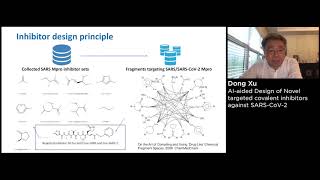
AI-Aided Design of Novel Inhibitors Against SARS-CoV-2
Explore AI-driven drug design for SARS-CoV-2, focusing on 3CLpro inhibitors. Learn about deep Q-learning networks, fragment-based design, and structure-based optimization for developing potential lead compounds.
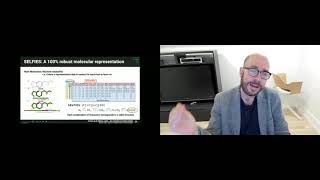
Artificial Intelligence for Molecular Design and Self-Driving Labs
Explore AI and automation for designing functional molecular materials, focusing on recent advancements in the field.
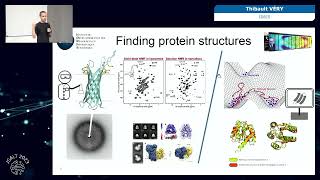
Deep Learning for Protein Structure Discovery
Explore deep learning techniques for uncovering protein structures, revolutionizing molecular biology and drug discovery.
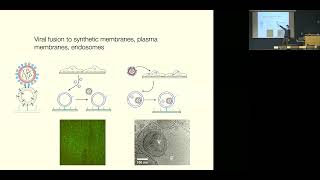
Physical Constraints on the Evolution of Viral Entry
Explore physical constraints on viral entry evolution with Dr. Peter Kasson. Gain insights into membrane dynamics, fusion mechanisms, and pandemic prediction through experimental and computational approaches.

Molly.jl - Molecular Dynamics in Julia
Explore Molly.jl for molecular dynamics simulations in Julia. Learn about its features, advantages, and applications in research, including differentiable molecular simulation and force field improvement.
Spin Orbit Coupling in QMCPACK
Explore spin orbit coupling implementation in QMCPACK with Cody Melton's workshop presentation, covering advanced quantum mechanics concepts and computational techniques.
Surrogate Hessian Method for Geometry Optimization - QMCPACK Workshop 2023
Explore the surrogate Hessian method for efficient geometry optimization in quantum systems, presented by Jaron Krogel at the QMCPACK Workshop 2023.
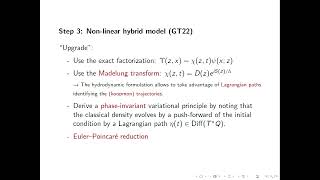
Madelung Transform and Variational Asymptotics in Born-Oppenheimer Molecular Dynamics
Explore variational asymptotics and Madelung transform in Born-Oppenheimer molecular dynamics, enhancing understanding of quantum chemistry principles.
Input Script for LAMMPS - Part 1
Learn to create and structure input scripts for LAMMPS molecular dynamics software, focusing on essential commands and parameters for simulation setup.
Basic Introduction to Molecular Dynamics
Explore molecular dynamics fundamentals, LAMMPS usage, visualization techniques, and key concepts like interatomic potentials and periodic boundary conditions.
Input Script for LAMMPS - Part 3
Learn to create and customize input scripts for LAMMPS molecular dynamics simulations, focusing on advanced techniques and best practices.
Input Script for LAMMPS - Part 2
Learn to create and customize input scripts for LAMMPS molecular dynamics simulations, enhancing your ability to model complex systems efficiently.
LAMMPS Exercises - Part 1
Explore LAMMPS molecular dynamics software through hands-on exercises, enhancing your understanding of simulation techniques and computational modeling.
LAMMPS Exercises - Part 5
Explore advanced LAMMPS exercises to enhance your molecular dynamics simulation skills and deepen your understanding of computational materials science.
Simulations of Multiphase Flow at Multiple Scales
Explore multiphase flow dynamics through simulations at various scales, from molecular to continuum, covering droplet behavior, emulsions, and fluid-solid interactions.
Connecting Modeling, Simulations, and Machine Learning with Experiments for Soft Materials Design - Structure-Property Relationships
Explore molecular modeling, simulations, and machine learning for soft materials design. Connect computational methods with experiments to uncover structure-property relationships in polymers and colloids.