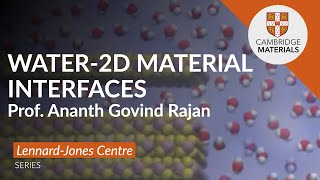
Probing Water-2D Material Interfaces: Quantum and Classical Simulations on Defective and Rough Surfaces
Explore quantum and classical simulations of water-2D material interfaces, focusing on defects and roughness in hexagonal boron nitride. Gain insights into wettability, slip length, and interfacial properties for desalination and sensing applications.
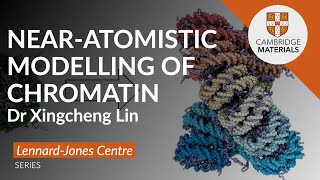
Near-atomistic Modeling of Chromatin - Insights into Structure and Dynamics
Explore near-atomistic modeling of chromatin structure, folding pathways, and sol-gel transitions. Gain insights into genome organization and chromatin behavior under various conditions.
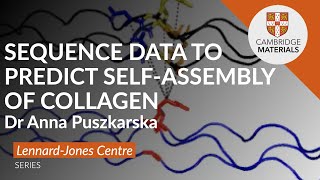
Using Sequence Data to Predict the Self-Assembly of Supramolecular Collagen Structures
Explore collagen self-assembly prediction using amino acid sequences. Learn to design custom periodic collagen structures for novel biomimetic materials.
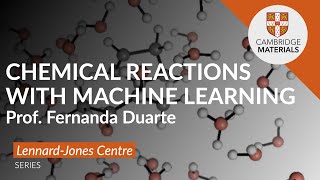
Exploring Chemical Reactions Through Automation and Machine Learning
Explore efficient strategies for generating machine learned potentials to study reaction mechanisms in gas-phase and solution, achieving ab initio accuracy with minimal computational investment.

Ab Initio Charge Transport of Ionic Fluids: Invariance Principles and Topological Invariants
Explore ab initio charge transport in ionic fluids, combining invariance principles and topological quantization to redefine oxidation numbers and electrical conductivity calculations.
Fully Quantum (Bio)Molecular Simulations - Dream or Reality?
Explore quantum-mechanical and machine learning advances in molecular simulations, their potential impact, and challenges in achieving fully quantum dynamics of complex biomolecular systems.

Solvated Electron: First Principles and Machine Learning Approaches
Explore advanced modeling of solvated electrons using machine learning, overcoming challenges in accuracy and efficiency to study structure, dynamics, and properties across temperatures.
New Correlation-Consistent Effective Core Potentials
Explore new correlation-consistent effective core potentials for quantum chemistry calculations, enhancing accuracy and efficiency in molecular simulations.
Orbital Optimization - QMCPACK Workshop 2023
Explore advanced techniques in quantum mechanics with a focus on orbital optimization methods and their applications in computational physics.
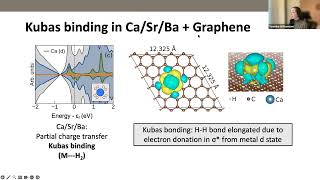
Using QMC to Understand Hydrogen Storage in Metal Decorated Graphene - 14/18
Explore quantum Monte Carlo techniques for analyzing hydrogen storage in metal-decorated graphene, enhancing understanding of advanced energy storage solutions.
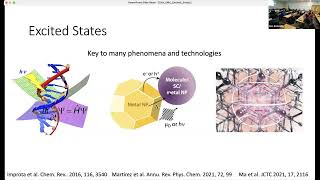
VMC Wave Function Optimization for Excited States in Molecules and Solids - 15/18
Explore VMC wave function optimization techniques for excited states in molecules and solids, enhancing quantum simulations and computational chemistry understanding.
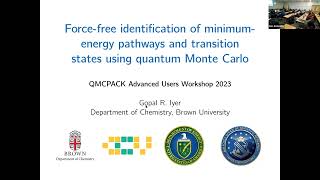
Force-Free Identification of Minimum-Energy Pathways and Transition States Using Quantum Monte Carlo Methods
Explore force-free quantum Monte Carlo methods for identifying minimum-energy pathways and transition states in chemical reactions and material transformations.
Can Microscopes Make Decisions? - Event-Triggered Microscopy
Explore event-triggered microscopy, a breakthrough in real-time decision-making microscopes, and its impact on capturing critical molecular events with unprecedented precision in biological observation.
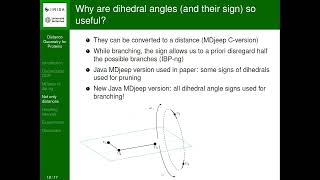
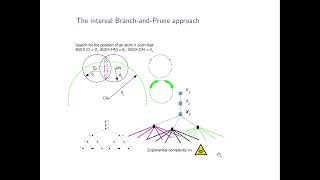
A Study on the Covalent Geometry of Proteins and Its Impact on Distance Geometry
Explore protein covalent geometry and its effects on distance geometry, gaining insights into molecular structures and interactions.
Exploration of Conformations for an Intrinsically Disordered Protein
Explore conformations of intrinsically disordered proteins, delving into their unique structural characteristics and functional implications in biological systems.
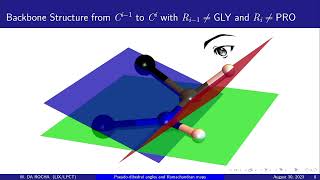
Pseudo Dihedral Angles in Proteins - A New Description of the Ramachandran Map
Explore a novel approach to protein structure analysis using pseudo dihedral angles, offering fresh insights into the Ramachandran map and its implications for protein folding.
A Coarse-Grained Molecular Dynamics Study of Damage Localization During the Fracture of Double Polymer Networks
Explore molecular dynamics of damage localization in double polymer networks, focusing on mechanisms behind increased toughness and the interplay between load sharing and damage propagation.
Foundation Models for Materials Synthesis
Explore foundation models for materials synthesis, focusing on AI-driven approaches to accelerate discovery and innovation in materials science.
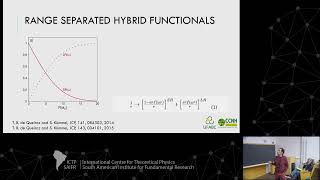
Revealing Mechanisms of Light Harvesting and Charge Separation in Molecular Systems
Explore mechanisms of light harvesting and charge separation in molecular systems, focusing on challenges for time-dependent density functional theory.
Structure-Aware Protein Self-Supervised Learning
Explore structure-aware protein self-supervised learning, combining GNN models with protein language models to enhance structural information capture for improved downstream task performance.

New Developments in Wolfram Chemistry
Explore upcoming Wolfram Language chemistry features, including enhanced molecular visualization, crystal structures, and biomolecule representation. Learn about ChemistryFunctions paclet for dynamic manipulation and analysis.