Reinforcement Learning-Based Fine-Tuning of Diffusion Models for Drug Discovery
Dive into advanced reinforcement learning techniques for fine-tuning diffusion models, focusing on accelerated drug discovery, bioinformatics, and molecular compound predictions.
Topological Message Passing: From Graph Neural Networks to Simplicial Complexes on CW Networks
Delve into advanced Graph Neural Network concepts, exploring topological message passing, simplicial complexes, and high-dimensional interactions for computational graph networks and molecular design applications.
Universality Classes for 1+1 Dimensional Systems
Explore universality classes in 1+1 dimensional systems, focusing on weak universality conjecture, graphical construction, and links to Brownian web. Gain insights into complex systems modeling.
Estimating Normalizing Constants for Log-Concave Distributions - Algorithms and Lower Bounds
Explore algorithms and lower bounds for estimating normalizing constants in log-concave distributions, covering annealing, Monte Carlo methods, and Langevin dynamics.
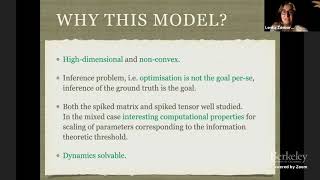
Insights on Gradient-Based Algorithms in High-Dimensional Learning
Explore gradient-based algorithms in high-dimensional learning, covering statistical physics solutions for performance analysis in nonconvex settings like spiked mixed matrix-tensor model, perceptron, and phase retrieval.
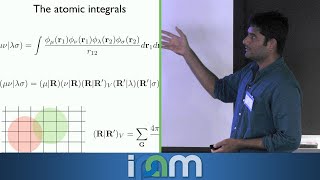
Auxiliary Field Quantum Monte Carlo - AFQMC with Multi Slater Wavefunctions
Explore advanced quantum Monte Carlo techniques, focusing on AFQMC with multi-Slater wavefunctions and efficient exchange matrix evaluation for large-scale quantum systems.
Advancing Molecular Simulation with Deep Learning - IPAM at UCLA
Explore cutting-edge applications of deep learning in molecular simulation, covering quantum chemistry, force fields, and Markov State Models for advanced scientific research.
Tensor Networks -QC-DMRG- in a Complete Active Space Coupled Cluster Method
Explore tensor networks in quantum mechanics, focusing on their application in coupled cluster methods for modeling strongly correlated systems and computing dynamical correlations.
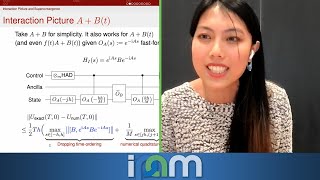
Time-Dependent Hamiltonian Simulation of Highly Oscillatory Dynamics - IPAM at UCLA
Explore highly oscillatory dynamics in quantum systems, focusing on efficient simulation algorithms for time-dependent Hamiltonians with applications in various scientific fields.
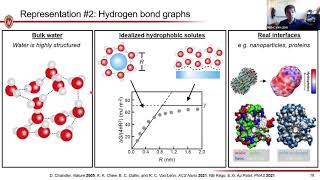
MD Simulations and Machine Learning to Quantify Interfacial Hydrophobicity
Explore molecular dynamics simulations and machine learning techniques to analyze interfacial hydrophobicity, focusing on efficient data analysis methods and topological approaches for complex chemical systems.
Message Passing Neural Networks for Atomistic Systems - Molecules
Explore message passing neural networks for molecular systems, focusing on their application in quantum mechanics and multiscale approaches to atomistic modeling.
New Approaches in Simulation of Transition Paths - IPAM at UCLA
Explores tensor methods for simulating chemical transition processes, focusing on compressing high-dimensional PDE functions and introducing a novel tensor-network generative modeling approach without optimization.
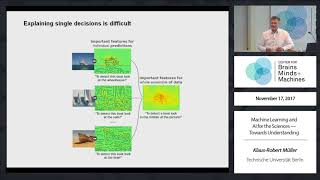
Machine Learning and AI for the Sciences - Towards Understanding
Explore ML and AI applications in sciences, focusing on neuroscience, medicine, and physics. Learn about extracting insights from ML models to enhance understanding in fields like quantum chemistry.
How Will Quantum Computing Change the Technology Landscape? - Bruce Davie, Systems Approach, LLC
Explore quantum computing's potential impact on technology, from achieving quantum supremacy to revolutionizing cryptography, optimization, and machine learning, while addressing challenges and separating hype from reality.
Quantum Algorithms for Chemistry - Part 2
Explore advanced quantum algorithms for chemistry applications, focusing on recent developments and their potential impact on computational chemistry and materials science.
Quantum Algorithms for Chemistry - Part I
Explore quantum algorithms for chemistry applications, focusing on computational techniques and their potential impact on molecular simulations and chemical problem-solving.
Open Challenges in AI for Molecular Design: Representation, Experimental Alignment, and Oracle Reliability
Explore AI challenges in molecular design: representation, experimental alignment, and oracle reliance. Learn about new workflows and approaches to address real-world complexities in molecular discovery.
Deep Learning and Numerical Methods Intersections for Improving Molecular and Fluid Dynamics
Explore intersections of deep learning and numerical methods to enhance molecular and fluid dynamics simulations, improving accuracy and efficiency in scientific computations.
Large ML Potentials for Chemistry - Generalization, Inductive Biases, and Error Cancellation
Explore machine learning potentials in chemistry, focusing on generalization, inductive biases, and error cancellation techniques for improved accuracy and efficiency.

Quantum Computing: Untangling the Hype
Experts discuss quantum computing's potential, workings, and impact on fields like cryptography and molecular modeling, separating hype from reality in this comprehensive exploration.
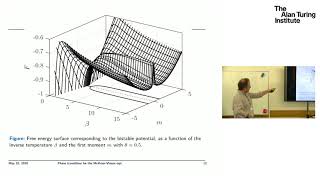
Phase Transitions for Mean Field Limits of Noisy Interacting Agents
Explore phase transitions in mean field limits of noisy interacting agents, examining complex systems modeling and statistical approaches for accurate predictions in various scientific fields.