
Применение Grafana Stack для Централизованного Логирования и Трейсинга
Узнайте, как эффективно внедрить Grafana stack для централизованного логирования и трейсинга, включая миграцию с Elastic на Loki и Tempo, масштабирование и решение технических проблем.
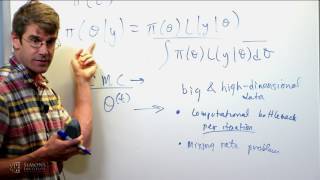
Scaling Up Bayesian Inference for Big and Complex Data
Explore advanced Bayesian inference techniques for large-scale datasets, focusing on computational challenges and innovative solutions in machine learning and deep learning applications.
Causal Inference for Earth System Sciences - Jakob Runge
Exploring causal inference techniques for Earth system sciences, focusing on advanced methods to uncover complex relationships in climate data and improve understanding of multi-scale processes.
Large Scale Machine Learning and Convex Optimization - Lecture 1
Explore advanced stochastic optimization techniques for large-scale machine learning, including novel Newton-based algorithms and hybrid approaches that achieve improved convergence rates and efficiency.
From Small Data to Big Data and Back: Statistics and Data Science - Rothschild Lecture
Explore the evolution of statistics from small to big data, examining key issues in modern data analysis and their impact on computational methods and predictive modeling.

Data-Driven Decision Making in the Music Industry
Explore data-driven insights in the music industry with Alex White, co-founder of Next Big Sound, as he discusses leveraging analytics for artist success.
Big Data in Personalized Medicine - Using Pharmacogenomics for Tailored Treatment
Explore how high-throughput DNA sequencing and pharmacogenomics drive personalized medicine, focusing on the development of ePGA-WB for optimized drug therapy in Western Balkan populations.
Debiasing Coarse-Scale Climate Models Using Statistically Consistent Neural Networks
Explores using neural networks to improve coarse-scale climate models, addressing unresolved scales and enhancing predictions. Discusses framework, wavelet analysis, and multi-model architecture for more accurate climate simulations.
A Deep Learning Parameterization of Gravity Wave Drag Coupled to an Atmospheric Global Climate Model - Aditi Sheshadri
Explores deep learning parameterization of gravity wave drag in climate models, demonstrating improved predictions of atmospheric phenomena like the QBO and potential for generalizing to future climate scenarios.
Earth System Emulation - Duncan Watson-Parris #CLIMATE-C21
Explore Earth system emulation for climate projections, uncertainty analysis, and machine learning applications in weather and climate science. Gain insights into advanced modeling techniques and data-driven approaches.
Data-Driven and Data-Assisted Modeling for Applications in Fluid Dynamics and Geophysics
Explores data-driven and data-assisted modeling techniques for fluid dynamics and geophysics, focusing on machine learning applications in climate science and high-resolution forecasting.
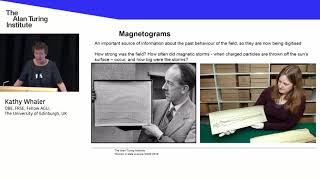
How Big Data Has Transformed and Is Transforming Geophysics
Exploring geophysical advancements: from analog instruments to digital data collection, satellite technology, and machine learning, revolutionizing Earth and planetary studies.
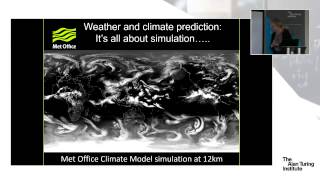
Big Data, Met Office and 21st Century Problems
Explore weather forecasting, climate prediction, and big data analysis at the Met Office. Learn about simulation techniques, ensemble forecasting, and addressing 21st-century environmental challenges.
Atmospheric Radiation - Using Machine Learning for the Unknowable and Uncomputable - Robert Pincus
Exploring machine learning applications in atmospheric radiation to tackle unknowable and uncomputable aspects, enhancing climate modeling and understanding of Earth's energy balance.
Skillful El Nino Prediction Beyond Predictability Barriers - Henk Dijkstra
Explores advanced techniques for predicting El Niño events beyond traditional limitations, discussing innovative approaches to enhance climate forecasting accuracy and extend prediction timeframes.
Relating Coastal Sea Level to Its Drivers in the Interior - Abigail Bodner
Explore the connection between coastal sea levels and interior drivers using advanced data analysis and machine learning techniques to enhance climate change understanding and prediction.
Objective Discovery of Dominant Dynamical Regimes - Bryan Kaiser - Climate-C21
Discover dominant dynamical regimes in climate systems using machine learning and big data. Explore objective methods to advance theoretical understanding and inform future climate predictions at regional scales.
Revealing the Impact of Global Heating on the Meridional Overturning Circulation
Explore the effects of global heating on ocean circulation using transparent machine learning techniques. Gain insights into climate system dynamics and future regional impacts.
Deep Unsupervised Learning for Climate Informatics - Claire Monteleoni
Exploring deep unsupervised learning techniques for climate data analysis, focusing on innovative approaches to extract insights from complex Earth system observations and modeling data.
Exploring Physical and Machine Learning Approaches for Stochastic Modeling and Ensemble Prediction of Weather and Climate
Explores innovative approaches combining physical principles and machine learning for stochastic modeling and ensemble prediction in weather and climate systems, addressing challenges in multi-scale processes and future projections.
Data-Driven Subgrid-Scale Modeling - Stability, Extrapolation, & Interpretation
Explores data-driven subgrid-scale modeling in climate science, focusing on stability, extrapolation, and interpretation. Discusses advancements in theoretical understanding and the potential of machine learning to address complex climate processes.