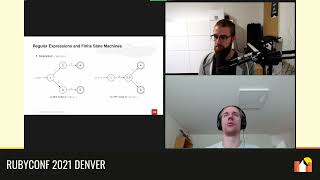
Just-in-Time Compiling Ruby Regexps on TruffleRuby
Explore TruffleRuby's innovative approach to just-in-time compiling Ruby regular expressions, achieving up to 40x faster execution through finite-state machines and cross-language optimization.
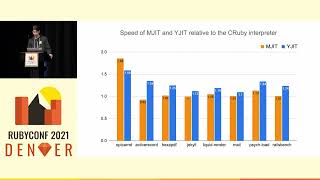
YJIT - Building a New JIT Compiler Inside CRuby
Explore YJIT, a new JIT compiler for CRuby, and learn about its implementation, performance improvements, and future plans for Ruby optimization.
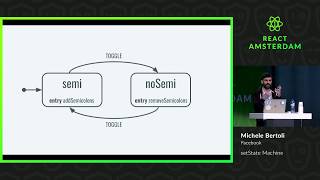
SetState Machine
Explore deterministic state management in React components using State Machines. Learn Automata theory basics and discover how to generate automated tests for more predictable applications.

SetState, We Need to Talk!
Explore finite state machines for managing React component state, eliminating bugs, and structuring development. Learn through practical examples and build your own state machine.

Simplifying Complex UIs with Finite Automata & Statecharts
Explore finite automata and statecharts to manage complex UI states, enhancing app robustness and visualization. Learn innovative techniques for implementation, testing, and automation with practical demos.

Crafting Stateful Styles with State Machines
Explore innovative UI styling using finite state machines, enhancing maintainability and interactivity through ARIA, data attributes, and CSS variables for complex user interfaces.

Máquinas de estado finitas con XState - Carlos Martínez Avendaño
Desarrolla mejores experiencias de usuario utilizando máquinas de estado finitas con XState. Aprende a implementar esta técnica para mejorar el flujo y la lógica de interacciones en componentes y UX.

Reactive Synthesis - Open Questions and Challenges
Experts discuss open questions and challenges in reactive synthesis, exploring cutting-edge research and future directions in system modeling and automation.
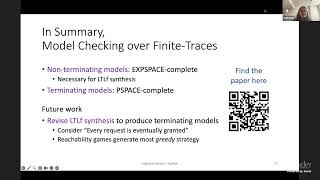
Synthesis and Verification of Finite Horizon Tasks
Explore finite horizon task synthesis and verification techniques, focusing on model and system creation for time-bounded objectives in computational systems.
From Fallible DFAs to DFA-Therapy and Things In-Between
Explore the theoretical foundations of fallible DFAs and their therapeutic applications, examining key concepts and intermediate developments in automata theory.
Finite Automata as a Tool for Modeling Psychological Phenomena
Explore how finite automata can effectively model psychological theories, focusing on stress and cognitive processes through clear mathematical frameworks and comparative analysis techniques.
Generating BPF Infrared Decoders Using Finite Automations
Generate BPF infrared decoders efficiently using finite automations. Explore advanced techniques for optimizing decoder performance in Linux systems.

Regular Expression Matching using Bit Vector Automata
Explore a new algorithm for efficient regex matching with bounded repetition using nondeterministic bit vector automata, offering improved performance for challenging patterns in practice.
Derivative Based Nonbacktracking Real-World Regex Matching with Backtracking Semantics
Explore a new derivative-based theory and algorithm for nonbacktracking regex matching, supporting anchors and counting while preserving backtracking semantics. Implemented in .NET7 with formal proof of correctness.

Efficient Matching of Regular Expressions with Lookaround Assertions
Explore efficient matching of regular expressions with lookaround assertions, including formal semantics, simplification properties, and a new O(m·n) algorithm using oracle-NFAs for improved performance.
Significance of Regular Languages and Regular Operations - Lecture 5
Explore regular languages, non-regular examples, and key operations like union, concatenation, and Kleene star to deepen understanding of formal language theory.

Recognition of Tokens in Compiler Design - Transition Tables and Diagrams
Explore token recognition in compiler design, including transition tables and diagrams. Learn key concepts for understanding lexical analysis and automata theory in compilation processes.

LEX: Language Specifying Lexical Analyzer - Compiler Design
Explore LEX, a powerful tool for creating lexical analyzers in compiler design. Learn its functionality, usage, and implementation in language processing.
Elimination of Left Recursion in Compiler Design - Examples and Explanation
Explore left recursion in compiler design, its impact on parsing, and techniques for elimination. Learn to identify and resolve left-recursive grammars for efficient parsing.

Specification of Tokens in Compiler Design - Regular Expressions, Languages, and Alphabets
Explore token specification in compiler design, covering regular expressions, languages, strings, and alphabets. Learn key concepts for effective lexical analysis and token recognition.
Parse Tree and Derivation Trees in Compiler Design
Explore parse trees, left-most and right-most derivations, and derivation trees in compiler design. Learn key concepts for understanding language parsing and syntax analysis.