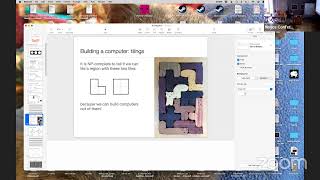
The Dynamics of Computation and the Computational Power of Dynamics
Explore the intersection of computation and dynamics, examining computational models, physical systems, and mathematical concepts to understand the nature of computation and its manifestation in various forms.
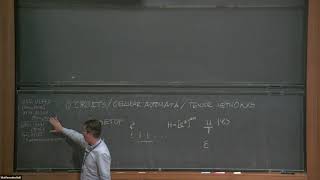
Quantum Circuits, Cellular Automata and Tensor Networks - Ignacio Cirac
Explore quantum circuits, cellular automata, and tensor networks, focusing on their representations, entanglement properties, and generalizations to quantum channels and measurement-assisted dynamics.
Crystals That Think About How They're Growing - Molecular Programming Research Seminar
Explore DNA nanotechnology's potential for creating smart molecular systems, including a 355-tile set capable of implementing various 6-bit algorithms with high reliability.
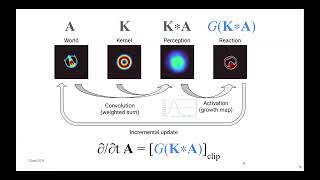
Lenia: A Continuous Model of Virtual Cell Growth Patterns
Explore virtual cell growth patterns through Lenia, a continuous model presented by Dr. Bert Chan in this Mathematical Oncology seminar.
Drum Generation with Cellular Automata - Lecture 14
Implement a Python-based cellular automaton for generating unique drum patterns, exploring rules for syncopation, accenting, and mutation in algorithmic music composition.

Python Simulation Tutorial - Conway's Game of Life
Learn to create Conway's Game of Life simulation in Python using Pygame. Build a cellular automation, understand its rules, and implement key features like grid drawing and cell updates.
Cellular Automaton Visualization with Rust and Bevy
Explore cellular automata visualization using Rust and Bevy framework. Learn implementation techniques and discover the fascinating world of simple simulations and their visual representations.
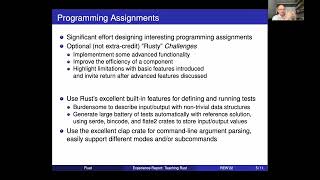
RustEdu Workshop - Teaching Rust and Programming Assignments
Explore teaching Rust through practical assignments, including interpreters, puzzle solvers, and networked servers. Gain insights from two semesters of instruction experience.

Intelligence at the Edge of Chaos - Understanding Complex Reasoning in Overparameterized LLMs
Explore groundbreaking research on how intelligence emerges in LLMs through complex datasets, focusing on the critical balance between order and chaos in cellular automata-based training.
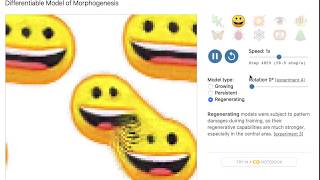
Growing Neural Cellular Automata
Explore neural cellular automata that learn to grow complex patterns through local interactions, mimicking biological morphogenesis and self-organization in a fascinating, interactive model.
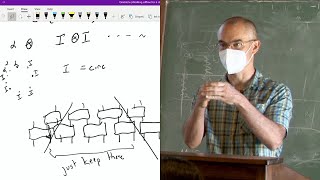
Introduction to Quantum Cellular Automata
Explore quantum cellular automata: fundamental concepts, applications, and connections to topological phases of matter in this comprehensive lecture by Microsoft Research expert.
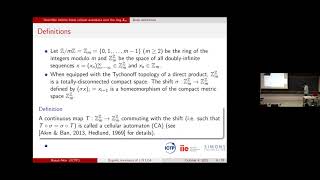
Reversible D-Dimensional CA Over the Ring ZM and Some Applications in Ergodic Theory
Explore cellular automata on $\mathbf{Z}_p$ and $\mathbf{Z}_m$, covering invertibility, ergodic properties, and entropy concepts. Delve into measure-theoretic and topological entropy for 1D linear CA and $\mathbb{Z}^2$-actions.
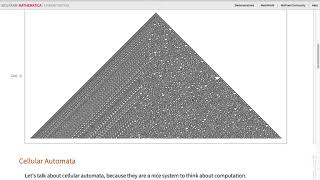
Cellular Automata: Algorithmic Information Dynamics in Living Systems
Explore cellular automata, a computational model for complex systems, and their applications in studying causality and living systems from networks to cells.
Mathematical Games - Turing Machines and Turmites - Episode 19
Explore mathematical games and puzzles involving Turing machines and turmites with Ed Pegg Jr. Discover fascinating concepts in computational theory and cellular automata.
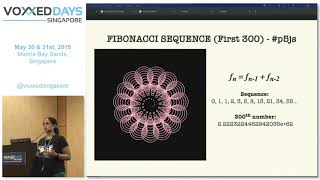
Can Code, Will Generate Art
Explore generative art through coding, from visualizing mathematical concepts to using neural networks for creative design. Learn how programming can be a tool for artistic expression.
Crowd Your Way Out of a Paper Bag
Explore cellular automata, swarms, and agents in crowd simulations. Learn about randomness in AI, machine learning basics, and spatial navigation through engaging simulations and practical examples.
Cellular Automata - How to Become an Artist with a Few Lines
Explore the artistic potential of cellular automata through simple code, transforming mathematical concepts into visually stunning patterns and designs.
Computational Modelling of Growth and Response of Multicellular EMT6/Ro Spheroids to Multi-Fraction Irradiation
Explore computational modeling of EMT6/Ro spheroid growth and response to multi-fraction irradiation, enhancing understanding of cancer dynamics and potential therapeutic improvements.

CellPond: Spatial Programming Without Escape
Explore spatial programming with CellPond, a novel approach that eliminates escape hatches and maximizes visual, interactive benefits.

Additive Cellular Automata Graded-Monadically
Explore cellular automata through graded comonadic and monadic perspectives, focusing on additive variants and their computational implications.
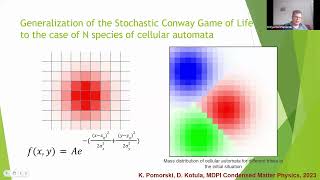
Classical and Quantum Conway Game of Life - Methodologies and Applications
Explore classical and quantum Conway Game of Life methodologies, including stochastic models, dissipative Schrödinger equations, and thermodynamic aspects. Gain insights into complex systems and quantum mechanics applications.