Theory of Computation
Explore finite automata, regular languages, context-free grammars, and Turing machines. Learn about computational models, their properties, and fundamental concepts in theoretical computer science.
Greibach Normal Form and Conversion of Context Free Grammar to GNF in Automata Theory
Explore Greibach Normal Form and learn how to convert context-free grammars to GNF. Gain insights into this important concept in automata theory and formal language processing.
Introduction to the Theory of Computing - Stanford
Explore fundamental concepts of theoretical computer science, including automata, computability, and complexity theory, with practical applications and algorithmic fairness.
Theory of Computation, Fall 2020
Explore computability and complexity theory with MIT's in-depth course. Covers automata, Turing machines, undecidability, NP-completeness, and advanced topics in computational theory.
Towards Understanding Modern Alchemy - Transformers as a Computational Model
Explore in-context learning of formal languages, comparing Transformers to other models and examining specialized "n-gram heads" for improved performance in language modeling.
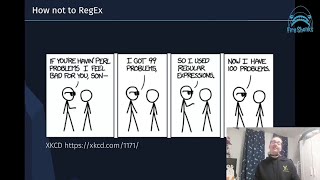
Regular Expressions: From Basics to Denial of Service Attacks - FireShonks 2023
Einführung in reguläre Ausdrücke: Von Grundlagen bis zu Sicherheitsrisiken wie ReDoS-Angriffen. Für Einsteiger geeignet, erklärt Konzepte und potenzielle Gefahren komplexer Ausdrücke.
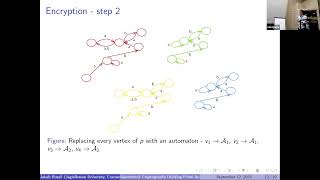
Kryptografia Asymetryczna z Użyciem Synchronizacji Automatów Skończonych
Poznaj innowacyjne podejście do kryptografii asymetrycznej wykorzystujące synchronizację automatów skończonych w wykładzie eksperta z Uniwersytetu Jagiellońskiego.
Great Ideas in Theoretical Computer Science: Finite Automata
Explore finite automata and regular languages in theoretical computer science, covering DFAs, computation concepts, and language analysis techniques.
Formal Verification of Embedded Linux Systems Using Trace-Based Models
Explore trace-based models for formal verification of embedded Linux systems, focusing on safety-critical aspects, real-time properties, and system instrumentation techniques.
PLSE Seminar Series - The Power of Symbolic Automata
Explores symbolic automata, their applications in program verification, and novel decision procedures for equivalence checking and minimization of these powerful automata operating over infinite alphabets.
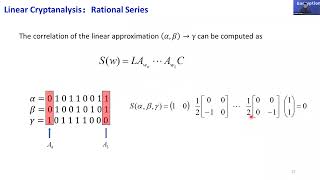
Cryptanalysis of ARX Ciphers - Recent Developments and Open Questions
Explore recent advancements in cryptanalysis of ARX ciphers, covering representation, differential group analysis, automatic methods, and open questions in this comprehensive talk by Siwei Sun.
Conversion of Regular Expression to Finite Automata Using Subset Method in Automata Theory
Learn to convert regular expressions to finite automata using the subset method, covering NFA construction, epsilon transition removal, and DFA conversion in automata theory.
Conversion of Finite Automata to Regular Expression Using State Eliminating Method in Automata Theory
Learn to convert finite automata to regular expressions using the state elimination method, a crucial technique in automata theory for simplifying complex systems.
Conversion of NFA with Epsilon to NFA Without Epsilon in Automata Theory
Learn to convert NFA with epsilon transitions to NFA without epsilon, a crucial skill in automata theory. Understand the step-by-step process and its importance in simplifying finite automata representations.
Simplifying Complex UIs with Finite Automata & Statecharts
Explore finite automata and statecharts to manage complex UI states, enhancing app robustness and visualization. Learn innovative techniques for implementation, testing, and automation with practical demos.
Finite Automata as a Tool for Modeling Psychological Phenomena
Explore how finite automata can effectively model psychological theories, focusing on stress and cognitive processes through clear mathematical frameworks and comparative analysis techniques.
Generating BPF Infrared Decoders Using Finite Automations
Generate BPF infrared decoders efficiently using finite automations. Explore advanced techniques for optimizing decoder performance in Linux systems.
Generating Parsers and Tokenizers in C++ with Maphoon - Part 2
Explore bottom-up parsing and tokenizing in C++ using Maphoon. Learn to generate efficient parsers, handle errors, and create Abstract Syntax Trees for compiler construction.