Synthesizing Distributed Protocols from Global Session Types
Automata-theoretic approach to synthesizing distributed protocols from global session types, introducing a sound and complete projection operator for multiparty session types.
Computational Modelling of Growth and Response of Multicellular EMT6/Ro Spheroids to Multi-Fraction Irradiation
Explore computational modeling of EMT6/Ro spheroid growth and response to multi-fraction irradiation, enhancing understanding of cancer dynamics and potential therapeutic improvements.
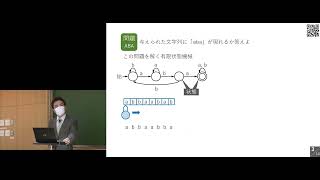
計算量理論入門 - 問題と機械 - 第1回
Dive into computational complexity theory through fundamental concepts of finite state machines, Turing machines, and the Church-Turing thesis, exploring how to measure and understand mathematical complexity.

CellPond: Spatial Programming Without Escape
Explore spatial programming with CellPond, a novel approach that eliminates escape hatches and maximizes visual, interactive benefits.

Complete Multiparty Session Type Projection with Automata - ST30
Explore efficient multiparty session type projection using automata. Learn sound, complete, and efficient techniques for verifying asynchronous communication protocols.

Additive Cellular Automata Graded-Monadically
Explore cellular automata through graded comonadic and monadic perspectives, focusing on additive variants and their computational implications.
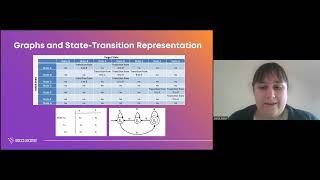
States, Transitions and a Bit of Code
Explore state management, transitions, and coding techniques in UI development for creating dynamic and responsive user interfaces.
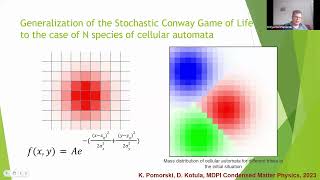
Classical and Quantum Conway Game of Life - Methodologies and Applications
Explore classical and quantum Conway Game of Life methodologies, including stochastic models, dissipative Schrödinger equations, and thermodynamic aspects. Gain insights into complex systems and quantum mechanics applications.

Akka Actor FSM: Changing Behavior with Improved Readability
Explore Akka Actor FSM to enhance actor behavior with improved code readability, especially for complex logic and challenging contexts.
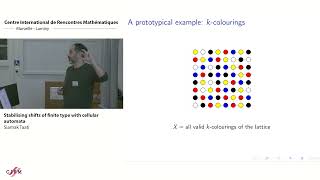
Stabilizing Shifts of Finite Type with Cellular Automata
Explore stabilization of finite type shifts using cellular automata in this mathematical conference talk on dynamic system complexity.
Tensor Networks for Classical and Quantum Machine Learning Tasks
Explore tensor networks for machine learning in quantum systems. Learn to implement sequence prediction using matrix product operators for classical and quantum problems.
Generating Parsers and Tokenizers in C++ with Maphoon - Part 2
Explore bottom-up parsing and tokenizing in C++ using Maphoon. Learn to generate efficient parsers, handle errors, and create Abstract Syntax Trees for compiler construction.

LR(0) Parser in Compiler Design - Bottom-up Parsing and Types of LR Parsers
Explore LR(0) parsing, bottom-up techniques, and LR parser types in compiler design. Learn key concepts for efficient syntax analysis and code generation.

CLR(1) Parser in Compiler Design - Bottom-up Parsing and Types of LR Parsers
Explore CLR(1) parsing in compiler design, including bottom-up parsing techniques and various LR parser types. Gain insights into efficient syntax analysis for programming languages.
Challenges in Formalising Recent Results in Formal Language Theory
Explore challenges in formalizing recent results linking formal language theory and computational group theory, with insights on making proofs more amenable to formalization.
On Partial-Order and Automata Techniques for Analyzing Communication
Explores verification and synthesis techniques for peer-to-peer and mailbox communication in concurrent programming, focusing on message-passing models and their applications in distributed systems.
Distributed Controller Synthesis for Deadlock Avoidance
Explore advanced techniques for synthesizing distributed controllers to prevent deadlocks in complex systems, enhancing system reliability and performance.
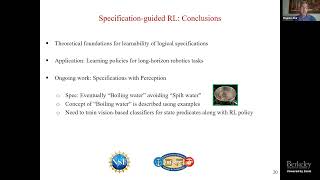
Specification-guided Reinforcement Learning
Explore specification-guided reinforcement learning techniques for synthesizing models and systems, presented by Rajeev Alur from the University of Pennsylvania.
Synthesis of Privacy-Preserving Systems
Explore privacy-preserving system synthesis, addressing hidden signals, budget constraints, and incomplete information while satisfying specifications and protecting secrets.
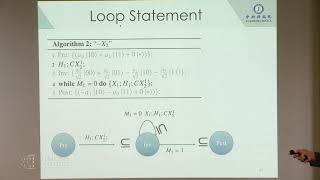
Automata-Based Approach for Quantum Circuit and Program Verification
Innovative automata-based technique for verifying quantum circuits, offering scalable analysis and bug detection through compact state representation and algebraic computations.
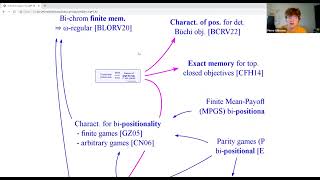
Infinite Duration Games, Memory and Graphs - Part 2
Delve into advanced concepts of infinite duration games, exploring memory structures and graph theory through rigorous mathematical analysis and computational complexity perspectives.