Armchair Type Theory
Explore the historical roots and fundamental concepts of type theory, tracing its origins beyond Haskell and examining its impact on modern programming paradigms.

Fast and Efficient Boolean Unification for Hindley-Milner-Style Type and Effect Systems
Explore efficient Boolean unification for Hindley-Milner-style type and effect systems. Learn about a hybrid algorithm improving compilation speed and reducing inference overhead in polymorphic effect systems.
An Intrinsically Typed Compiler for Algebraic Effect Handlers
Explore type-preserving compilation for algebraic effect handlers, focusing on safety in continuation capture and resumption using stack polymorphism in an Agda-implemented compiler.
Associated Effects: Flexible Abstractions for Effectful Programming
Explore associated effects, a programming language feature enhancing type classes' flexibility in abstracting over function effects, improving expressive power in type and effect systems.
A Calculus of Inductive Linear Constructions
Explore a novel calculus combining linear and dependent types, addressing challenges in linear dependent types research and enabling efficient resource management in programming.
An Intrinsically-typed Probabilistic Programming Language in Coq - Extended Abstract
Explore formalization of intrinsically-typed probabilistic programming language in Coq, focusing on syntax, evaluation, and formal verification applications.
A Type System for Feature Engineering in Machine Learning
Explore a dependent type system for feature engineering, enhancing machine learning model inputs through advanced data operations and compiler techniques.
A Type-Theoretic Account of Quantum Computation
Explore type-theoretic concepts for describing and proving properties of quantum computations, focusing on quantum circuits using Coq's dependent and polymorphic types.

Explicit Refinement Types - A Type Theory with Embedded Proofs
Explore λert, a type theory with explicit proof refinement types. Learn about its soundness, denotational semantics, and formalization in Lean 4.
Modular Denotational Semantics for Effects with Guarded Interaction Trees
Explore guarded interaction trees for representing higher-order computations with effects in Coq. Learn about modular reasoning and cross-language interactions in higher-order languages.
Binding Syntax for Dependently-Typed Programs - WITS'24
Explore innovative binding syntax for dependently-typed programs, enhancing ergonomics while maintaining fixed grammar for improved error messaging.
Efficient Evaluation with Controlled Definition Unfolding - WITS'24
Explore efficient evaluation techniques in polymorphic and dependently typed languages, focusing on controlled definition unfolding for improved user interaction and unification processes.
Parameterized Algebraic Protocols
Explore parameterized algebraic protocols for defining protocol templates and session types, enhancing expressiveness and modularity while enabling efficient type checking in linear time.
Operational Game Semantics for Generative Algebraic Effects and Handlers
Explore operational game semantics for generative algebraic effects and handlers in a typed call-by-value λ-calculus, focusing on dynamic allocation and first-class effect instances.
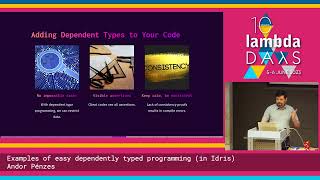
Examples of Easy Dependently Typed Programming in Idris
Explore practical applications of dependently typed programming in Idris, focusing on everyday software correctness without complex proofs. Suitable for those familiar with algebraic data types and FP functions.
How to Trust a Verified Program - Challenges and Solutions in Program Verification
Explore challenges in trusting verified programs, examining theoretical and practical issues in program verification using proof assistants, and discussing potential solutions for enhancing trustworthiness.
Operational Game Semantics for Generative Algebraic Effects and Handlers
Explore operational game semantics for generative algebraic effects and handlers in a typed call-by-value λ-calculus with dynamic allocation of effect instances.

Dependently-Typed Programming with Logical Equality Reflection
Explore System DE, a calculus for dependently-typed programming with equality reflection. Learn about termination tracking, inductive proofs, and performance-safety trade-offs in functional languages.

Graded Modal Dependent Type Theory with Universe and Erasure - Formalized
Explore a graded modal type theory with dependent types, erasure, and formalized meta-theoretic properties. Delve into its universe, extraction function, and soundness proofs for open programs.

Session Types vs. Ordinary Types: Understanding Fundamental Differences - Lecture 30
Explore fundamental principles of type systems, comparing session types with traditional types in logic, mathematics, and computer science.

What We Learned from Writing a Book About Session Types
Explore insights gained while writing a book on session types, including coinductive definitions, linear vs. sharable types, subtyping, and propositions-as-types approach.