Formalizing the ∞-Categorical Yoneda Lemma
Explore the first formalization of ∞-category theory's Yoneda lemma using Rzk, a new proof assistant for synthetic ∞-category theory, paving the way for advanced mathematical proofs.
Uncovering the Unknown - Principles of Type Inference in Programming Languages
Explore type inference in programming languages, uncovering quirks and power in C#, Scala, and Haskell. Delve into local and global inference, constraint typing, and structural typing.
Universes and Lifetimes in Rust - Higher-Ranked Types Implementation
Explore higher-ranked types in Rust, focusing on universes and placeholders in subtyping. Learn about implementation details and advanced concepts in the Rust compiler.
Gradualizing Languages with Set-Theoretic Types in Elixir
Explore practical implementations of gradual set-theoretic types in Elixir, focusing on disjoint unions, singleton types, and elegant solutions for type representation and checking.
Scheduling Array Operations for GPU and Distributed Computing
Explore array operation scheduling for optimized execution across hardware. Learn about static scheduling, type theory, and parallelization for GPUs and distributed computing.
Type Theory Session Preview - POPL 2023
Explore type theory fundamentals and recent advancements in this expert-led session preview for POPL 2023, enhancing accessibility of upcoming talks.

On the Metatheory of IRs and the CPS-Calculus
Explore the metatheory of IRs and CPS-calculus, examining their foundations, semantics, and applications in compiler optimization and dependently-typed programming languages.

Structural Subtyping as Parametric Polymorphism
Explore the relationship between structural subtyping and parametric polymorphism in programming languages, focusing on their expressive power and potential encodings.

Mutually Iso-Recursive Subtyping - OOPSLA 2023
Explore mutually iso-recursive subtyping, addressing challenges in type recursion for programming languages. Gain insights into efficient type checking and subtyping for intermediate code representations.
Combining Dependency, Grades, and Adjoint Logic in Type Systems
Explore new dependent type systems combining graded/linear types with modal operators and Adjoint Logic. Delve into meta-theoretic properties and graded substitution in advanced type theory.
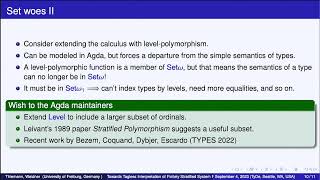
Towards Tagless Interpretation of Stratified System F
Explore the design of an intrinsically typed, tagless interpreter for stratified System F in Agda, focusing on advanced type theory concepts and implementation strategies.
A Dependently Typed Language with Dynamic Equality
Explore a novel dependently typed language with dynamic equality, addressing usability issues in type systems and providing clearer error messages through runtime equality checking.
Internalizing Indistinguishability with Dependent Types
Explore a novel type system combining dependency tracking and dependent types, internalizing indistinguishability for enhanced information flow control and program equivalence reasoning.
Homotopy Type Theory for Sewn Quilts
Explore PieceWork, an innovative programming language for quilt design inspired by Homotopy Type Theory. Learn how computational methods can enhance diversity in sewn designs and bridge programming theory with quilting craft.
Ill-Typed Programs Don't Evaluate - Two-Sided Type Systems for Program Verification
Explore two-sided type systems for symmetrical well-typing and ill-typing, enabling incorrectness reasoning in higher-order program verification and precise data-flow typing.
Internal Parametricity Without an Interval
Explore internal parametricity in type theory without explicit geometry. Learn about a simple extension to Martin-Löf type theory and its implications for parametricity and canonicity.
Peter Dybjer - Intuitionistic Type Theory
Explore intuitionistic type theory, inductive definitions, and finite axiomatizations in this advanced lecture on mathematical foundations and type systems.
Erik Palmgren: From Type Theory to Setoids and Back
Exploring setoids in constructive mathematics, their implementation in proof assistants, and their role in formalizing Bishop-style mathematics and Martin-Löf type theory models.
The Extended Predicative Mahlo Universe and the Need for Partial Proofs
Explores the extended predicative Mahlo Universe in type theory, discussing the need for partial functions and proofs to achieve a more predicative justification of the Mahlo Universe.
A Fibrational Framework for Modal Simple Type Theories
Explore modal extensions of homotopy type theory, focusing on fibrational frameworks for modal simple type theories and their applications in topology, geometry, and spectra.
Discrete and Codiscrete Modalities in Cohesive HoTT
Explore discrete and codiscrete modalities in Cohesive Homotopy Type Theory, examining their applications in topology, differential geometry, and synthetic formalizations of mathematical concepts.