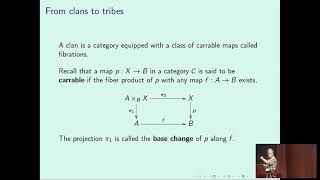
On Voevodsky's Univalence Principle - André Joyal
Explorez le principe d'univalence de Voevodsky avec André Joyal, examinant ses implications pour la théorie des types et les catégories dans cette conférence commémorative approfondie.
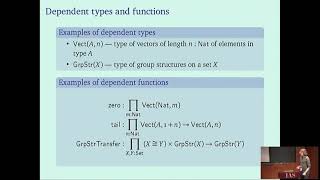
Univalent Foundations and the Equivalence Principle - Benedikt Ahrens
Explore univalent foundations and the equivalence principle in mathematics, covering type theory, dependent types, and their applications to structures like monoids and categories.
Peter Dybjer - Intuitionistic Type Theory - Lecture I
Explore intuitionistic type theory's foundations, historical context, and applications in mathematics and computer science with Prof. Peter Dybjer's comprehensive lecture.
From HoTT to HOTT - Exploring Homotopy Type Theory
Explore the evolution from Homotopy Type Theory (HoTT) to Higher-Order Type Theory (HOTT) in this insightful lecture by Michael Shulman.
Type Theory Session Preview - POPL 2023
Explore type theory fundamentals and recent advancements in this expert-led session preview for POPL 2023, enhancing accessibility of upcoming talks.
Combining Dependency, Grades, and Adjoint Logic in Type Systems
Explore new dependent type systems combining graded/linear types with modal operators and Adjoint Logic. Delve into meta-theoretic properties and graded substitution in advanced type theory.
A Dependently Typed Language with Dynamic Equality
Explore a novel dependently typed language with dynamic equality, addressing usability issues in type systems and providing clearer error messages through runtime equality checking.
Internalizing Indistinguishability with Dependent Types
Explore a novel type system combining dependency tracking and dependent types, internalizing indistinguishability for enhanced information flow control and program equivalence reasoning.
HOL with Dependent Types and Subtyping
Explore advanced type theory concepts combining Higher-Order Logic, dependent types, and subtyping for enhanced formal reasoning and theorem proving capabilities.
What Are Types For, Or Are They Only Against? - Exploring Type Systems in Programming
Explore the purpose and benefits of types in programming, examining their role beyond just preventing errors, with insights into functional programming concepts and type theory.
One-Pass CPS Translation of Dependent Types
Explore type-preserving CPS translation for dependently typed languages, focusing on optimizing techniques to eliminate administrative redexes in the Calculus of Constructions.
Proof Theory Impressionism - Blurring the Curry-Howard Line
Exploring approaches to bridge the gap between proof assistants and production languages, focusing on Rust and its potential for incorporating provable system capabilities.
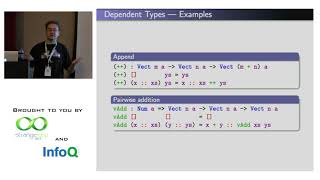
Scala vs Idris - Dependent Types, Now and in the Future
Exploring dependent types in Scala and Idris: current capabilities, limitations, and future possibilities. Demonstrates rich type systems' potential for program verification and static constraint capture in functional programming.
A Little Taste of Dependent Types
Explore dependent types, uniting programming and mathematical proofs. Learn about Pie, a tiny dependently typed language, and see a proof that's also a program.
Dependent Types in Haskell
Explore dependent types in Haskell, their influence on GHC, and practical applications through an extended example. Learn about current capabilities, challenges, and surprises in language design.
A Taste of Type Theory
Explore the foundations of type theory in programming, from algebraic data types to dependent types, with insights on mathematical connections and future developments in the field.
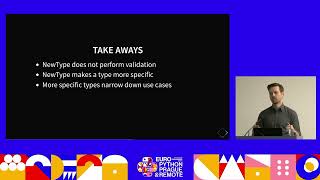
Bulletproof Python - Writing Fewer Tests with a Typed Code Base
Explore how a fully typed Python codebase can reduce the need for extensive testing, leveraging dependent types and exhaustiveness checking to enhance code reliability and efficiency.
An Intrinsically Typed Compiler for Algebraic Effect Handlers
Explore type-preserving compilation for algebraic effect handlers, focusing on safety in continuation capture and resumption using stack polymorphism in an Agda-implemented compiler.
A Calculus of Inductive Linear Constructions
Explore a novel calculus combining linear and dependent types, addressing challenges in linear dependent types research and enabling efficient resource management in programming.
An Intrinsically-typed Probabilistic Programming Language in Coq - Extended Abstract
Explore formalization of intrinsically-typed probabilistic programming language in Coq, focusing on syntax, evaluation, and formal verification applications.
A Type System for Feature Engineering in Machine Learning
Explore a dependent type system for feature engineering, enhancing machine learning model inputs through advanced data operations and compiler techniques.