HOL with Dependent Types and Subtyping
Explore advanced type theory concepts combining Higher-Order Logic, dependent types, and subtyping for enhanced formal reasoning and theorem proving capabilities.
What Are Types For, Or Are They Only Against? - Exploring Type Systems in Programming
Explore the purpose and benefits of types in programming, examining their role beyond just preventing errors, with insights into functional programming concepts and type theory.
Condensed Type Theory - Axioms and Applications
Explore condensed sets' topos and internal type theory, examining axioms, predicates, and their interactions. Learn about compact Hausdorff and overt discrete types, with applications in category theory.
Taylor Expansion and Game Semantics - Exploring Isomorphisms in Lambda Calculus
Explore the isomorphism between Taylor expansion of λ-terms and pointer concurrent games interpretation, extending previous results on resource terms and game semantics.
Space-Efficient Polymorphic Gradual Typing, Mostly Parametric - PLDI 2024
Explore space-efficient implementation of gradual typing with mostly parametric polymorphism. Learn about λCmp and λSmp calculi, their properties, and the implications for type-preserving translations.
One-Pass CPS Translation of Dependent Types
Explore type-preserving CPS translation for dependently typed languages, focusing on optimizing techniques to eliminate administrative redexes in the Calculus of Constructions.
Decalf: A Directed, Effectful Cost-Aware Logical Framework
Explore Decalf, a logical framework for analyzing quantitative aspects of effectful functional programs, focusing on cost-aware type theory and its applications to algorithm analysis.
Internal and Observational Parametricity for Cubical Agda
Explore internal parametricity in Cubical Agda, introducing Agda --bridges and the Structure Relatedness Principle for efficient proofs of parametricity theorems in dependent type theory.
Parametric Subtyping for Structural Parametric Polymorphism
Explore parametric subtyping for structural parametric polymorphism. Learn about a decidable fragment of structural subtyping that generalizes rigid subtyping, with a proven saturation-based decision procedure.
Types 3: Session Preview
Explore cutting-edge research in type systems and their applications in programming languages with Nick Benton's preview of the Types 3 session at POPL'24.
Haskell Symposium 2024 - Session 3
Explore advanced Haskell concepts and applications in this comprehensive symposium, featuring expert presentations and cutting-edge research in functional programming.
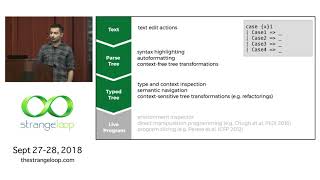
Hazel - A Live Functional Programming Environment with Typed Holes
Explore Hazel, a web-based environment for functional programming with typed holes, enabling continuous type-based services and live debugging during development of incomplete programs.
Proof Theory Impressionism - Blurring the Curry-Howard Line
Exploring approaches to bridge the gap between proof assistants and production languages, focusing on Rust and its potential for incorporating provable system capabilities.
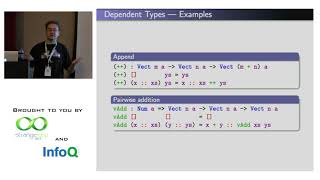
Scala vs Idris - Dependent Types, Now and in the Future
Exploring dependent types in Scala and Idris: current capabilities, limitations, and future possibilities. Demonstrates rich type systems' potential for program verification and static constraint capture in functional programming.
A Little Taste of Dependent Types
Explore dependent types, uniting programming and mathematical proofs. Learn about Pie, a tiny dependently typed language, and see a proof that's also a program.
Dependent Types in Haskell
Explore dependent types in Haskell, their influence on GHC, and practical applications through an extended example. Learn about current capabilities, challenges, and surprises in language design.
Propositions as Types
Explore the profound connection between logic and computation, delving into the Propositions as Types principle and its impact on theorem provers, programming languages, and computing frontiers.
A Taste of Type Theory
Explore the foundations of type theory in programming, from algebraic data types to dependent types, with insights on mathematical connections and future developments in the field.
Why Algebraic Data Types Are Important
Explore type theory, category theory, and logic in functional programming, focusing on algebraic data types and their role in enhancing code reliability and expressiveness.
The Intellectual Ascent to Agda
Explore denotative design and its application in C++ programming, using Agda's syntax to derive powerful, composable libraries from domain-specific mathematical entities.
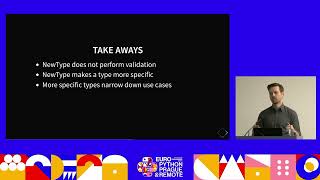
Bulletproof Python - Writing Fewer Tests with a Typed Code Base
Explore how a fully typed Python codebase can reduce the need for extensive testing, leveraging dependent types and exhaustiveness checking to enhance code reliability and efficiency.