Low Dimensional Topology and Circle-valued Morse Functions
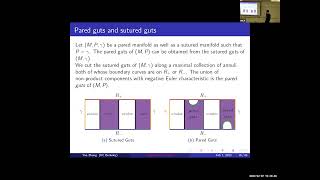
Explore applications of guts in 3-manifolds, including minimal volumes of hyperbolic manifolds and Euler characteristic control in Dehn fillings. Gain insights into advanced topological concepts and their implications.
Low Dimensional Topology and Circle-Valued Morse Functions
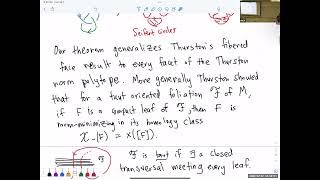
Explore knot complements, Seifert surfaces, and sutured manifolds in low-dimensional topology. Discover unique decompositions and their implications for the Kakimizu complex and Thurston norm.
Low Dimensional Topology and Circle-valued Morse Functions
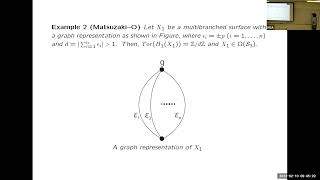
Explore forbidden minor multibranched surfaces and critical complexes in 3-sphere embeddings. Analyze K5 × S1 and K3,3 × S1 families, critical complexes, and their properties in low-dimensional topology.
Low Dimensional Topology and Circle-valued Morse Functions
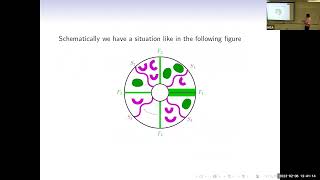
Explores non almost-fibered knots in 3-sphere, analyzing circular thin positions and Seifert surfaces. Focuses on hyperbolic genus one knots with multiple disjoint Seifert surfaces, demonstrating their complex circular thin positions.
Low Dimensional Topology and Circle-valued Morse Functions
Explore instanton Floer homology's surgery formula, its applications in computing 3-manifold invariants, and connections to SU(2)-representations of fundamental groups.
Low Dimensional Topology and Circle-valued Morse Functions
Explore singular fibrations in knot exteriors and their extensions over handlebodies, connecting handle-ribbon knots to circular Morse functions in low-dimensional topology.

The Mathematician Who Cracked Wall Street
Explore how mathematician Jim Simons applied complex math to finance, revolutionizing Wall Street and using his success to support math education and scientific research.
Mixing Surfaces, Algebra, and Geometry
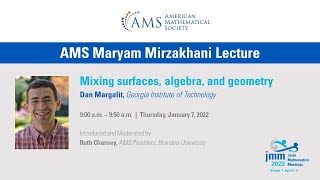
Explore the interplay of surfaces, algebra, and geometry through Mirzakhani's theorem, taffy pullers, and mapping class groups in this engaging mathematical journey.
Groups with Bounded Geometry
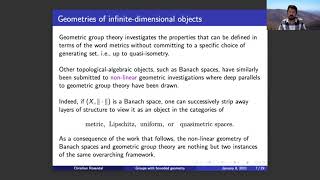
Explore geometric groups, their properties, and connections to topology and transformation groups in this advanced mathematics lecture on groups with bounded geometry.
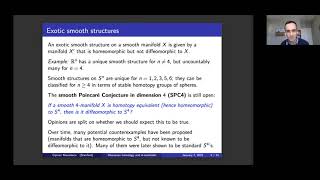
Khovanov Homology and Surfaces in Four-Manifolds
Explore Khovanov homology, exotic smooth structures, and surfaces in four-manifolds. Discover applications in gauge theory and new approaches to longstanding mathematical problems.
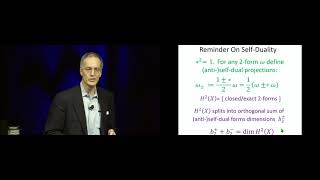
Smooth Invariants of Four-dimensional Manifolds and Quantum Field Theory
Explore the intersection of smooth 4D manifold invariants and quantum field theory, focusing on Yang-Mills theory, instantons, and topological invariants in this advanced mathematics lecture.
Tame Geometry for Hodge Theory
Explore tame geometry's role in Hodge Theory, covering major advances, definable structures, and key theorems. Gain insights into geometric variation and functional transcendence in this advanced mathematics lecture.
Homotopical Foundations of Quantum Spin Systems
Explore the mathematical foundations of quantum spin systems through homotopy theory, offering insights into non-commutative geometry and operator algebras in physics.
Consciousness - Coherence of Modalities
Explores a coherence-based theory of consciousness, proposing structured nets and dynamic mappings as key elements. Discusses data structures, neural codes, and links to mathematical concepts.
The Emergence of Geometric Worldviews in Qualia Space
Explores how cognitive capabilities, subjective experience, and macroscopic perception lead to geometric worldviews in organisms, using qualia-based measurement spaces and topological concepts.
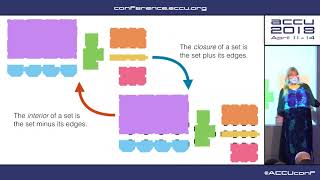
The Shape of a Program
Explore topology's application to programming, viewing code as a shape in time, space, causality, and possibility. Gain insights into program structure and design.
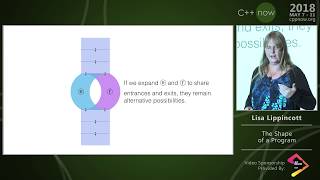
The Shape of a Program
Explore how programs can be viewed as mathematical shapes using topology, examining connections between actions, capabilities, time, and possibility in software architecture.
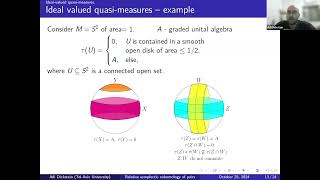
Relative Symplectic Cohomology of Pairs
Delve into advanced symplectic geometry concepts, focusing on relative symplectic cohomology's extension to subset pairs and its applications in demonstrating new symplectic rigidity phenomena.
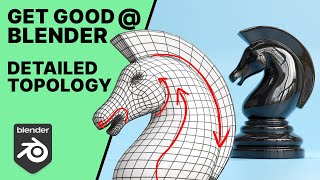
Get Good at Blender - Advanced Topology - The Knight
Advanced Blender tutorial on creating a knight chess piece, focusing on topology techniques like edge flow and pole placement. Covers modeling from base to final details, emphasizing best practices for 3D artists.
Space of Possible Minds - The Landscape of Consciousness
Explore the vast landscape of consciousness across biological species, artificial minds, and theoretical entities through mathematical frameworks and philosophical perspectives.
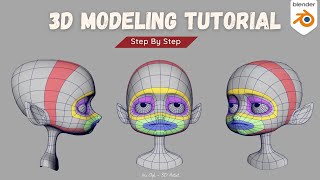
Stylized Character Head Modeling and Animation Tutorial in Blender
Master essential sculpting techniques to create a stylized, animation-ready character head in Blender, focusing on low-poly modeling and facial refinement for optimal performance.