Topology Shapes Dynamics of Higher-order Networks
Exploring how higher-order network interactions influence non-linear dynamics, synchronization, and percolation in complex systems like brain networks and climate patterns.
Random Walks on Simplicial Complexes
Explore random walks on simplicial complexes in this mathematical conference talk, delving into advanced concepts and applications in the field.
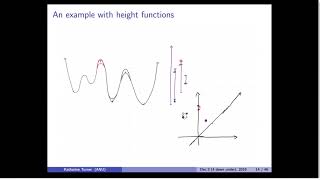
Why Should Q=P in the Wasserstein Distance Between Persistence Diagrams?
Explore Wasserstein distance in persistence diagrams, focusing on q=p choice. Covers geometric implications, stability results, algebraic versions, and computational advantages for central tendencies.
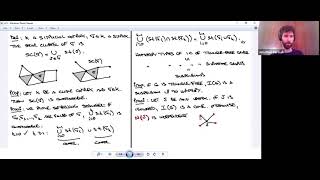
Star Clusters in Clique Complexes and the Vietoris-Rips Complex of Planar Sets
Explore star clusters in simplicial complexes and their applications to independence complexes and Vietoris-Rips complexes of planar sets, with insights on homotopy information and related conjectures.
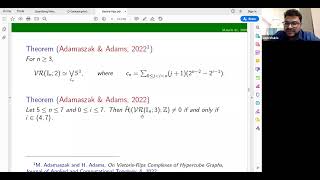
Vietoris-Rips Complexes of Hypercube Graphs
Explore Vietoris-Rips complexes of hypercube graphs, their collapsibility, and applications in genetic trees and persistent homology. Gain insights into simplicial complexes and topological data analysis.
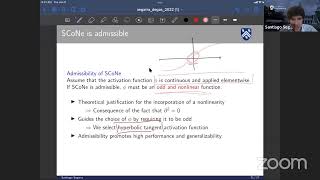
Principled Simplicial Neural Networks for Trajectory Prediction
Learn advanced techniques for trajectory prediction using simplicial neural networks, exploring their principles and applications in data science and signal processing.
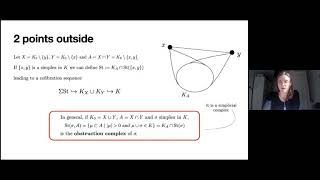
Homotopical Decompositions of Simplicial and Vietoris Rips Complexes
Explore homotopical decompositions of simplicial complexes, focusing on obstruction complexes and their applications in topological data analysis, with insights on Vietoris-Rips complexes.
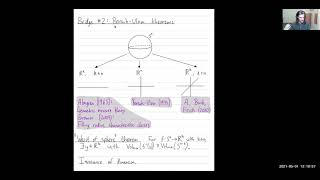
Bridging Applied and Quantitative Topology
Survey of emerging connections between applied and quantitative topology, focusing on Vietoris-Rips complexes and their applications in computational topology, geometric group theory, and dataset shape approximation.
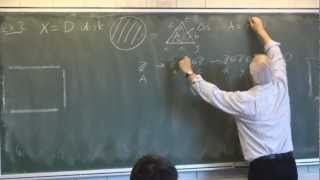
Computing Homology Groups - Algebraic Topology - NJ Wildberger
Explore homology groups in algebraic topology, focusing on examples like circles and disks. Learn about connectivity, loops, and higher-dimensional holes in spaces.
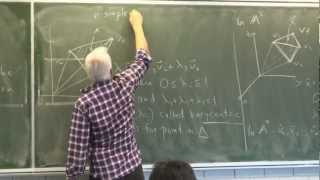
Simplices and Simplicial Complexes - Algebraic Topology
Explore higher-dimensional geometry through simplices and simplicial complexes. Learn about convex combinations, orientations, and the fundamental concept of homology in algebraic topology.
Theory Seminar - Face Numbers, Isabella Novik
Face numbers in centrally symmetric polytopes and spheres: exploring upper bounds, recent developments, and open problems in combinatorial geometry. Insights into maximum face counts and structural properties.
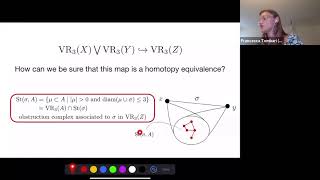
Decomposing Simplicial Complexes - Without Losing Pieces
Explore simplicial complex decomposition, its impact on homotopy type, and applications in Vietoris-Rips complexes. Learn about obstruction complexes and their role in understanding topological changes.
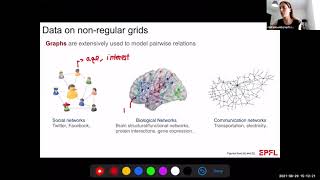
Simplicial Neural Networks
Explore simplicial neural networks, a generalization of graph neural networks for multi-dimensional data, and their applications in imputing missing data on coauthorship complexes.
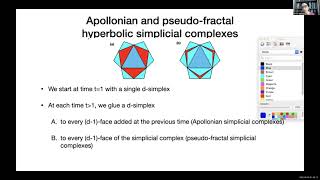
The Topological Dirac Operator and the Dynamics of Topological Signals
Explore topological signals, higher-order Laplacians, and the Dirac operator in network science. Learn about spectral properties, diffusion dynamics, and topological synchronization in simplicial complexes and multiplex networks.
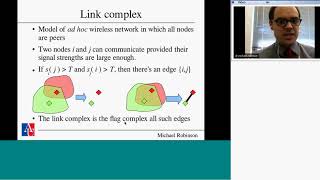
Sheaf Based Modeling of Wireless Communications
Explore sheaf-based modeling for wireless communications, covering topology, simplicial complexes, interference, and network activation. Learn about persistence, homological invariants, and simulation examples.
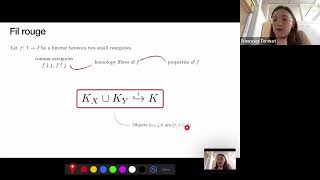
What's Behind the Homotopical Decomposition of a Simplicial Complex
Explore homotopical decomposition of simplicial complexes, focusing on conditions for homotopy type preservation and the mathematics behind decomposability results.
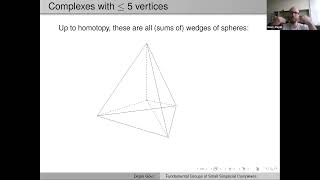
Dejan Govc - Fundamental Groups of Small Simplicial Complexes
Explore minimal triangulations of manifolds and fundamental groups of small simplicial complexes, with insights on estimating vertex counts in minimal triangulations.
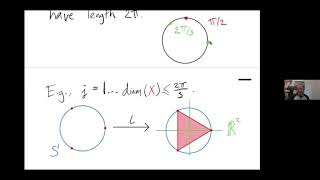
Borsuk–Ulam Theorems for Maps into Higher-Dimensional Codomains
Explore Borsuk-Ulam theorems for sphere maps to higher-dimensional spaces, examining topological properties and optimal diameter bounds for odd maps from S^n to R^k where k > n.
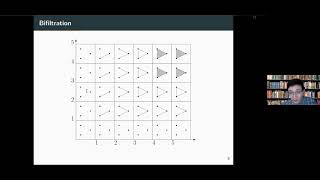
Efficient Approximation of the Matching Distance for 2-Parameter Persistence
Explore efficient algorithms for approximating matching distance in 2-parameter persistence modules, focusing on quad-tree refinement and local adaptive bounds for improved computational performance.

Two Methods of Efficiently Approximating Semi-Algebraic Sets Up to Homotopy
Explores efficient methods for approximating semi-algebraic sets, focusing on singly exponential complexity algorithms and their applications in algebraic geometry.
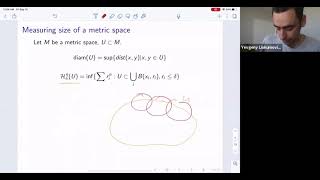
Yevgeny Liokumovich - Urysohn Width, Isoperimetric Inequalities and Scalar Curvature
Explore metric spaces, Hausdorff measure, and continuous mappings. Discover connections to isoperimetric inequalities and Riemannian geometry's positive scalar curvature.