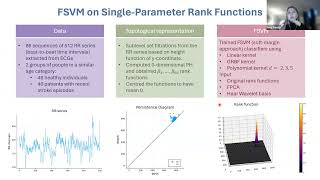
Computable Stability for Persistence Rank Function Machine Learning
Exploring persistent rank functions and rank invariants as alternatives to persistent homology barcodes, with applications in machine learning and topological data analysis.
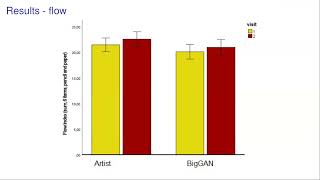
Perception of Visual Art and Topological Data Analysis
Explore the intersection of visual art perception and topological data analysis, uncovering new insights into artistic interpretation and mathematical techniques.
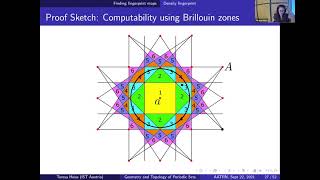
Geometry and Topology of Periodic Point Sets, for Example Crystals
Explore geometric and topological tools for characterizing crystalline materials, including Brillouin zones and persistent homology, and discuss challenges in defining persistent homology for periodic point sets.
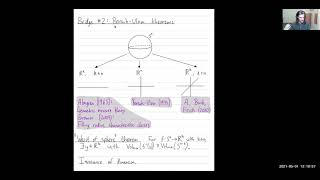
Bridging Applied and Quantitative Topology
Survey of emerging connections between applied and quantitative topology, focusing on Vietoris-Rips complexes and their applications in computational topology, geometric group theory, and dataset shape approximation.
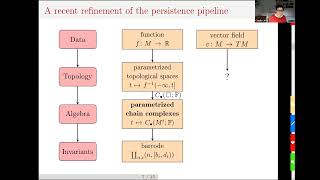
Barcodes for the Topological Analysis of Gradient-Like Vector Fields
Explore topological analysis of gradient-like vector fields using barcodes. Learn about chain complexes, parametrization, and applications in smooth and discrete settings, with insights on stability and approximation.
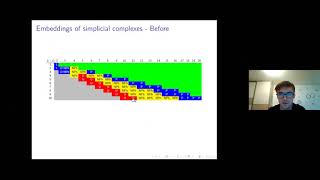
Embeddings and Tverberg-Type Problems: New Algorithms and Undecidability Results
Explore computational topology: algorithmic embeddability, undecidability in higher dimensions, and polynomial-time decidability of r-Tverberg problem in metastable range.
Pawel Dlotko - A Few Simple Stories on Topology in Action
Explore practical applications of computational topology in material science, dynamical systems, and brain research. Learn how theory and algorithms work together to solve real-world problems.
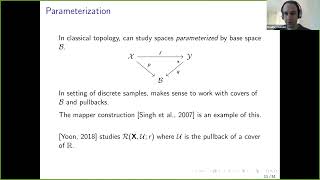
Bradley Nelson: Parameterized Vietoris-Rips Filtrations via Covers
Explore computational topology techniques for large filtered geometric complexes, focusing on Vietoris-Rips filtrations and cover-based methods for parallel computation and compression.
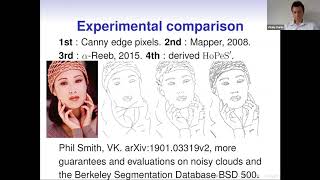
Persistence-Based Skeletonization of Images
Explores algorithms for splitting images into convex polygons using topological persistence, including Convex Constrained Mesh and Persistent Resolution-Independent Mesh for edge detection.
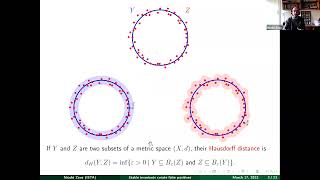
Every Stable Invariant of Finite Metric Spaces Produces False Positives
Explore stable invariants in computational topology, their limitations in approximating Gromov-Hausdorff distance, and the inevitability of false positives when using Hilbert space-valued invariants.
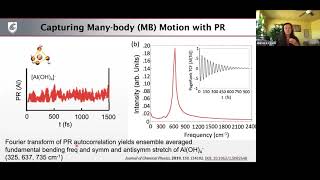
Multiscale Many-body Correlations and Structure in Chemistry Data
Integrating graphs, topology, and geometry to analyze complex chemistry data, providing insights into multiscale correlations and structures beyond traditional methods.
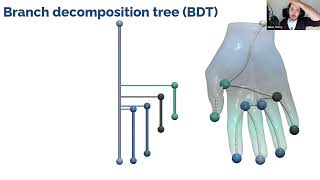
Wasserstein Distances, Geodesics and Barycenters of Merge Trees
Explore computational frameworks for merge trees, including Wasserstein distances, geodesics, and barycenters. Learn efficient algorithms and applications in visualization, feature tracking, and ensemble clustering.
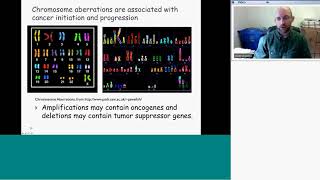
Javier Arsuaga - Applications of Computational Topology to the Analysis of Breast Cancer
Explore computational topology's role in breast cancer analysis, uncovering new insights through advanced mathematical techniques and data visualization methods.
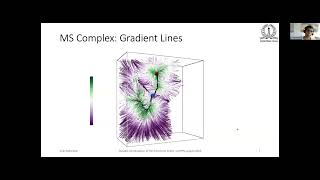
Scalable Computation of the Extremum Graph
Explore scalable computation of extremum graphs, a simplified topological descriptor for scalar functions, with applications in visualization and shape analysis. Learn efficient parallel algorithms for large datasets.
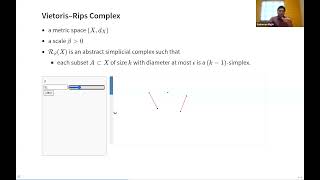
Demystifying Latschev's Theorem for Manifold Reconstruction
Explores quantitative approaches to Latschev's theorem for topological manifold reconstruction, advancing finite sample analysis in data science and manifold learning applications.
Classical Topology and Quantum Complexity - IPAM at UCLA
Explore the intersection of classical topology and quantum complexity, focusing on computational challenges in determining homology groups and their implications for quantum mechanics and data analysis.

Topological Perspectives on Networks
Explore algebraic topology tools for network analysis, focusing on their application in neuroscience to understand structure-function relationships.

Topological Perspectives on Networks
Explore algebraic topology tools for network analysis, focusing on their application in neuroscience to understand structure-function relationships.
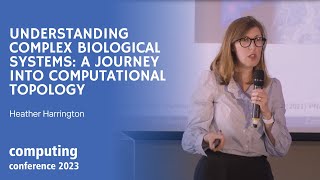
Understanding Complex Biological Systems: A Journey into Computational Topology
Explore computational topology's role in decoding complex biological systems. Learn how algorithms interpret data from molecular biology, genetics, and medicine, offering unique insights into disease progression and protein structures.
The Genus-One Question for Open Book Decomposition in Contact Structures and Anosov Flows
Explore the genus-one question for open book decomposition in 3D contact structures and Anosov flows, examining constructions and partial results.
Geometrization and its Consequences in 3-Manifold Topology - Part I
Explore Thurston's geometric perspective on 3-manifolds, including Perelman's Geometrization Theorem, and its implications for topology, algorithms, and group theory in 3-dimensional spaces.